By Rebecca Martin
There is something magical about watching food waste become soil.
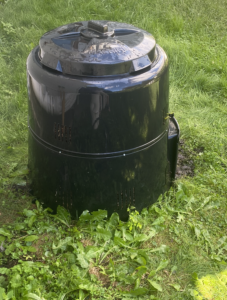
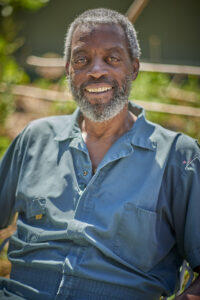
I would know, because I’ve been doing it in my own backyard this summer—with a little help from Shabazz Jackson and Josephine Papagni of Greenway Environmental Services.
One principle Shabazz and Josephine shared with me: waste should be managed as close to where it is generated as possible. And what could be closer than our own backyards?
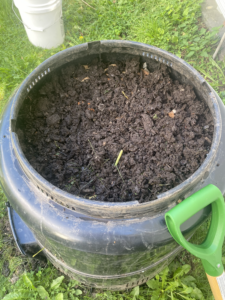
In just a couple of months, I’ve been turning about 20 pounds a week of household organic material into compost—all in my little Earth Machine composter that they provided for me. At that rate, my backyard will process more than 1,000 pounds, or roughly half a ton, of organic material in a year.
Think about that. Half a ton of material getting a second life right here at home—not hauled away, buried or burned, but turned into healthy soil that helps create beautiful gardens.
And I’m not just breaking down vegetable scraps and other organics, but meat and oils, too—something I never thought would be possible in my little home composting system. No maggots. No flies. Just red wigglers. My compost has become such a rich, healthy ecosystem that the jumping worms can’t tolerate it.
And my backyard isn’t unusual. Roughly two-thirds of Ulster County’s housing units are single-family, detached homes—that’s tens of thousands of households with outdoor space. If more of those households composted even 20 pounds of food waste a week, as I do, we could keep thousands of tons of organic material out of the waste stream every year.
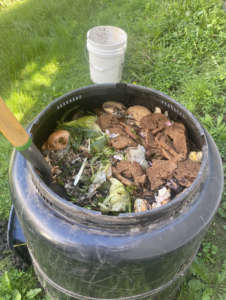
In Kingston, the backyard composter doesn’t have to stand alone. The City’s community composting program gives residents a way to keep the practice going year-round—when backyard composters freeze in the winter, residents can bring their food waste to the community system instead.
That’s the power of thinking about organic waste differently. We don’t need one giant solution—we need a network of local solutions working together: backyards, community composting programs and transfer stations. And Greenway has figured out how to make one of the smallest pieces of that system—the backyard composter—remarkably efficient.
That’s what makes Greenway’s invention so exciting. They’ve taken the natural process of decomposition and figured out how to make it work quickly and cleanly in an urban backyard—even with meat and oils. What once seemed like “waste” can become a resource right where it is generated. And that’s something I want everyone who reads KingstonCitizens.org to know: you can do this, too.
###
Who are you, and how long have you been doing this work?
Shabazz Jackson: Greenway Environmental Services is a regional organics recovery and soil company. We collect and process food scraps, leaves, brush, logs, pallets, and other organic materials and transform them into compost, mulch, topsoil, and specialty soil blends rather than sending them to the landfill. Our philosophy is to recover the organic fraction of the waste stream and return that fertility to the soil, while helping protect groundwater and surface water. We also design zero-waste systems and work with colleges, municipalities, businesses, and other institutions to develop and manage food-waste programs. We’ve been doing this work for more than 50 years. I’m an inventor, but what we invent are natural systems. The challenge is to take a process that nature designed to happen slowly and redesign it so that it works efficiently in an urban environment. We’re essentially learning from nature and figuring out how to make those systems work at the scale and speed that our communities need.
How do you do that?
SJ: In nature, organic material breaks down slowly and feeds small organisms that depend on it. That’s a good system for a forest, but in a city or neighborhood, we don’t want food waste sitting around, attracting maggots and flies and creating odors. We work with nature, not against it—to take the biological process nature designed and adapt it to the way we live. And we’ve succeeded at doing that.
What exactly have you invented?
SJ: The key is to engage during the decomposition process. We’re imitating the human digestion system. It’s a form of biomimicry. We give it the right biology and the right environment to decompose efficiently from the start.
We start with a rapid decomposition medium that goes into the Earth Machine, like the one you have, along with the food waste. We make it by mixing actively decomposing food-waste compost with wood chips from the local tree-service industry. When a tree is removed, the tree service grinds it into chips, and we use some of those locally sourced chips in our medium.
The medium introduces an active biological process right from the beginning. Instead of letting food waste sit around and begin to rot, we’re creating the conditions for it to break down quickly and aerobically. That’s the key.
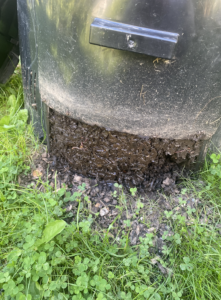
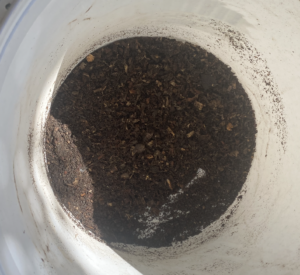
The second component is our odor-control blend, which is what you call the “lasagna.” Every time you add food waste to your kitchen container, you simply sprinkle a handful of the blend over it. It’s a biological filter that absorbs the sulfur generated when food rots. The odor control blend is a mix of completely cured and finely screened food waste compost and wood shavings which is effective in controlling moisture. At present, we are field testing the materials in preparation for household distribution. It’s available in bulk at our community composters in New Paltz and Poughkeepsie. We make the blend at our facility using clean wood shavings collected from a modern wood shop. The shavings are a clean byproduct of that process. We mix the kiln-dried wood shavings with fully decomposed and cured food-waste compost that has been finely screened. The blend inoculates the food with the bacteria needed right at the beginning of the process. That’s what makes it work.
So the goal at the start is to stop food from rotting?
SJ: Yes. The goal is to help it decompose in the right way from the start when it matters.
Why is the beginning of the process so important?
SJ: Because that’s where you establish the biological environment. We’ve inherited a culture that treats food as garbage as soon as we’re finished with it. Think about what happens in a typical household. Once a week, you take out a load of rotting food. Maybe you’ve separated it from the rest of your garbage and put it in a container provided by the municipality. But you’re still carrying over the culture of disposal. And the problem is that rotting food is inherently difficult to manage that way. It’s wet. It attracts flies and maggots. It smells. We’re trying to make a cultural transition—a cultural upgrade. At the base of that transition is the idea that we should stop having rotting food sitting around our kitchens. Instead, we need to separate this material and give it the biological conditions it needs from the very beginning.
And some of the materials you’re using are themselves made from waste?
SJ: Yes. That’s one of the reasons we can keep the cost so low. We’ve figured out how to take commercial waste and turn it into a resource.
How do you work with local businesses while keeping their food waste as close to its source as possible?
SJ: We want to encourage food waste to go to the closest appropriate local facility. For example, we have a contract with Adams Fairacre Farms, and we also work with the Culinary Institute of America. Both generate food waste locally. Adams has a store in Kingston, and the CIA is in Hyde Park, close to UCRRA. So, in keeping with our principle of managing waste as close to its source as possible, it doesn’t make sense to haul that material all the way to New Paltz when UCRRA is right there. We send their food waste to UCRRA.
So you don’t believe that everything needs to go to one centralized facility?
SJ: No. There is no one-size-fits-all solution for removing organics from the waste stream. We need to start thinking differently. We’re looking at each waste stream and asking what makes the most sense locally.
How does compost connect to food systems?
SJ: In nature, soil and food are part of the same cycle. Plants take nutrients from the soil, and organic material eventually returns those nutrients to the soil. If we’re designing a sustainable food system, we should be doing the same thing. The composter and the garden shouldn’t be separate—they should be part of one system. You might bring in materials at the beginning to establish a garden. That’s a one-time contribution of material we’ve recovered from commercial sources. After that, the food waste generated in the surrounding community can be broken down and returned to the soil, helping maintain the fertility of the garden. The food feeds the soil, and the soil helps grow more food. That’s how nature works.
Haven’t we already built a decentralized waste system?
SJ: In many ways, we have. Ulster County’s goal is to recover 90 percent of the waste stream by 2050. And the county has already invested in a decentralized system to help get there. UCRRA is the hub, and the 19 transfer stations are the spokes. That’s a significant investment in infrastructure that is already spread throughout the county. So I don’t think the question is whether we should have a decentralized system. We’ve already made that choice. Now we need to develop it. The question is: How do we use the system we’ve already built to recover 90 percent of our waste? That means looking at what each transfer station can do, how we can remove organics from the waste stream, and how we can connect the different pieces.
What does this have to do with the future of Ulster County’s waste system?
SJ: Everything. I think we need to stop pursuing projects like Global NRG and decide what kind of system we actually want to build. There is only one pool of money. UCRRA already has access to roughly $60 million in bonding—enough to invest significantly in a more decentralized system. I’m currently serving on the UCRRA Zero Waste Committee, and I think our first job should be to decide is if we want a centralized system, or do we want to develop the decentralized system we already have?
Why is removing organics from the waste stream so important?
SJ: Because you can’t get to zero waste without removing organics from the waste stream. Food waste is one of the largest parts of what we’re throwing away, and it doesn’t belong in a landfill or an incinerator. It belongs back in the biological cycle. There isn’t one solution that will work everywhere. We need to look at what we’re generating, where we’re generating it, and what infrastructure we already have. And we have to pay attention to our largest industries.
Tourism is a major part of Ulster County’s economy, and tourism generates a tremendous amount of food waste. We can’t seriously talk about zero waste without figuring out how to keep that material out of the disposal stream.
New Paltz gives us an opportunity to demonstrate what this could look like. The Village has a significant tourism economy and a concentration of restaurants and other food-related businesses generating commercial food waste. The Town already has infrastructure at its transfer station. Why not put those pieces together and make New Paltz a model?
The transfer station could take the food waste generated by the Village’s tourism economy, and we could measure what happens when we actually capture that material—how much is diverted, how clean the stream is, what it costs, and how much compost and soil we can produce from it. That would give us a real-world demonstration that could be replicated in other communities across Ulster County.
What do you think Greenway’s role is in this transition?
SJ: Greenway has the solution. Our society has the problem. We’ve been preparing for the day when people finally say, “Okay, Shabazz. We’ve heard enough.” When that day comes, we’re ready. In fact, we’re ready now.
Our role was to invent natural systems and figure out how to make them work in the places where people live. Nature has already designed a system for breaking down organic material. Flies, mealworms, bacteria and other organisms do that work naturally. But when we live in an urban environment, we need to manage that same material differently. Our challenge is to create the conditions for it to break down without the flies and the odor.
And that’s where people come in. Maybe you have a small piece of property. Maybe you’ve invested thousands of dollars and countless hours into your backyard garden. You’re already investing in the food you’re growing. Why not take the organic material you’re already generating and turn it back into the soil that makes your garden more productive?
That’s what Greenway is here to do: take what nature designed, adapt it to our urban environment, and use it to meet people’s needs. We don’t need to start from scratch. We need to connect the pieces we already have—and build a system that keeps organic material close to where it is generated, puts it back into the soil, and move Ulster County toward its goal of recovering 90 percent of its waste by 2050.
If you’re interested in Greenway’s backyard composting program and other services, contact Shabazz and Josephine at: gr*********@*ol.com