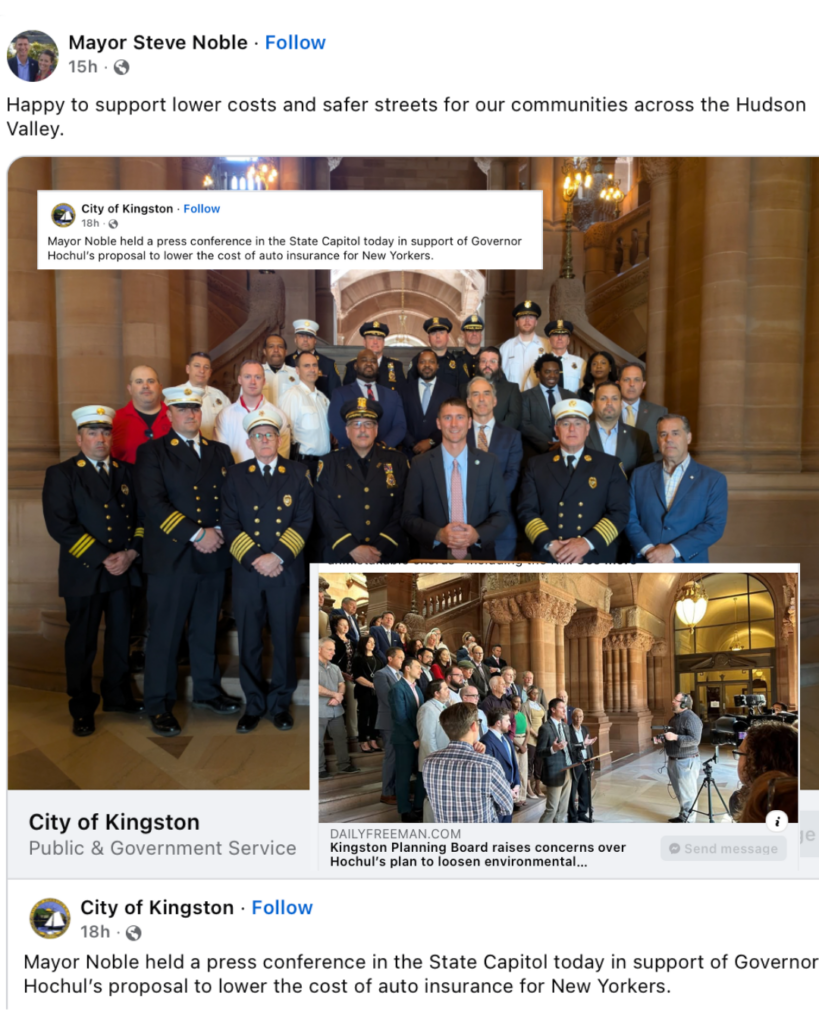
SEQR Changes Belong in Public Debate—Not the State Budget

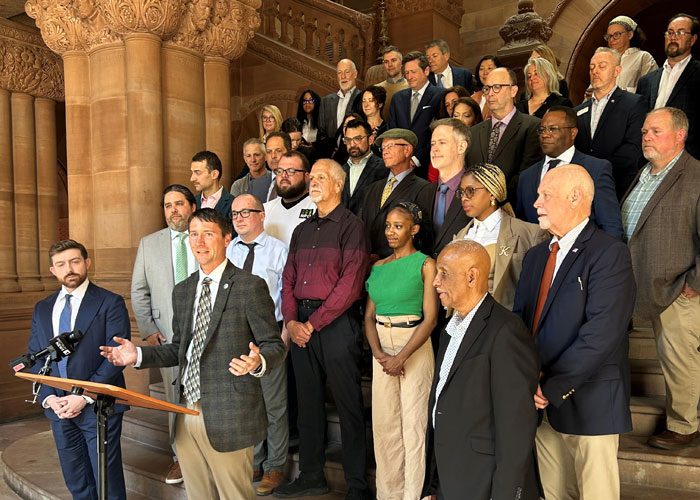
(Photo credit: Mid-Hudson News)

There’s something telling about the “40 mayors and supervisors” and their friends lobbying in Albany in an attempt to support the Governor’s proposed dismantling of the State Environmental Quality Review Act (SEQR)—an effort reportedly organized by our own City of Kingston’s own mayor alongside the Orange County Partnership, a not-for-profit economic development group.

The Governor’s plan would make sweeping changes to SEQR, including exempting large mixed-use developments—like projects combining housing and data centers—from review requirements that currently protect communities and the environment. That alone should trigger serious public scrutiny.

But it can’t—because these changes are buried in the state budget, where there is no opportunity for public comment and where two people ultimately control the outcome: Senate Majority Leader Andrea Stewart-Cousins and Assembly Speaker Carl Heastie.

Budget bills are meant to allocate money, not quietly dismantle environmental law. Folding major policy changes into must-pass legislation cuts out hearings, limits debate, and shuts down meaningful public input.

Worse, this comes as the state is already in the middle of a formal SEQR regulatory update process that includes environmental justice and disadvantaged community protections. Public comment closed in May 2025 after months of engagement and substantial input from communities and advocates.

These budget proposals sidestep that entire process.

When decisions of this scale are made behind closed doors by a handful of leaders, it says everything you need to know: if these changes could stand on its own, it wouldn’t need to be in the budget.

Democrats are literally rolling back environmental laws. That’s where we are now.  CALL your state senator and tell them to get SEQR out of the budget. 

Read our FAQ: Protect SEQRA: Ensure Housing Development Without Weakening Environmental Protections

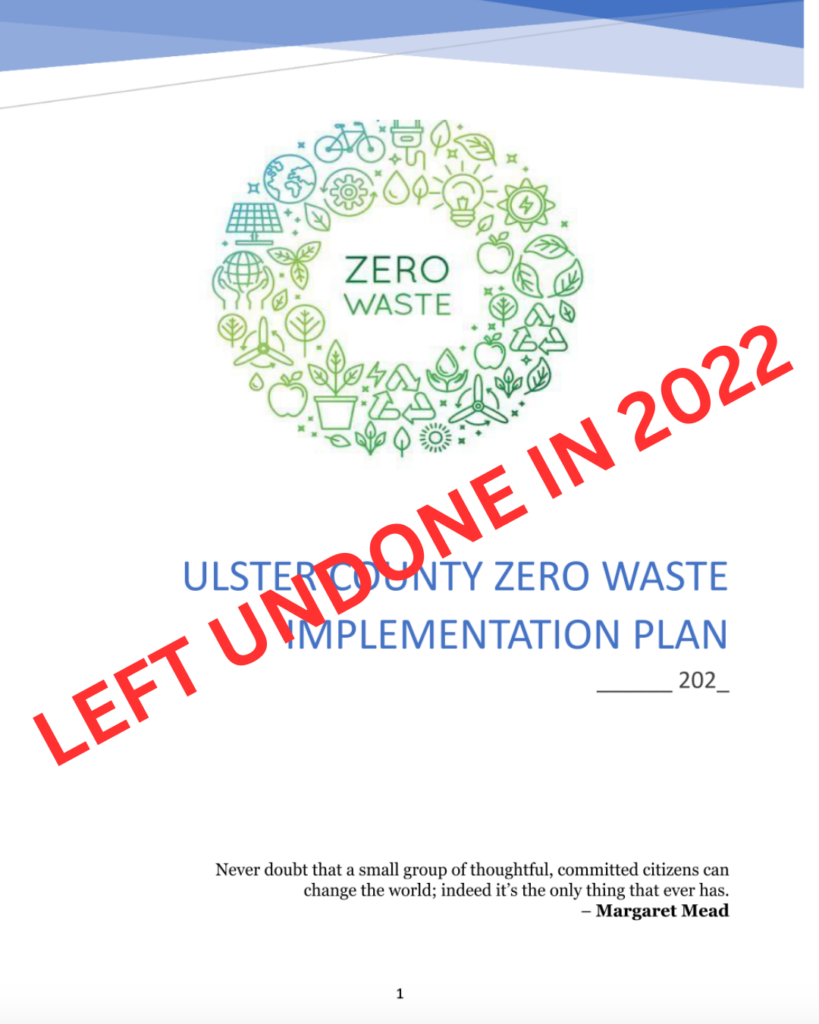
Zero Waste Resolution 242’s Definition of Collaboration Is Being Undermined—Again—And There Is No More Time to Waste

“UCRRA’s commitment to review waste diversion strategies and alternative technologies to approach Zero Waste not covered in the Local Solid Waste Management Plan, and to collaboratively develop  and participate in a comprehensive Zero Waste Action Implementation Plan…”
(Resolution No. 242 of 2020 (signed February 16, 2021), Approving Ulster County’s Local Solid Waste Management Plan)


Seven years after the Ulster County Legislature (UCL) passed Resolution 451 in 2019, establishing a policy to become a Zero Waste Community, the legislature and Ulster County Resource Recovery Agency (UCRRA) have yet to complete a Zero Waste Implementation Plan (ZWIP). Instead, lacking political will and sufficient funding, it continues to redefine the process and kick the can down the road.  At a time when we have no time to waste. 

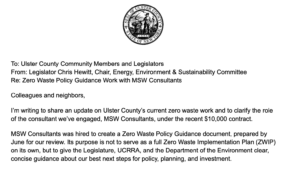
An undated memo written by UCL Chris Hewitt, and received by us on March 25, was recently brought into public view during the month’s UCL Energy, Environment and Sustainability Committee meeting following our recent Ulster Toward Zero Waste webinar.  It highlights a serious and recurring problem: the UCL is once again moving forward without following the process it has already established.

This is not the first time, and it is not a small procedural issue. It speaks directly to how decisions about major waste infrastructure have been made, with or without the public meaningfully included before those decisions are locked in.

Deja Vu

Last summer, the UCL issued a Request for Qualifications (RFQ) for a Zero Waste Implementation Plan (ZWIP).  As could have been expected, consultants submitted proposals in the range of $100,000, far exceeding the County’s $10,000 allocation—an amount widely recognized as insufficient for a planning document as critical as a ZWIP.

Instead of increasing funding or revising the scope to align with implementation needs, Legislator Hewitt circulated a memo reclassifying the project with MSW Consultants as a “Zero Waste Policy Guidance Document.” There was no public explanation for this change before it occurred, no opportunity for public input on the revised scope, and no discussion of the difference between an implementation plan and a policy guidance document.

This is the second time the UCL has stepped away from the original intent of Resolution 242. The first attempt, in and around 2021-2022, was also based on a $10,000 allocation and produced a draft that was never completed. That failure has already cost us time. We are now repeating the pattern.

We Already Have the Information—What We Don’t Have Is a Plan

During the April UCL Energy, Environment and Sustainability Committee meeting, the public heard for the first time what is now being proposed. The explanation centered on compiling information —materials we already know exist, including the 2020 Solid Waste Management Plan and its updates, draft Zero Waste Implementation Plan materials, UCRRA annual reports, Greenway Environmental submissions, and NYS DEC annual reports.

The issue is not access to information. The issue is the absence of a true implementation framework that organizes, tests, and applies that information into a functioning system.

KingstonCitizens.org played a direct role in ensuring that this memo was brought into the public process. On April 7, we requested that the document be placed on the agenda for the April 13 UCL Energy, Environment and Sustainability Committee meeting and that public comment be allowed. Without that request, the item would have not likely been included for discussion.

At the meeting itself, public comment was limited to two minutes. Concerns were raised, questions were asked, and the lack of transparency in the process was clearly identified. There was no substantive response or discussion. Instead, it was suggested that the act of public comment itself satisfied the “collaboration” requirement in Resolution 242.

Restoring the Intent of Resolution 242: The County Must Now Act on Zero Waste Implementation

As we learned from Greenway Environmental Services—who have been on the ground for decades building zero waste systems in Ulster County and were featured in our recent “Ulster Toward Zero Waste” webinar—the Recycling Oversight Committee’s (ROC) initial approach to the Zero Waste Implementation Plan is to begin with a demonstration project at a single transfer station.

In 1986, Ulster County invested approximately $200 million to build 19 transfer stations, the UCRRA facility, and close its landfills. The ROC’s rationale is that a system proven at one facility can and should be scaled across the full system, leveraging this investment, which was fully paid off in 2025.

Our coalition of partners expect full collaboration with Ulster County leadership and UCRRA, and a process grounded in transparency, accountability, and shared responsibility for public health, quality of life, and costs.

Key Next Steps: What Needs to Happen Next

The MSW consultant document may inform the discussion with a policy guidance memo, but it is not the plan. Resolution 242 requires that the Zero Waste Implementation Plan itself be built collaboratively, transparently, and with clear steps toward execution—not deferred or redefined after the fact.

1. Reaffirm Resolution 242 as the Governing Framework

Resolution 242 requires a collaboratively developed Zero Waste Implementation Plan (ZWIP). This means shared planning from the beginning—not a late-stage review, and not a substitute document such as a policy guidance memo.

2. Clarify the MSW Policy Guidance Document’s Limited Role

The MSW Consultants policy guidance document must be clearly defined as background reference material only. It cannot replace the ZWIP, and it cannot be treated as the County’s implementation plan.

3. Pause Major Infrastructure Commitments Until a ZWIP Exists

No new long-term contracts, facility decisions, or major infrastructure investments should move forward until a formal, adopted Zero Waste Implementation Plan is completed through a public process.

4. Establish a True Collaborative Working Group

Create a formal, inclusive working group to build the ZWIP from the ground up. This group should include the County, UCRRA, legislators, transfer station operators and staff, and community stakeholders. Collaboration must mean shared development of the plan, not limited public comment on pre-determined direction.

5. Prioritize Real-World Pilot Projects at Transfer Stations in Ulster County

Begin implementation through transfer station-based pilot projects, consistent with the New Paltz model approach. These pilots should test what works operationally and generate real data to build the countywide system, supported by a Transfer Station Database (permits, operators, staffing, volumes, recycling rates, and facility rankings).

  • From this, a short list should identify the two highest-volume and two highest recycling-rate transfer stations, with the top-performing recycling facility fully documented. The short list must then be evaluated for willingness to participate in a pilot project, future plans, grants pending, equipment, personnel structure (including union status, wages, job titles, and training), and full operational financials.
  • A Request for Proposal (RFP) should then be issued for a contractor or consortium to design, install, and operate a facility targeting a 90% recovery rate while doubling current capacity. Funding for this effort already exists within UCRRA’s “unrestricted funds,” generated through tipping fee revenues, consistent with the intent of the 2012 flow control law.
  • The pilot is intended to produce the operational model needed for countywide deployment and the development of a Zero Waste Implementation Plan, to be incorporated into the Solid Waste Management Plan.

6. Establish a Public Implementation Schedule and Accountability Framework

Establish a public implementation schedule and accountability framework by setting clear, transparent milestones for the formation of a working group, the selection and launch of pilot sites, the drafting of the Zero Waste Implementation Plan (ZWIP), and key decision points for countywide rollout. This is essential to prevent further delay and ensure the process does not repeat past cycles of inaction.
KingstonCitizens.org “Ulster Toward Zero Waste” webinar brings together expertise and advocates from Ulster, Dutchess and Sullivan County


Judith Enck provides opening remarks
“We need systemic change”

Rebecca Martin, KingstonCitizens.org
“There is no “away” in throwaway”

Greenway Environmental Services (Shabazz Jackson and Josephine Papagni)
“We must study the New Paltz model and other Ulster County transfer stations to guide the Zero Waste Implementation Plan. By upgrading the remaining 18 transfer stations to each process 5,000 tons of organics per year, Ulster County could divert up to 95,000 tons of food and yard waste annually from the waste stream—at a fraction of the cost of a $100M+ “put or pay” anaerobic digester project currently being considered by Ulster County and UCRRA.”

Neil Seldman, Zero Waste USA
“When you separate materials, you create jobs, support small businesses and expand the tax base.”

Sustainable Sullivan (Eric Feinblatt and Rebekah Creshkoff)
“With a “put or pay” incinerator (Covanta) project in Sullivan County, we would be obliged to provide up to 1 million tons of garbage per year. Sullivan County produces 100,000 tons per year. We have flow control, but no one enforcing flow control, and at the moment, 20% of that is going to Pennsylvania. So what remains is 80,000 tons per year.  So what we would have to do is bring in trash from Ulster County and other counties. Ulster County, in its proposed “put or pay” plan, does not have enough waste to supply the anaerobic digester, so it has suggested bringing in trash from Sullivan County.  The whole thing is a cluster ^%*(. It’s like Abbott and Costello. The left doesn’t know what the right hand is doing.”

Mothers Out Front Dutchess County (Sandra Stratton-Gonzalez)
“It is really disheartening to hear all the plans afoot in Sullivan and Ulster Counties regarding Incineration (Sullivan) and Anerobic Digestion (Ulster)…these facilities continue to keep us on the path of disposal rather than the path of recovery. They lock us into decades of disposal culture because of the “put or pay” agreements. We are currently in a position where we’re fighting to change practices in Dutchess County and understand how we are impacting our neighboring counties practices…”

Now is the time to get involved and take action
Call your Ulster County Legislator in support a properly funded Zero Waste Implementation Plan (ZWIP) that creates a model for Zero Waste that can be replicated across all remaining 18 transfer stations in Ulster County.


Guest Editorial: “Moving at the Speed of Need” – Revising New York’s Environmental Laws for Housing and Environmental Justice

By Jennifer O’Donnell, Hone Strategic LLC

New York is currently at a high-stakes crossroads in urban and environmental policy. Whether we are discussing the Expedited Land Use Review Procedure (ELURP) in New York City or the proposed State Environmental Quality Review Act (SEQRA) revisions in Albany, the mandate is clear: we must ‘build at the speed of need’ to solve our housing crisis. I see a recurring structural risk in these ‘fast-track’ models. Speed is a necessary objective, but it cannot be achieved by dismantling the very review processes that ensure development is compatible with our physical, historical, and climate limits. True efficiency in land use isn’t about bypassing scrutiny; it’s about refining it to incentivize growth where it is most sustainable. My analysis suggests a deeper structural risk.

Moving at the Speed of Need

Last week, NYC’s new Expedited Land Use Review Procedure (ELURP) underwent its first real-world tests (see Shelterforce story). With the Mamdani Administration and the Department of City Planning aiming to reduce review times from seven months to just 90 days, the “Manhattan Plan” is officially in motion.

I view this as a fascinating yet precarious crossroads, similar to the one we face with SEQRA in New York State.

There is consensus that the status quo is broken. We need at least 100,000 new homes in New York City and have a shortage of more than 800,000 in New York State, according to figures being used in Albany. However, the “Fast Track” approach requires more than just speed—it requires adaptation, resilience, and agency.

The new measures emphasize the 12 community districts with the lowest affordable housing production. While increasing density is a mechanical solution to the supply crisis, we must be cautious not to lose the character that defines our 19th-century commercial streetscapes.

I believe this new era calls for three key pillars:

  • Adaptive Integrity: Speed should facilitate the adaptive reuse of historic structures. “The greenest building is the one already built” (i.e., embodied energy is more environmentally sound than new construction) is a longstanding motto of the National Trust for Historic Preservation.
  • Climate-Resilient Infrastructure: The ELURP includes “climate-resilient infrastructure.” This must be a priority, ensuring regenerative land management is integral to every new urban site plan.
  • Community Agency: Streamlining should not equate to silencing. 

True success in expediting occurs when developers engage early and authentically, rather than waiting for a 90-day clock to start.

The objective is not merely to construct “units,” but to develop neighborhoods. To my fellow planners and developers: How are you preparing for the January 2027 rollout of the full “City of Yes” framework? Are we ready to build at the speed of need while preserving the quality our unique city demands?

Let’s Go Further: Focusing Reforms on Sustainable, Environmentally Just Housing

As Albany nears a final budget agreement, a critical debate is unfolding over SEQRA. While the goal is to accelerate housing, the current legislative language contains technical gaps that could undermine local planning.

“….focusing growth precisely where it is most sustainable: in areas already served by robust infrastructure, transit access, and walkable neighborhood centers. Rather than allowing sprawl to hide behind vague definitions, these changes ensure that ‘fast-tracked’ housing is built in the locations best equipped to support it”

In my work as an environmental strategist and urban planner, I’ve raised these issues with state leadership. Here’s what matters most:

  1. The “Disturbed” Definition: Current proposals broadly define “disturbed land” to include maintained lawns. This risks bypassing reviews for subsurface archaeological resources and critical pervious landscapes.
  2. The Sprawl Loophole: We must ensure that a minor existing road or structure isn’t used to classify a massive greenfield site as “previously disturbed,” allowing large-scale sprawl to skip traditional environmental scrutiny.
  3. Infrastructure Reality: Fast-tracking cannot ignore physical limits. Without mandatory water and sewer capacity analysis, we risk overwhelming local systems and degrading environmental health.

Critically, adopting these technical refinements will not hinder the delivery of new housing. On the contrary, by narrowing the ‘previously disturbed’ and ‘mixed-use’ definitions, the State provides a clearer, more predictable roadmap for the development community. These revisions act as a strategic incentive, focusing growth precisely where it is most sustainable: in areas already served by robust infrastructure, transit access, and walkable neighborhood centers. Rather than allowing sprawl to hide behind vague definitions, these changes ensure that ‘fast-tracked’ housing is built in the locations best equipped to support it, thereby reducing the likelihood of the very infrastructure failures and legal challenges that currently stall production.

While many advocates, including Ulster County Executive Jen Metzger, suggest that “tweaking” the bill to include affordability and sustainability standards is enough, my analysis suggests a deeper structural risk. While I support those goals, adding “criteria” to an exemption is an honor-system approach. The review process itself is the only way to verify infrastructure capacity and prevent industrial-scale energy users from hiding behind residential facades and honor the intent of CLCPA’s climate and environmental justice goals.

SEQRA is not a substitute for local planning and zoning, but it is the essential “hard look” that ensures development is compatible with a community’s physical limits. Efficiency must not come at the cost of evidence-based decision-making.

Ultimately, the goal of these recommendations—whether tightening the definition of ‘previously disturbed land’ upstate or ensuring community agency within the ‘City of Yes’ framework —is to move from a culture of delay to one of strategic acceleration. 

By ensuring our environmental reviews are precise rather than permissive, we provide a clearer, more predictable roadmap for developers while protecting our aging infrastructure and the character of our neighborhoods. We do not have to choose between housing production and environmental integrity; in fact, the most resilient housing is that which respects the ‘hard look’ required by our state and city laws. As we move toward full implementation of these new frameworks, let’s ensure we are not just constructing ‘units,’ but developing the sustainable, equitable neighborhoods that the next generation of New Yorkers deserves.

Jennifer O’Donnell is the founder of Hone Strategic.  She has lived in the Hudson Valley since 2004, where she has worked with numerous communities and organizations to plan and implement projects in historic sites and neighborhoods. Prior to this, she was a cultural heritage specialist and planner at the World Bank, where she was involved with World Heritage sites and cities in over 30 places abroad. Jennifer was also a design and construction project manager for many historic buildings and cultural institutions in her native New York City.  She has Masters’ degrees from Columbia University in Urban Planning and Real Estate Development, a BA in Art History from SUNY Stony Brook, and studied conservation at UNESCO’s ICCROM program in Rome, Italy.

Why Weakening SEQRA Would Leave Many Communities Behind

By Rebecca Martin

Ulster County Executive Jen Metzger recently sent a letter largely supporting the Governor’s proposed changes to New York’s environmental review law, the State Environmental Quality Review Act (SEQRA), suggesting that with a few “tweaks”we could “get the housing that we need”. However, significant portions of the letter are out of step with the realities of the debate, which is being pushed into the state budget without proper public scrutiny.

In particular, her affordable housing request is currently dead in the water.

Politicians who identify strongly as environmentalists may feel between a rock and a hard place, having to choose where to draw the line with this Democratic Governor, who is rolling back environmental protections—deciding whether to defend SEQRA or New York’s climate law, the Climate Leadership and Community Protection Act (CLCPA). Leaders like Jen Metzger, Senator Michelle Hinchey, and Assemblymember Sarahana Shrestha have spoken forcefully in defense of the CLCPA, while Metzger is the first to come out with a statement on SEQRA.

If a choice must be made, it shouldn’t be SEQRA that is sacrificed. The CLCPA, while critically important, is still being implemented. SEQRA, on the other hand, already exists and functions as one of the most important tools communities have to review, shape, and mitigate major development projects before they occur.

Maybe Metzger’s position is influenced by her history serving in the State Senate as one of the architects of the CLCPA. That’s understandable, but it also highlights the complexity of this moment. Climate action and environmental review should be complementary, not competing priorities.

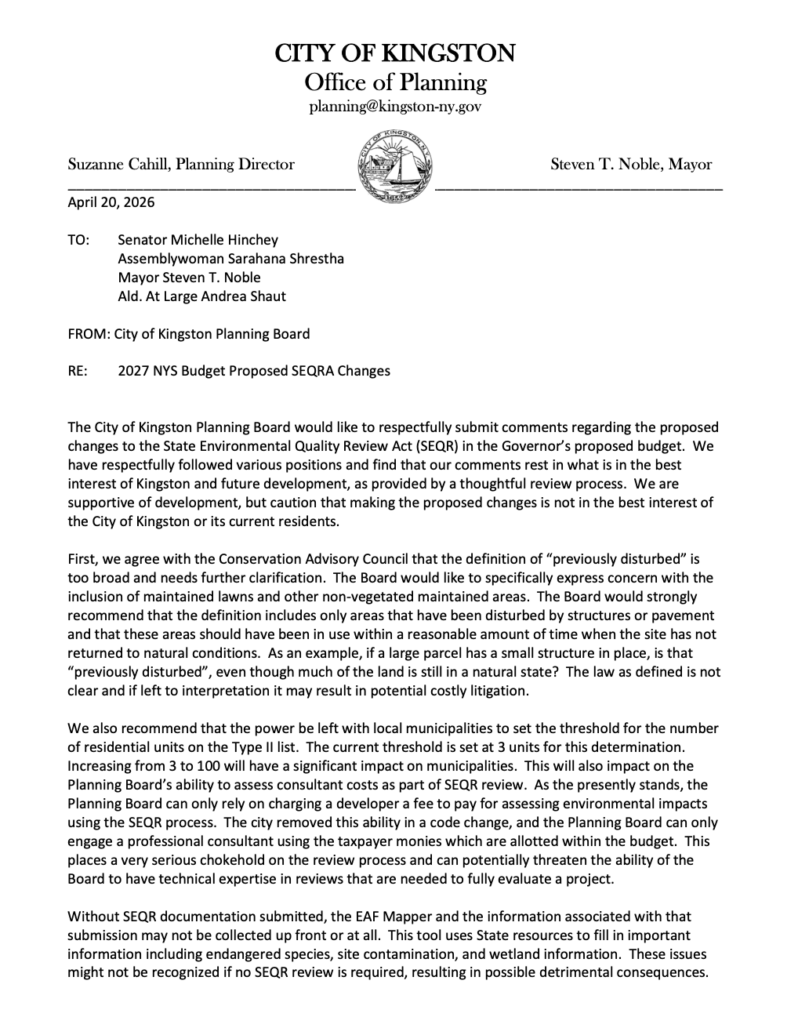
While Metzger and others emphasize targeted exemptions to accelerate housing, there are serious reasons for caution regarding the Governor’s proposal. To suggest that it could be acceptable with minor “tweaks” misses the risks. The proposed SEQRA reforms, as drafted, include broad exemptions for major housing and mixed-use developments without clear limits or safeguards. Key terms like “previously disturbed land” are vague, and there are few geographic or environmental guardrails. This could allow sprawling developments on sensitive or polluted sites, strain existing infrastructure, and reduce local oversight—particularly in communities outside New York City.

The reality is that if the proposed sweeping SEQRA changes are adopted through the state budget pushed by Governor Kathy Hochul’s administration, we all lose, and the people who will lose the most are those living in communities without zoning laws.

These are often rural communities that lack the planning infrastructure of larger municipalities. They are also the communities least likely to be closely following the details of this policy debate in Albany. Yet under the proposed changes, these lands could effectively be opened up to whatever development the state prioritizes—whether local residents want it or not. Without strong zoning protections, and with SEQR significantly weakened, local governments could have very little authority left to shape what gets built in their own communities.

It’s hard not to conclude that the push to gut SEQRA is connected to the state administration’s development priorities. Whether those projects are energy infrastructure, housing developments, or large-scale facilities like data centers, the effect would be the same: fewer opportunities for communities to review, question, and mitigate projects before they are approved. “Let Them Build” alright – but what and how? 

SEQRA was created to ensure environmental impacts are considered and mitigated and that the public has a meaningful voice in decisions that shape their communities. Weakening it may speed up approvals—but it will also weaken local democracy.

And that’s a tradeoff New Yorkers should think carefully about before it’s made for them—and right now, by just two decision makers, without any opportunity for public comment: Andrea Stewart-Cousins in the Senate and Carl Heastie in the Assembly.

Two people, both under pressure from the Governor. It’s not hard to imagine how that will go.

Call your senator and demand that their leadership remove the Governor’s SEQRA regulations from the budget before it’s adopted in April. The budget is not the place for SEQRA reform.

READ our FAQ about the proposed SEQRA changes proposed by the Governor