
“UCRRA’s commitment to review waste diversion strategies and alternative technologies to approach Zero Waste not covered in the Local Solid Waste Management Plan, and to collaboratively develop and participate in a comprehensive Zero Waste Action Implementation Plan…”
(Resolution No. 242 of 2020 (signed February 16, 2021), Approving Ulster County’s Local Solid Waste Management Plan)
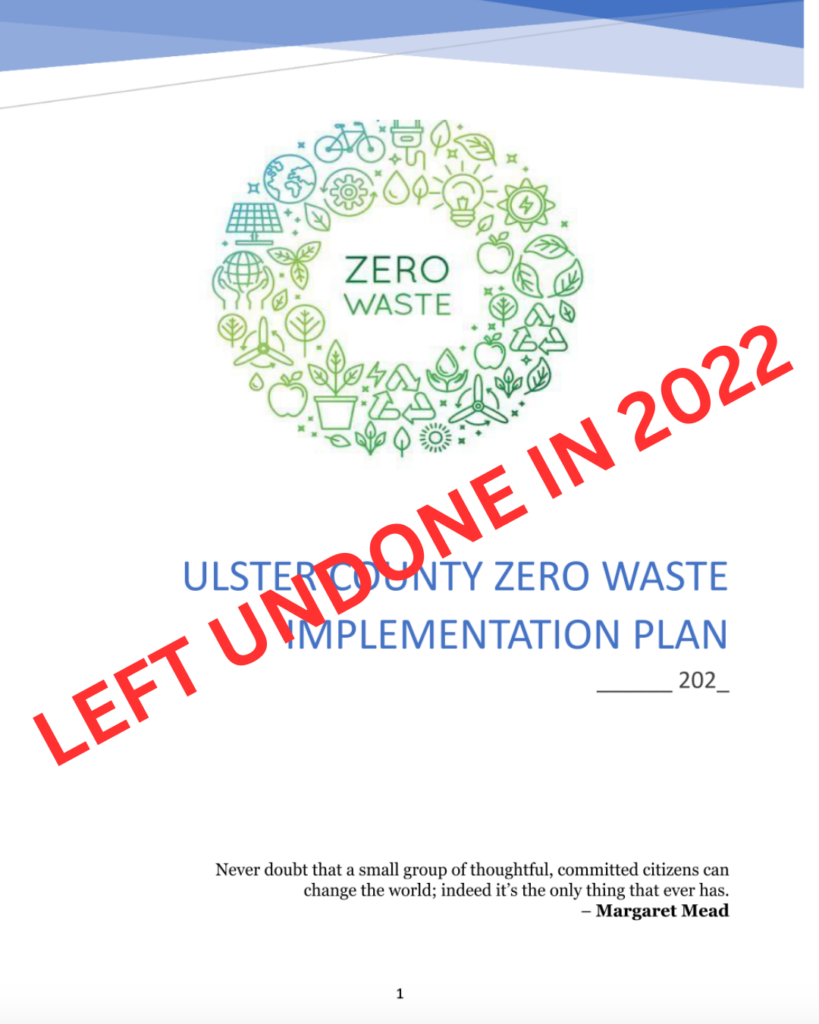
Seven years after the Ulster County Legislature (UCL) passed Resolution 451 in 2019, establishing a policy to become a Zero Waste Community, the legislature and Ulster County Resource Recovery Agency (UCRRA) have yet to complete a Zero Waste Implementation Plan (ZWIP). Instead, lacking political will and sufficient funding, it continues to redefine the process and kick the can down the road. At a time when we have no time to waste.
An undated memo written by UCL Chris Hewitt, and received by us on March 25, was recently brought into public view during the month’s UCL Energy, Environment and Sustainability Committee meeting following our recent Ulster Toward Zero Waste webinar. It highlights a serious and recurring problem: the UCL is once again moving forward without following the process it has already established.
This is not the first time, and it is not a small procedural issue. It speaks directly to how decisions about major waste infrastructure have been made, with or without the public meaningfully included before those decisions are locked in.
Deja Vu
Last summer, the UCL issued a Request for Qualifications (RFQ) for a Zero Waste Implementation Plan (ZWIP). As could have been expected, consultants submitted proposals in the range of $100,000, far exceeding the County’s $10,000 allocation—an amount widely recognized as insufficient for a planning document as critical as a ZWIP.
Instead of increasing funding or revising the scope to align with implementation needs, Legislator Hewitt circulated a memo reclassifying the project with MSW Consultants as a “Zero Waste Policy Guidance Document.” There was no public explanation for this change before it occurred, no opportunity for public input on the revised scope, and no discussion of the difference between an implementation plan and a policy guidance document.
This is the second time the UCL has stepped away from the original intent of Resolution 242. The first attempt, in and around 2021-2022, was also based on a $10,000 allocation and produced a draft that was never completed. That failure has already cost us time. We are now repeating the pattern.
We Already Have the Information—What We Don’t Have Is a Plan
During the April UCL Energy, Environment and Sustainability Committee meeting, the public heard for the first time what is now being proposed. The explanation centered on compiling information —materials we already know exist, including the 2020 Solid Waste Management Plan and its updates, draft Zero Waste Implementation Plan materials, UCRRA annual reports, Greenway Environmental submissions, and NYS DEC annual reports.
The issue is not access to information. The issue is the absence of a true implementation framework that organizes, tests, and applies that information into a functioning system.
KingstonCitizens.org played a direct role in ensuring that this memo was brought into the public process. On April 7, we requested that the document be placed on the agenda for the April 13 UCL Energy, Environment and Sustainability Committee meeting and that public comment be allowed. Without that request, the item would have not likely been included for discussion.
At the meeting itself, public comment was limited to two minutes. Concerns were raised, questions were asked, and the lack of transparency in the process was clearly identified. There was no substantive response or discussion. Instead, it was suggested that the act of public comment itself satisfied the “collaboration” requirement in Resolution 242.
Restoring the Intent of Resolution 242: The County Must Now Act on Zero Waste Implementation
As we learned from Greenway Environmental Services—who have been on the ground for decades building zero waste systems in Ulster County and were featured in our recent “Ulster Toward Zero Waste” webinar—the Recycling Oversight Committee’s (ROC) initial approach to the Zero Waste Implementation Plan is to begin with a demonstration project at a single transfer station.
In 1986, Ulster County invested approximately $200 million to build 19 transfer stations, the UCRRA facility, and close its landfills. The ROC’s rationale is that a system proven at one facility can and should be scaled across the full system, leveraging this investment, which was fully paid off in 2025.
Our coalition of partners expect full collaboration with Ulster County leadership and UCRRA, and a process grounded in transparency, accountability, and shared responsibility for public health, quality of life, and costs.
Key Next Steps: What Needs to Happen Next
The MSW consultant document may inform the discussion with a policy guidance memo, but it is not the plan. Resolution 242 requires that the Zero Waste Implementation Plan itself be built collaboratively, transparently, and with clear steps toward execution—not deferred or redefined after the fact.
1. Reaffirm Resolution 242 as the Governing Framework
Resolution 242 requires a collaboratively developed Zero Waste Implementation Plan (ZWIP). This means shared planning from the beginning—not a late-stage review, and not a substitute document such as a policy guidance memo.
2. Clarify the MSW Policy Guidance Document’s Limited Role
The MSW Consultants policy guidance document must be clearly defined as background reference material only. It cannot replace the ZWIP, and it cannot be treated as the County’s implementation plan.
3. Pause Major Infrastructure Commitments Until a ZWIP Exists
No new long-term contracts, facility decisions, or major infrastructure investments should move forward until a formal, adopted Zero Waste Implementation Plan is completed through a public process.
4. Establish a True Collaborative Working Group
Create a formal, inclusive working group to build the ZWIP from the ground up. This group should include the County, UCRRA, legislators, transfer station operators and staff, and community stakeholders. Collaboration must mean shared development of the plan, not limited public comment on pre-determined direction.
5. Prioritize Real-World Pilot Projects at Transfer Stations in Ulster County
Begin implementation through transfer station-based pilot projects, consistent with the New Paltz model approach. These pilots should test what works operationally and generate real data to build the countywide system, supported by a Transfer Station Database (permits, operators, staffing, volumes, recycling rates, and facility rankings).
- From this, a short list should identify the two highest-volume and two highest recycling-rate transfer stations, with the top-performing recycling facility fully documented. The short list must then be evaluated for willingness to participate in a pilot project, future plans, grants pending, equipment, personnel structure (including union status, wages, job titles, and training), and full operational financials.
- A Request for Proposal (RFP) should then be issued for a contractor or consortium to design, install, and operate a facility targeting a 90% recovery rate while doubling current capacity. Funding for this effort already exists within UCRRA’s “unrestricted funds,” generated through tipping fee revenues, consistent with the intent of the 2012 flow control law.
- The pilot is intended to produce the operational model needed for countywide deployment and the development of a Zero Waste Implementation Plan, to be incorporated into the Solid Waste Management Plan.
6. Establish a Public Implementation Schedule and Accountability Framework
Establish a public implementation schedule and accountability framework by setting clear, transparent milestones for the formation of a working group, the selection and launch of pilot sites, the drafting of the Zero Waste Implementation Plan (ZWIP), and key decision points for countywide rollout. This is essential to prevent further delay and ensure the process does not repeat past cycles of inaction.