Another Step Toward Public Engagement in Ulster County Zero Waste Planning

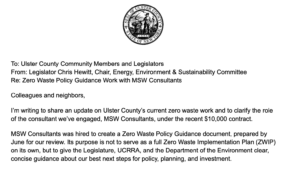
In an effort to expand public participation in Ulster County’s Zero Waste planning process, we recently called on members of the Ulster County Legislature’s Energy, Environment and Sustainability Committee to ensure that meaningful opportunities for public comment are built into MSW consultants’ work on the County’s Zero Waste Policy Guidance document before it is finalized.

If this Policy Guidance document has the potential to shape the path toward a Zero Waste Implementation Plan (ZWIP), then the public must have a seat at the table. With a $10,000 investment already committed, this is a key opportunity to leverage the current work into the next phase of developing a ZWIP in a way that is collaborative, participatory, and properly funded. We urged the need for a public presentation or workshop to share preliminary recommendations, timely online access to materials, a publicly noticed comment period on draft documents, and clear consideration of public input in the final guidance document.

Legislator Chris Hewitt responded, and it’s encouraging.

He wrote that the Legislature will be reaching out to the consultant to create a version of the document that is accessible to the public for edits, feedback, and suggestions. There will also be additional opportunities for input, including during and after the public presentation. We will continue to keep KingstonCitizens.org readers informed so that anyone interested can participate and contribute. If you haven’t already, please sign up for our newsletter for continued updates.
Kingston Planning Board Expands Mounting Pushback on Governor’s SEQR Changes


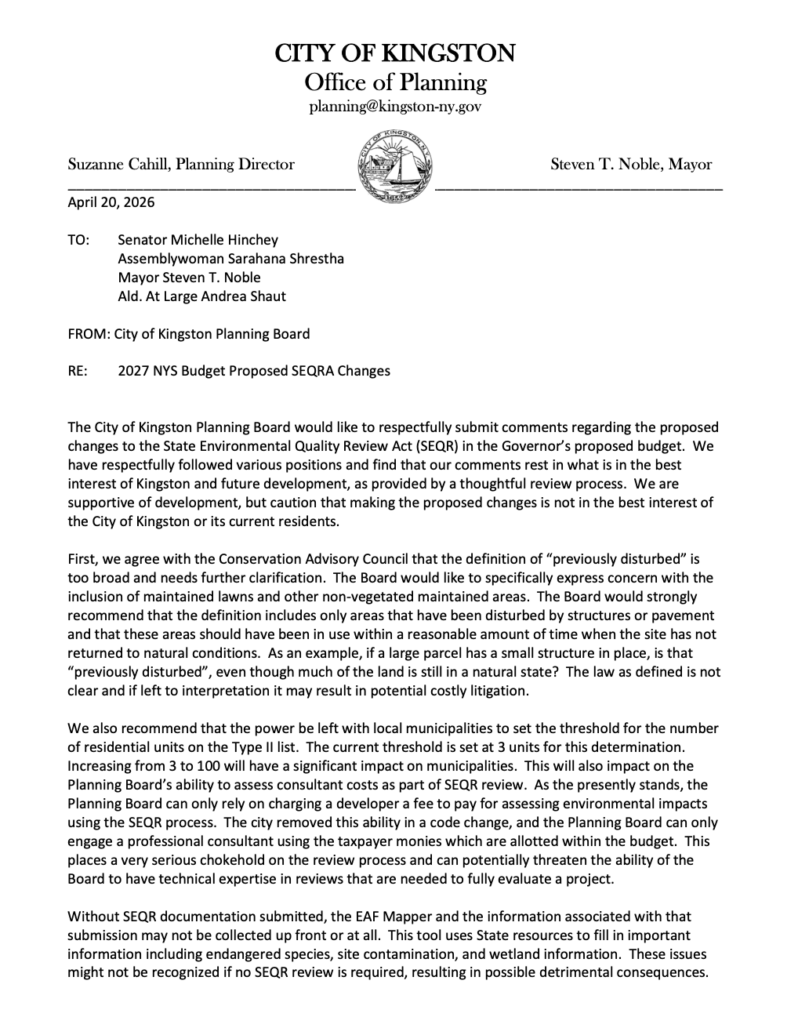
The Kingston Planning Board has formally weighed in on the Governor’s proposed changes to the State Environmental Quality Review Act (SEQR), warning that, as written, the changes could undermine thoughtful, responsible development in Kingston. Their letter adds to a growing and aligned chorus that includes the Kingston Common Council and the Kingston Conservation Advisory Council (CAC).

What makes the Planning Board’s perspective especially important is its daily, hands-on review of development proposals in Kingston, giving it a grounded understanding of how projects affect neighborhoods, infrastructure, and the environment. Because of that experience, their concerns deserve close attention in Kingston and across the state—particularly from other local legislative and advisory bodies that may not be fully engaged with the issue – yet. 

The result is a growing disconnect between Kingston’s local legislative and advisory bodies and the political posturing at both the local and state executive level, reflecting a broader pattern of “I know best” policymaking that sidelines everyone except well-resourced developers.

If the Governor’s proposal were advanced through a fully public, transparent process, it would face far greater scrutiny on its merits. Instead, embedding these changes in the budget limits debate, restricts public participation, and effectively puts a thumb on the scale of a decision with long-term consequences for communities across the state.

While the Kingston Common Council, Planning Board, and CAC are raising concerns about both the substance of the Governor’s SEQR proposal and the use of the budget process to advance sweeping policy changes with no meaningful opportunity for public input, our Mayor is organizing rallies in Albany in support of the Governor, likely involving city hall staff time.

This comes as the state is already in the middle of a formal SEQR regulatory update process that includes environmental justice siting and disadvantaged community protections. Public comment closed in May 2025 after months of engagement and substantial input from communities and advocates. If the Governor’s proposed SEQR changes are adopted in the budget, they would effectively override that ongoing process and the work that has been done to date.

It has become increasingly clear that the Governor’s SEQR proposal should be removed from the budget—since the budget is no place for sweeping changes to SEQR—or, at minimum, it requires significant refinement to avoid unintended and potentially serious consequences.

TAKE ACTION

Call your State Senator and Assembly Member today and tell them: SEQR changes do not belong in the budget.  Demand that these sweeping environmental policy changes be removed and considered through a full, transparent public process where communities have a real voice.

Read our FAQ: Protect SEQRA: Ensure Housing Development Without Weakening Environmental Protections