
By Rebecca Martin
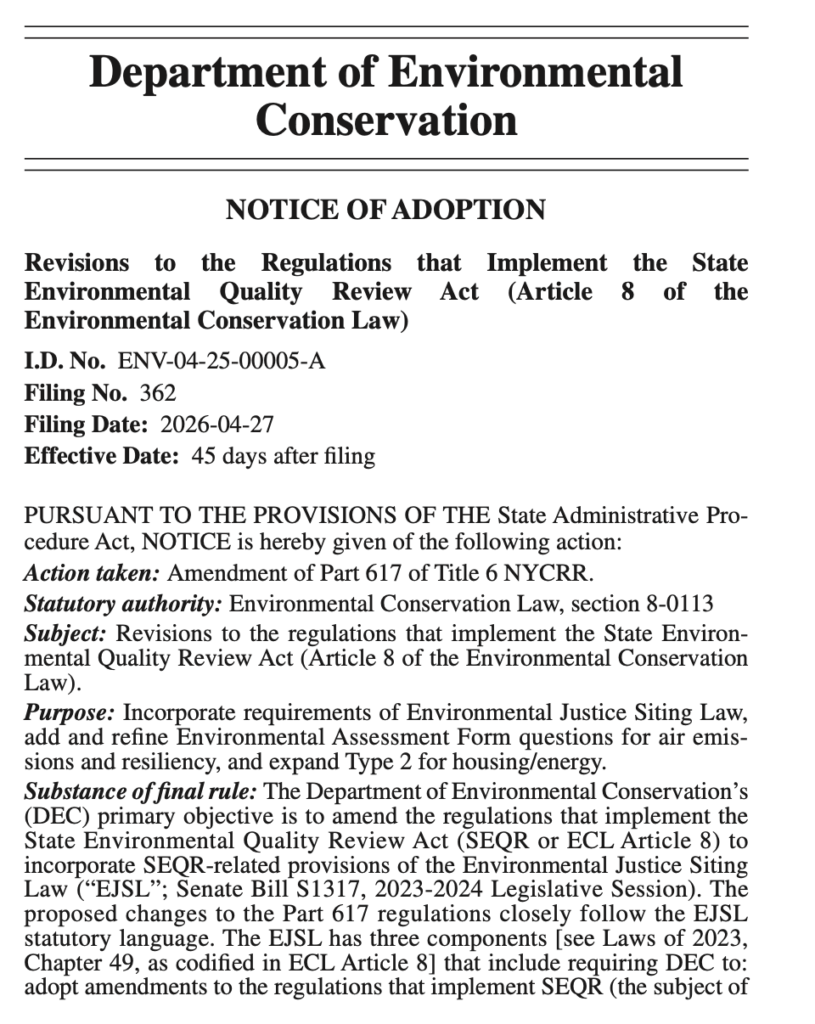
The New York State Department of Environmental Conservation (DEC) has finalized long-awaited updates to the State Environmental Quality Review Act (SEQRA) regulations to implement the Environmental Justice Siting Law. The agency adopted the final regulations on April 24, just ahead of the April 30, 2026 deadline (and posted on May 13). The regulations are scheduled to take effect on June 12.
What SEQRA Is and Why It Matters
SEQRA is New York’s environmental review law. Since becoming effective in 1976, it has helped protect communities, public health, water, infrastructure, and natural resources by requiring government agencies to evaluate the potential impacts of major development projects before approvals are granted.
SEQRA is unique to New York State, and not every state has an equivalent environmental review process. It is one of the state’s primary tools for identifying environmental and community impacts, including traffic, air and water quality, noise, infrastructure strain, and cumulative effects. It also requires agencies and applicants to consider mitigation measures to avoid or reduce significant impacts before projects move forward.
This distinction becomes clear when looking at cases outside New York. During our fight against Niagara Bottling over a decade ago, after a five-month effort that helped push the company out of our area, KingstonCitizens.org followed their proposal to Bloomfield, Connecticut, where the community was at a significant disadvantage compared to New York communities. In Connecticut, the local water system was controlled at the state level, and there was no comparable environmental review framework like SEQRA to require the same level of public process and impact analysis.
As a result, despite local opposition, the small community ultimately lost its fight against a 432,000-square-foot Niagara Bottling facility that had originally been proposed for Ulster County. Experiences like this illustrate how important SEQRA is in New York—it is a safeguard that should be valued and improved through careful, transparent change, not dismantled or treated as an obstacle.
What the Environmental Justice Siting Law Requires
The Environmental Justice Siting Law requires decision-makers to consider whether proposed projects could have disproportionate impacts on disadvantaged communities. Until now, there has not been clear guidance explaining exactly how local governments were supposed to make those determinations during environmental review.
The updated regulations will revise the Environmental Assessment Form used during SEQRA review and add questions designed to better identify potential impacts on disadvantaged communities. DEC is also expected to update its SEQRA Handbook and related guidance so municipalities and applicants can apply the new requirements more consistently across the state.
Small Housing Projects and SEQRA Exemptions
The final regulations also expand certain SEQRA categories known as “Type II actions” for small multifamily housing projects. Type II actions are categories of development that are excluded from SEQRA environmental review because they are considered unlikely to result in significant adverse environmental impacts.
Under the DEC’s final rule, some multifamily projects with four or more housing units may qualify for this exemption if they are under 10,000 square feet, located on an approved lot, connected to existing public water and sewer service, allowed under local zoning either as-of-right or by special permit, and still subject to local site plan review.
These conditions limit the exemption to relatively small projects that DEC considers to have already been sufficiently evaluated through past environmental review experience, making additional SEQRA review unnecessary.
The Governor’s Proposal
At the same time, Governor Hochul has proposed separate changes to SEQRA through the state budget that would go significantly further than DEC’s rulemaking. Her proposal would exempt housing developments of up to 300 units in cities and 100 units outside cities from environmental review entirely, meaning it would allow much larger housing projects to bypass review than those covered under current DEC rules. If enacted, those changes could override portions of DEC’s newly finalized framework, including its Type II exemption for small multifamily housing, meaning that although DEC’s rules may take effect on June 12, parts of them could later be superseded by broader exemptions adopted through the budget process.
Unlike DEC’s rulemaking, which was grounded in prior environmental review experience with smaller developments and included a public rulemaking process, the Governor’s proposal has not been accompanied by any publicly explained analysis or supporting data for the chosen unit thresholds, including review of past environmental review outcomes, Environmental Notice Bulletin filings, community input, or environmental justice impacts. The proposal has instead been advanced through the state budget process, where policy changes are negotiated and enacted as part of executive-led budget negotiations rather than through separate, standalone legislative hearings.
In a recent social media post defending her changes, Governor Hochul stated: “For too long, NIMBY culture has blocked the housing New Yorkers need. Not anymore.” Her statement is a broad dismissal of her constituents, framing opposition as the problem rather than part of the democratic process. This reflects a familiar political dynamic in which crises are used as justification to advance sweeping changes that would otherwise face greater scrutiny, including the rollback of environmental review protections.
What Happens Next
The difference between DEC’s rulemaking and the Governor’s proposal is substantial. DEC’s exemption applies only to relatively small projects and still operates within a broader environmental justice review framework. The Governor’s proposal, by contrast, would exempt far larger developments from SEQRA review entirely, including environmental justice considerations.
For now, DEC’s rulemaking is complete and the new regulations are scheduled to take effect on June 12. The focus will shift to how municipalities apply the updated requirements in practice and whether the Governor’s broader SEQRA proposal is ultimately adopted through the state budget process.
To help municipalities come up to speed once the budget process concludes, local leadership should consider training for its boards, councils, trustees and committees who are most likely to serve as lead agencies for projects in their communities.
Communities in NYS without a zoning code may also want to prioritize adopting a comprehensive plan and zoning regulations. Doing so can provide clearer long-term direction for development decisions and help ensure that growth occurs in a way that reflects community priorities rather than leaving those decisions entirely to individual project proposals.
ADDITIONAL READING
70+ Local Leaders Rally Against Gov. Hochul’s Changes to NY’s Environmental Review Law (5/1/26)
Read the City of Kingston Planning Board’s letter (4/20/26)
Read the City of Kingston Common Council’s letter (3/27/26)
Read the City of Kingston Mayor’s letter (3/16/26)
Read the Kingston Conservation Advisory Council letter (3/5/26)
As always, Rebecca gives the reader a precise explanation of what is happening. Hochul’s scapegoating of SEQRA as to why not enough housing has been created is cynical at best, ignorant at worst. For while SEQR is abused by NIMBYism, pure NIMBYism doesn’t stop projects and only slows them a bit. The real problem with housing reviews is usually the applicant, or their representative, fighting tooth-and-nail against having to adhere to the local zoning code requirements with a singular objective, viz., lowering initial costs associated with development.
Also, applicants often change direction or add wrinkles to the application mid-review which triggers having to resend all materials to the various involved agencies which takes additional time, effort and money.
What the NYSDEC has proposed here, is rational and in keeping with the letter, intent and spirit of SEQRA.