By Dan Nelson
My partner and I moved back to the East coast in spring 2023 after 35 and 25 years, respectively, living in Oakland, California. We managed to find a rental in Kingston (not easy!), which fortunately turned out to be a loft, so it had built-in studio space. Otherwise we would have been looking for studios in a market where they’re more expensive than the Bay Area (!). Our neighborhood in Oakland was mostly quiet at night, but some nights and early mornings featured muscle cars peeling out, fireworks (almost nightly in the 2-3 months leading up to July 4th), public fights, crazy people yelling on the sidewalk, etc. We were no strangers to sleep disturbance, but we had no idea about the freight trains of Kingston.
For about a year in 2024-25 we were looking for a house to buy. After looking at fifty-ish houses in person, being outbid on two, withdrawing a bid on one money pit, and unsuccessfully asking for a small contingency on the fourth house, the fifth house we bid on became ours. We knew it was one block from a rail crossing, but we had heard only one train pass during a brief daytime visit to the house, and were ready to end the search. We moved into the house, about 450 ft. from the Flatbush Ave. rail crossing, in February.
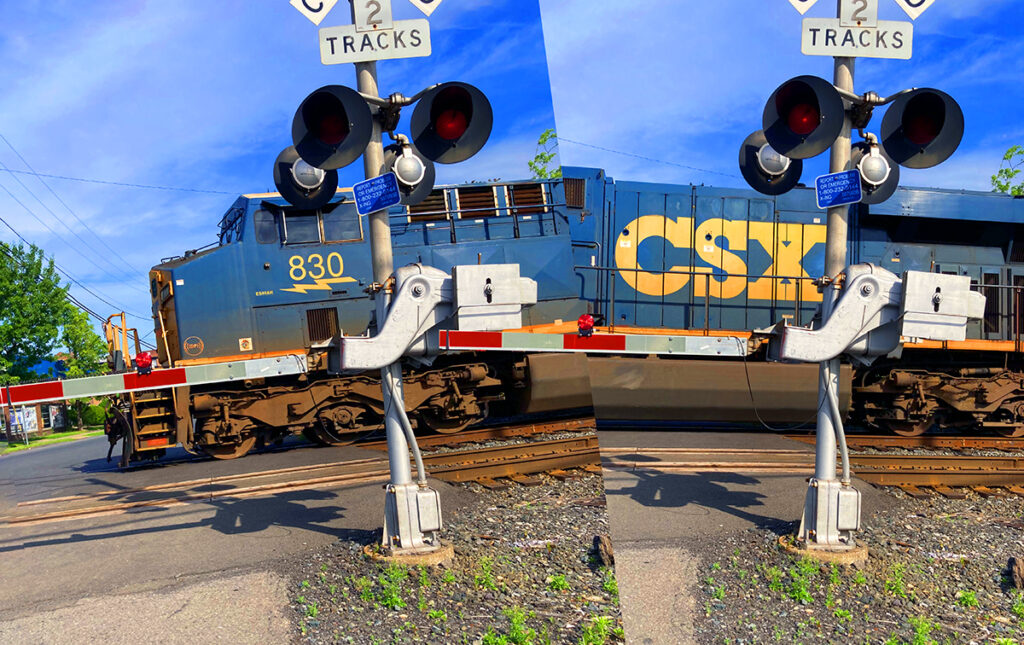
As is probably obvious to anyone living here, there are many trains at all hours of the day and night. Kingston seems to be the only town or city of any size between Albany and New York City through which freight trains pass, all of which are operated by CSX. There are six rail crossings in Kingston proper, all in a one-mile stretch through our most densely-populated neighborhood. Publicly available info showed that there are 20 to 30 trains passing through Kingston in any given 24-hour period.
In March, after looking into what the law dictated about train signals, the first person I messaged about train noise was Suzanne Cahill, the Planning Director for the City of Kingston: “Despite only being required to sound one short and one longer horn (of undefined lengths) at each crossing, the trains routinely sound many blasts of an average of four seconds each, before during and after crossings. These blasts are of the same length and frequency at 4 AM as they are at 4 PM, in other words, regardless of the amount of vehicle and pedestrian traffic. The vibrations—a result of poorly maintained tracks, some say—shake our entire house, rattling mirrors and furniture and waking us up a few times per night…..”
Peter Criswell, a former co-worker of mine who had since become an Ulster County representative, directed me to Bob Dennison, the Alderman for Ward 6 on the City of Kingston Common Council. In response to the first of several emails I would send, Bob (CC-ing Mayor Steve Noble and Kingston Common Council President Andrea Shaut) included a link to the Ulster County Quiet Zone Study (2024). I had already stumbled upon a study from 2006. He summarized the City’s take on it:
“The cost of establishing a Quiet Zone in the City is significant and beyond the resources of the City at this time.
“As you know, sounding the train horn is required when a train crosses a public street. There are four city streets crossing the tracks at grade close to your house which is part of the problem.
“I know the Mayor is in conversation about the trains moving through the city with CSX but they are regulated by the Federal Government and mostly outside of our control. I suggest you contact our federal representatives for more information.
“I understand and share your frustration. I hope the study is useful.”
A friend of a friend, who lives in Midtown near the Foxhall and Ten Broeck crossings and who was losing as much sleep as we were, had also been in contact with the City, and his take was that they were not prepared to do anything. Though it at first felt like the City was brushing us off, my impression now is that they are concerned and had already done a lot to look into possible solutions, including applying for a federal grant to establish a quiet zone.
Having read the 2006 study and noting that the busiest and most accident-prone crossings were Foxhall and Flatbush, my takeaway was that, in the 45-year period covered by the report, there were about 15 incidents involving vehicles or pedestrians being struck by trains, resulting in 4 fatalities and a number of injuries. It also appears that many, if not all, of these incidents occurred before the installation of the enhanced crossing protections that exist today, including the flashing crossing gates that were added roughly a decade ago (if anyone can confirm this, I would appreciate it). I asked myself and the City:
- What specific safety risks are the train horns intended to address, and are there alternative safety measures that could provide comparable protection while reducing noise impacts on nearby residents?
- How has the anticipated safety benefit of the horns been evaluated against the potential impacts on the thousands of residents who may be affected by nighttime noise throughout the year?
- What evidence exists regarding the frequency and likelihood of incidents that train horns are intended to prevent, and how was that weighed against the public health and quality-of-life impacts of routine horn use?
- How does the decision-making process balance the goal of preventing rare but serious incidents with the ongoing impacts that noise may have on residents, particularly during overnight hours?
I still wanted to know what the City was prepared to do to address this chronic problem. I’d been in touch with Natalie Lincoln at Congressman Pat Ryan’s office and, while I was encouraged that they were looking into the matter, the conversation seemed to be going in circles.
One thing that stood out was that neither the City nor Peter Criswell had mentioned the $1M grant secured by Senators Schumer and Gillibrand for the Safe & Accessible Flatbush & Foxhall Project. Even though a huge benefit to establishing a quiet zone was to eliminate train honking, the stated goal of it was to replace safety measures like horns with other safety measures in the form of physical markings and barriers to keep people and cars from wandering onto the tracks. I naturally wondered whether elements of a future quiet zone were already being contemplated as part of that work. At a minimum, there seemed to be potential overlap between the two efforts. If the City is already investing in crossing safety improvements, it seems reasonable to ask whether those improvements could also advance the long-term goal of reducing or eliminating routine train horn noise through a quiet zone designation.
Natalie, who was extremely helpful and responsive, shared a substantial amount of information from the FRA (Federal Railway Administration), which I tried navigating. But by that point, I felt as though I was being bounced between different levels of government. The City had directed me to my federal representatives, and the FRA materials seemed to show that the necessary steps would ultimately need to be initiated and carried out at the local level. It started to feel a bit like a classic “Ask your mother” / “Ask your father” situation!
Natalie also explained that Kingston would likely be less competitive for the next round of Consolidated Rail Infrastructure and Safety Improvements (CRISI) Program funding than larger communities such as Port Jervis. That made me wonder what steps the City could take on its own, or in partnership with state and federal agencies, rather than waiting for a future grant opportunity that may or may not materialize.
Bob Dennison burst my bubble:
“The Safe and Accessible Flatbush Foxhall Project does not include work necessary to establish a quiet zone. It’s primarily a pedestrian safety improvement project. It will include improvements to rail crossing but not to the extent necessary to make a quiet zone.
“The biggest hurdle to a quiet zone is cost. In my experience the railroad will not participate in the cost of establishing a quiet zone. The list of requirements the FRA sent you is intimidating and it is typically their expectation that the local government will do the work and bear the cost necessary to establish the zone.
“Some of the requirements, like closing low volume crossings, can be done by local government. Other improvements like new gates and fencing the railroad right of way are expensive and need cooperation of the railroad.
“Of course the Railroad’s preference is to grade separate the crossings which is very costly and very difficult to implement, requiring Right of Way acquisition and years to accomplish. As well as significant impact to the surrounding area. [“Grade separation” means to put passenger and freight traffic on different levels using overpasses and underpasses.]
“I suggest you reach out to the NYSDOT Rail Safety Unit in Albany. The Director is Ray Hessinger. I know this sounds like another hand off, but I understand your concern and think you will find them helpful.”
The list of infrastructure needed to establish a quiet zone didn’t seem particularly long: flashing gates, center lane delineators, safety markings, signage, and fencing. Hadn’t the City already implemented the flashing gates sometime between the 2006 and 2024 safety studies? If so, couldn’t this grant help fund some of the remaining items? It sounded like fencing around some of the crossings would be a significant expense, but the report focused that need mainly in the area around Broadway, where high school students cut across the tracks–a daytime activity, right?
At the end of the day, maybe the simplest, cheapest and easiest solution would be for trains to just not blow the horn more than they needed to.
Meanwhile, Natalie assured me that the City was assiduously pursuing grant opportunities on more than one front:
Consolidated Rail Infrastructure and Safety Improvements (CRISI) Program. The last round was in 2024 in the Biden Administration. We are waiting on the next round to be announced. It may be a combo FY25-FY26 Grant which combines two funding years into one application.
Railroad Crossing Elimination Grant Program: This program provides funding for highway-rail or pathway-rail grade crossing improvement projects that focus on improving the safety and mobility of people and goods. Same timeline as the CRISI Program, keeping an eye on the latest found round. You can read about the funding we helped secure for Port Jervis through this program below.
“It is a little bit of a chicken/egg issue, but I know the safety concerns on Flatbush/Foxhall are being taken very seriously by the city.
“I think the Ulster County Transportation Council might be a good place to direct some of these questions. You can read their old study on Kingston Quiet Zones from 2006 which might provide some helpful background too.“
I filled Natalie in on what I’d learned from the City and she said: “I think Bob is right, the hardest part is the cooperation of the railroad [CSX]. They really throw a wrench in the gears….”
At this point it was clear that there was not very much in the way of persuasion or cajoling that could be done. It all seemed to boil down to the willingness – and the funding – to implement the specific physical improvements required for a quiet zone, all without any participation from CSX.
Which brings us to the May 8th Town of Ulster council meeting, where not only did some citizens complain about the train noise, but Councilman Mike Schatzel did as well. Schatzel, who lives approximately 1,000 feet from the tracks and/or a crossing, spoke about the issue from his own experience. (Again, we live half that distance from a crossing.) The meeting was covered by the Daily Freeman, which reported that Schatzel:
…acknowledged that reports of homeless people being near the tracks could be related to the change in horn use.
“There is no consistency on how the horns are blown,” he said. “Sometimes it’s one or two (short horns), sometimes they don’t let off on it until they get to Staples, maybe even farther. … There’s one particular guy that (on) Sunday night he just likes to lay on it from (Neighborhood Road) to Dunkin’ Donuts in Kingston [about 2 miles – DN]. He just won’t let up.”
Some residents said the issue is “extremely disruptive.”
“We have noticed a significant and concerning increase in train traffic along with unusually loud noise levels,” wrote residents Simone Garzella and Robert Canfield.
“Some trains in particular have been extremely disruptive at all hours of the day and night,” they wrote. “We are routinely being woken up between midnight and 5 a.m. During the day, it often feels as though we are living inside a train station.”
The piece quoted Town of Ulster Supervisor James Quigley, who had said CSX has been told of the complaints but received only standard responses.
“As a government, we jokingly call trying to deal with the railroads as trying to talk to God,” he said. “They don’t talk back. When I sent the email the other day to the representative that I usually communicate with at CSX, his short reply was ‘Thank you, but we comply with all federal railway administration requirements.’”
Quigley said a study previously undertaken by Kingston to determine whether rail crossings, including some in the town of Ulster, should be updated to allow train conductors to limit the number of times a horn is needed.
“Those intersections would require major engineering improvements,” he said. “If you were to go on to Grant Avenue, which is a four-lane crossing of the CSX tracks with a median, a grass median, and curbing in the middle, a quiet zone would produce gates that absolutely prevent any vehicle from entering onto the crossing, which gives the CSX railroad the right to change the horn patterns.”
Schatzel’s observation that there was a lot of inconsistency in horn use, and at times some particularly aggressive-sounding train horns, resonated with us. I think of it in the context of car drivers: the difference between a brief tap of the horn to signal that the light has changed and laying on the horn for five seconds is significant. A long horn blast communicates urgency, anger or danger. When you are on the receiving end of that sound, note your physiological response. Now imagine that same response occurring while you are asleep. How does the body react on a subconscious level?
The CSX Media Relations Director Austin Staton was at the meeting. The article noted his claim that the federal regulations give guidelines “…with specific guidance on timing and volume….” He’s correct that horn volume is specific: between 96 and 110 dB. The “timing” specifies a certain distance, confusingly not a linear distance but a time to destination: 15 to 20 seconds before the train’s lead car reaches the crossing. But in the “two long, one short and one long blast” at each crossing, the regulations don’t specify the duration of the blasts.
In CSX’s view, one or both of these things would need to happen to change their behavior: enhanced safety infrastructure such as gates and medians, and concrete information about when and how long CSX engineers are sounding their horns. In fact, after a couple of exhausting months dealing with this issue, I was ready to give up and accept what many people had said: “You’ll get used to it.” Until, that is, Staton said,
“If you can’t give me specific locations and times I can’t speculate on this,” he said. “We understand the frustration of the community but…if you want me to give an answer, I need specific locations and timing.”
Well I’m a musician, and I’ve made recordings. My first idea to see – and raise – Staton’s bluff was to put a microphone outside our window and connect it to a laptop with a program that is sound-activated and could record horn frequency, duration, and decibels. What I ended up doing was pointing a Zoom recorder toward the crossing and recording about ten nights in a row between 8 PM and 8 AM, as well as several 24-hour periods, capturing train signals. The times, frequency, and durations can now be noted in a spreadsheet.
Next will be to set up a decibel meter next to the crossing, one that can connect to an app and be sound activated, ideally also noting the time. Walking to work in the Rondout a few days a week, on different routes that take me past two to three crossings, I’m only sometimes able to catch a decibel reading. The last one was 109.5, just 0.5 dB below the maximum – and equivalent to, for example, a hair brushing against skin.
Note that, as is clearly stated on the websites of companies like Union Pacific and BNSF, railroads appear to be uniformly and strongly opposed to quiet zones, which they claim is for safety reasons.
I emailed Councilman Schatzel about my efforts on May 13th, expecting a swift response and imagining that we might be clinking beer steins in solidarity before long, but three weeks later and still no reply.
I’d copied Natlie (from Congressman Pat Ryan’s office) who responded that the Railroad Crossing Elimination (RCE) and Consolidated Rail Infrastructure and Safety Improvements (CRISI) programs had released their FY25-26 Notices of Funding Opportunity (NoFOs!). In other words, grants were now open for applications. I passed this along to Bob Dennison, who forwarded it to Ruth Ann Devitt-Frank, Director of Grants Management for Kingston, and John M. Schultheis, P.E., City Engineer.
What they had to say was disappointing. After pinning my hopes on what seemed like the only viable tool available to encourage CSX to change its behavior—federal funding to help Kingston meet federal safety requirements —Ruth Ann said that the project cost of the quiet zone project would fall way below the amount of the grant, and so would not be eligible:
“The Crossing Elimination program requires a minimum total project cost of $1 million. City Engineer John Schultheis estimated that closing Gage and Ten Broeck and constructing embankments to create Quiet Zones would be about $20,000 – we could also include new signage, but would not be near the minimum. John’s recommendation is that we instead consider adding the project to the city budget to be handled by city staff. We’ll request consideration for the 2027 budget and continue to look for other funding sources.
“John has also done some exploration about the 4-quadrant gates solution and concluded it isn’t desirable as there’s a high upfront cost with ongoing annual maintenance. The City would be responsible for covering that cost estimated to be $15,000 a year. His recommendation is that the City look at installation of non-traversable medians instead of gates.
“We could apply for these measures under the CRISI program instead of the Crossing Elimination Program. However, a benefit cost analysis (BCA) is required as part of the CRISI application; the City doesn’t currently have the staff capacity to take on development of a BCA. We’re also not convinced the outcome of a BCA would be competitive enough to win an award.
“All that said, we do hear and share your frustration.”
So a quiet zone would cost the City too much, but not enough to qualify for a grant.
John clarified:
“…Closing Gage and Ten Broeck alone will not allow the city to request establishment of a quiet zone. Additional work would be needed at 4 other crossing locations. Those may or may not be solved by the non-traversable medians, closure, or other means. Further, one of the crossing locations is a private road in the cemetery and is not under city control. More study is needed to determine whether a quiet zone is possible and if so the best path.”
At that point, I was left confused—weren’t there already four-quadrant gates at all six crossings? And it began to sound like the goalposts were moving, with medians and other measures being framed as either sufficient or insufficient depending on the location.
On May 18th, my email to Ray Hessinger at the NYSDOT got a response from his colleague Brian Galvin, an Intermodal Transportation Specialist. Brian requested more information, which I immediately provided. As of June 1st, I hadn’t heard back.
One question I have not yet raised directly is whether a noise ordinance could apply here. Cities can regulate noise from music, car horns, lawn equipment and power tools, so why not trains? Looking closely at Kingston’s noise ordinance suggests it applies to private entities, which would likely exclude CSX or be preempted by federal law.
Natalie, in response to Ruth Ann and John’s messages, said,
“It seems the City has done its due diligence to look into the programs, sadly it is a complicated set of programs and they are extremely competitive. I work with the City’s grants team often and they are experts!
“I just attended a briefing by the FRA with other Congressional staff on both programs and they shared that the FY2023-2024 application round received 374 applications totaling $10,278,893,840.16 in requests but they only had $2,478,391,050.00 in funding available. I am flagging this for my colleague to see if we can identify future opportunities to help Kingston study the quiet zone.”
Or the City could just tell CSX to divert the tracks around Kingston? Couldn’t they? It’s not clear how Kingston is benefitting at all from its “relationship” with CSX.
Take action:
- If you’d like to join our growing group to discuss this issue and identify solutions, please contact Dan Nelson at thedannelson [at] proton.me.
- Attend KingstonCitizens.org’s upcoming webinar on rail safety on Wednesday, June 17 at 6:00pm with Jess Conard of Rail Watch.