
By Rebecca Martin
One of the ongoing problems for the Kingston Common Council is pretty basic: there isn’t a clear, shared understanding of how legislation actually moves through the system.
Some of it is in the Council Rules. Some of it is in the City Charter. Some of it is just “how it’s always been done.” And the result is the same—council members, staff, and the public end up debating the substance of an issue without any real attention to the process shaping it.
That shows up recently in moments like the tree ordinance or the commuter rail memorializing resolution introduced through the executive branch. Whatever you think of either proposal, they both point to the same underlying problem: ideas are being introduced without a clear, consistent path for turning them into legislation that the public can actually follow, evaluate, and act on.
Without clear procedure—which the Council President is supposed to oversee—the council is left reacting in real time, without the information or structure it needs to properly evaluate, amend, or move forward what’s in front of it.
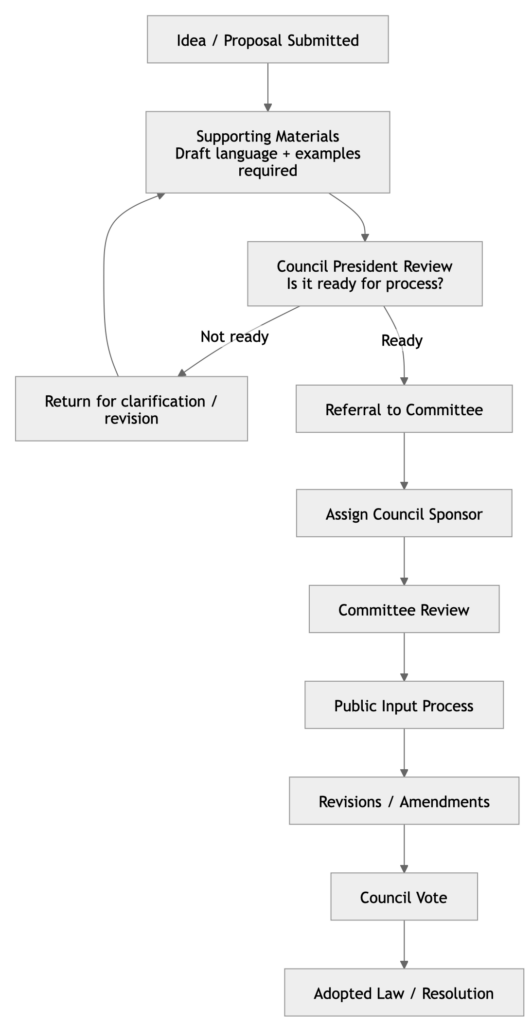
At a minimum, any request for legislative change—whether it comes from the executive branch, council members, or the public—should include supporting materials such as draft language, examples, or comparable legislation. Without that, the council must construct language from scratch, often under time pressure and without a shared reference point.
When this process is repeated across multiple issues and proposals, the workload grows substantially. Council members are expected to research complex topics, draft legislation, solicit public input, and make informed decisions, all while serving in positions that are intended to be part-time and provide relatively modest compensation. Providing supporting materials from the outset helps create a more efficient and effective legislative process while making better use of everyone’s limited time and resources.
The Council President should also be responsible for determining whether something is sufficiently developed to move into committee. If there isn’t enough structure to work from, it isn’t ready for formal legislative consideration.
Once something reaches committee, there should be a designated council sponsor who carries it through the process. That sponsor works with staff, the public, and the original proponents to refine it into workable legislation.
That process takes time—and it should. It requires a council that is actually working from a strategic understanding of its priorities, not just reacting to whatever shows up on the agenda. That can’t happen through emails, informal conversations, or backchannel discussions. And it can’t be something that happens entirely before the public ever sees it.
There has to be a real public process—structured, transparent, and consistent from start to finish. That is what gives legitimacy to the outcome, even for people who disagree with it.
Right now, that structure doesn’t exist in any consistent way that we can see. And without it, the council defaults into a reactive posture—responding to whatever gets dropped in front of it instead of shaping policy deliberately.
If the council is going to do this work well, it also needs the capacity to do it. That means independent legal and clerical support on the legislative side—not solely reliance on executive-controlled staffing. The Corporation Counsel serves at the pleasure of the mayor. Even with good faith efforts, there is no structural guarantee of equal support to the legislative branch. In practice, that can influence which ideas move forward, how quickly they move, and what shape they are in by the time they reach the full council.
This is exactly the kind of work the Council President should be leading: organizing a clear mapping of how legislation actually moves through the system and getting the council aligned around a shared understanding of that process. If that role isn’t doing that work, then the question has to be asked—what is the point of having a Council President at all? The position doesn’t vote, so it shouldn’t function as an unchecked gatekeeper over process without meaningful accountability or transparency.
But if the Council President is not willing to lead that effort collaboratively, the council should not need to wait for permission. It already has the authority to assign one of its own members to take it on—map the process, identify the gaps, and begin closing them so that future work and rule changes are grounded in something coherent.
Fixing this isn’t glamorous work. But it’s the work that determines whether city government actually functions—or just remains status quo. KingstonCitizens.org appreciates and supports the Kingston Common Council to have the clarity and tools it needs to legislate effectively.