Kingston BESS Update: Why We Still Need Time to Get This Right

By Rebecca Martin

When we first wrote about the need for a temporary moratorium on new Battery Energy Storage System (BESS) applications in Kingston, the goal was to give the City time to understand this emerging technology and get our zoning right before a project arrives.

That need has become even clearer given what we are now seeing in the neighboring Town of Ulster, where three very large BESS projects are being proposed in close proximity to Kingston. Imagine being a small town board with limited expertise, suddenly having to manage three major environmental review processes under an outdated zoning code that doesn’t account for large-scale battery storage. That means making consequential decisions while still trying to understand the technology, the risks, and what the community needs under the circumstances. It gives me a cold sweat just thinking about it. I don’t envy their position.

The City’s Zoning Working Group, following the recommendation of the Climate Smart Kingston Committee, has advised the Common Council to amend Kingston’s zoning code to address BESS, while acknowledging that additional expertise is needed. In fact, one member of the Working Group expressed concern that the city council itself did not have the expertise to propose a BESS ordinance. Doing this well will require the City to determine what it needs to know, identify the appropriate professionals, and develop a thoughtful path forward. That takes time.

Why does this matter?

Battery storage is an important part of the clean-energy transition. The question isn’t whether Kingston should support energy storage. The question is how—and where—we should allow battery facilities to be built.

Lithium-ion battery storage presents safety considerations that are different from many other types of development. Batteries can experience thermal runaway, which can produce intense fires, release flammable gases, and, under certain conditions, create explosion or deflagration hazards. Fire-safety standards for BESS address fire propagation, separation distances, ventilation, testing, and emergency response—and those standards continue to evolve.

That matters when we’re talking about facilities in or near densely populated areas. Kingston needs to understand what those standards mean for our geography: setbacks from homes and businesses, emergency access, water resources, firefighting capacity, emergency-response plans, and the potential cumulative impacts of multiple facilities in the region.

Kingston has seen this movie before

Although the circumstances aren’t exactly the same, there is a useful lesson in what happened in the Town of Ulster in 2018. When GlidePath proposed its Lincoln Park Grid Support Center, the developers argued that a large power-generating facility could be treated as a “utility company structure” under the Town’s existing zoning.

The zoning code did not clearly define what that term meant or distinguish conventional utility infrastructure from a privately developed power plant. That ambiguity became a major point of contention and ultimately prompted the Town to revisit its zoning.

We should learn from that experience rather than repeat it

If a BESS project is submitted before Kingston amends its zoning, the developer will be looking at the zoning that exists at the time of its application. Once a project enters the approval process and an environmental review process begins, the City is responding to a specific proposal under the rules that exist at that point.

Given the complexity surrounding BESS, Kingston could find itself in a contentious and avoidable fight over how a project should be regulated—after the fact, rather than having established the rules in advance.

That’s why a temporary moratorium of at least six months is a reasonable and protective step. It would give the Common Council time to deliberate, understand Kingston’s particular assets and vulnerabilities, and bring in qualified consultants and other professionals where the City lacks the necessary expertise.

So we tried to move the conversation forward.

We reached out to several Council members, including Sara Pasti (Ward 1), Michele Hirsch (Ward 9 and Majority Leader), and Marissa Marvelli (Ward 3), to share the proposal and the concerns behind it. We appreciate Sara’s responsiveness and her engagement with Ward 1 constituents who are concerned about the Terragen BESS project—particularly because they live closest, within Kingston, to the proposed Town of Ulster site.

Ultimately, our communication requesting that the Council consider a temporary moratorium was not placed on a committee agenda. The proposal never reached the point where the public could come before a committee, explain the reasoning behind the request, and have Council members publicly consider and debate it.

That is gatekeeping. 

We don’t expect Council members to agree with a moratorium. They may ultimately decide it isn’t the right approach. That’s democracy. If no Council member wants to sponsor a proposal, then it goes nowhere. But the public should at least have the opportunity to make the case.

Any member of the public can submit a communication to the Common Council asking that an issue or proposed legislation be considered. That is precisely what the communication process is for: to give members of the public a pathway to bring an idea forward, have it assigned to the appropriate committee, and allow Council members and the public to discuss, consider, and ultimately decide what happens next.

Public participation isn’t simply being given an opportunity to speak after decisions have already been made. It means having a meaningful pathway into the process from the beginning.

When One Door Closes…

Although the Council proved to be a dead end, we looked for another avenue. We knew the Conservation Advisory Council (CAC) advises the council, so we brought the conversation there. In advance of the CAC’s recent meeting, we spent hours speaking with members about why Kingston needs to thoughtfully consider how its zoning law accommodates BESS—before an application lands on our laps.

Unfortunately, when the possibility of a moratorium was raised, the Council members we engaged were not able to bring our concerns forward in a meaningful way, nor were we asked to attend the CAC meeting to explain the proposal and speak directly to the members.

Questions were also raised about the logic behind a moratorium, including comparisons to the Kingston Climate Smart Committee—as though its position should carry greater weight. But the Climate Smart Committee’s connection to NYSERDA and the Governor’s clean-energy agenda does not give it greater expertise on Kingston’s zoning, land-use, or public-safety questions. Those are questions that deserve to be considered on their merits, with the appropriate expertise brought to the table.

The CAC was also told by its administrator, Julie Noble, that the Executive Administration would veto any BESS moratorium. As the Mayor’s wife, she would presumably have some insight into the administration’s position. But anticipating a veto before the Council has even had the opportunity to fully consider the public’s concerns is troubling.

A Moratorium Gives Kingston Time to Do the Work

A temporary moratorium is a legitimate planning tool—one that a handful of municipalities right here in Ulster County have used to give themselves time to understand BESS and establish local rules.

The Laws & Rules Committee discussed creating a task force within the next 30—and potentially 60—days to examine BESS rather than pursuing a moratorium.

But they miss the point of a temporary moratorium. A moratorium doesn’t replace the work of a task force—it gives the City time to do that work without a BESS project arriving while the rules are still being figured out.

A project could be submitted tomorrow, next week, or while the task force is getting organized. A temporary moratorium would give Kingston the time to establish the task force, bring in qualified experts, review its zoning, and develop protective standards without interruption.

That’s good planning.

Take Action

Call your Kingston Common Council member. Ask them to pause BESS applications by supporting a temporary moratorium of at least six months so the City can review its zoning, bring in qualified experts, and develop thoughtful, protective regulations before a project arrives.
 

Half a Billion Gallons of “Garbage Water” Going Into Rivers and Lakes That Serve as Drinking Water: A New Statewide Report Has More Than One Kingston Connection

By Rebecca Martin

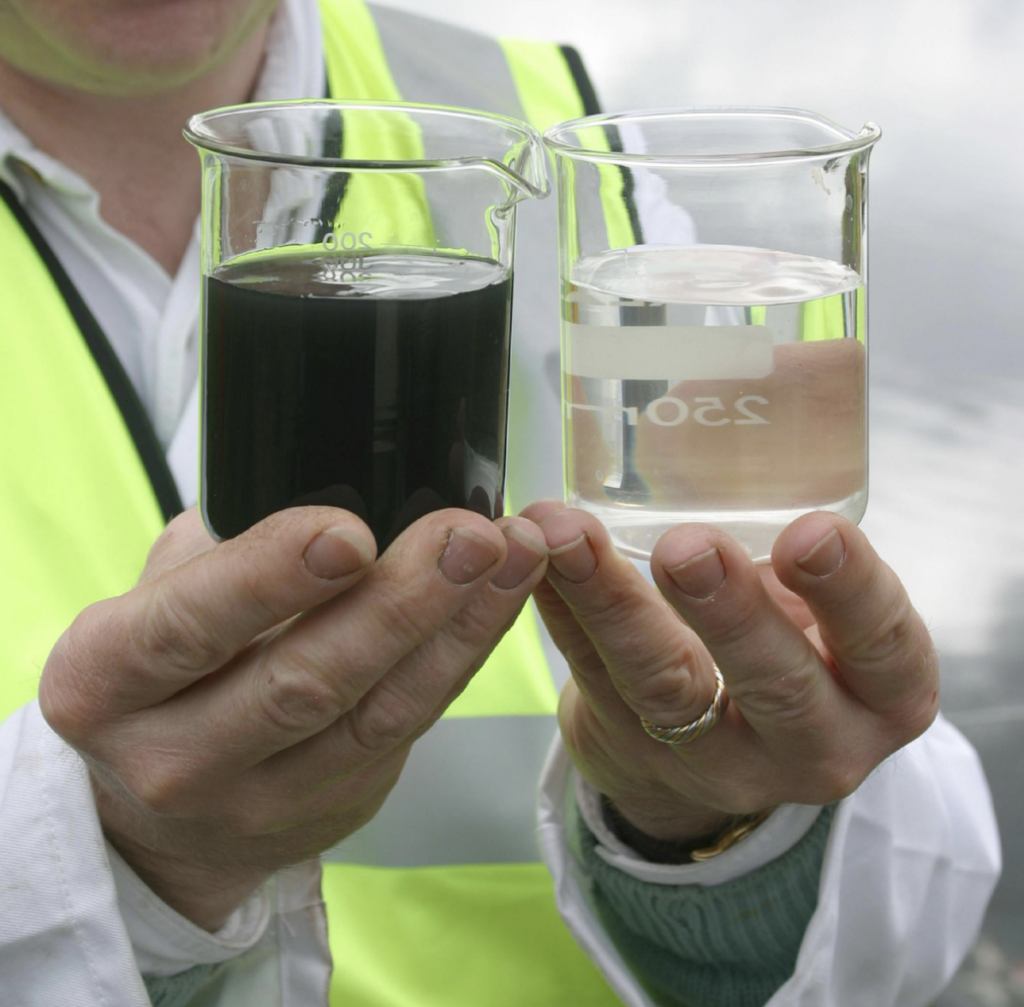
A new statewide report from New York River Watch exposes a regulatory loophole that allows toxic leachate from landfills to enter New York’s rivers and lakes.

During the report’s five-year study period, more than half a billion gallons of landfill leachate—highly contaminated “garbage water” created when rain and snowmelt move through buried waste—were sent to municipal sewage treatment plants each year from 2019 through 2023. While the report documents five years of data, this practice has been going on for decades.

The report, The Leachate Loophole in New York State, found that  approximately 167 million gallons were ultimately discharged into rivers and lakes designated as drinking-water sources—about one-third of the statewide total.

The Hudson River was among the four waterbodies receiving the largest volumes, along with the Mohawk River, Lake Ontario, and Niagara River.

The City of Kingston Is Part of the Statewide Problem

This statewide report reveals that the problem is happening right here in Kingston, where garbage water is being sent to our municipal sewage treatment plant, discharged into Rondout Creek, and carried directly into the Hudson River.

Landfill leachate can contain PFAS, heavy metals, pesticides, and other industrial pollutants. Yet instead of being treated at the landfill, it is often trucked or piped to municipal sewage treatment plants designed primarily for domestic sewage.

The scale of the problem goes far beyond any single contaminant. EPA lists 86,000 unique chemicals that are used in manufacturing or processing in the U.S., not including chemicals used in foods, drugs, and cosmetics, with more added everyday.  Many of these chemicals ultimately become part of the products we use, the waste we throw away, and potentially the leachate produced when that waste is buried. We cannot know what we are not looking for.

That makes focusing on any one contaminant an unrealistic way to address treatment of garbage water.  However, if PFAS is the “poster child” chemical of concern today, here is a sobering truth: chemical companies can create and introduce synthetic chemicals faster than we can understand them, regulate them, or protect ourselves from their consequences—because in the United States, the burden of proof falls on the public to demonstrate harm after exposure, rather than on manufacturers to prove safety before these chemicals enter our products, communities, and environment.  The number of known PFAS chemicals has grown from approximately 14,000 to more than 21,000.

Twenty-one thousand.

And that number will continue to grow because manufacturers can continue introducing new chemicals without first having to demonstrate that they are safe. Even more concerning, some PFAS treatment methods can create new PFAS compounds that we don’t even know exist. We are trying to manage a problem involving more than 21,000 known PFAS chemicals, while New York’s enforceable drinking-water standards currently address just two: PFOA and PFOS.

Two.

That is one reason we should not be sending landfill leachate containing potentially thousands of synthetic chemicals into sewage treatment plants and relying on those facilities to protect our rivers and lakes that serve as drinking-water supplies to more than 2-million people statewide. 

In the case of the Hudson River, according to the report, 73.4 million gallons of leachate entered the Hudson  between 2019 and 2023, including approximately 5 million gallons discharged near Hudson 7 drinking-water intakes.   Nearly 4 million gallons of that passed through the City of Kingston Sewage Treatment Plant, which accepts leachate from the Town of Hurley, Jockey Hill, the Town of Ulster, and the Town of New Paltz.

“The findings in this report raise significant concerns for the more than 107,000 residents who rely on the Hudson River as their primary source of drinking water,” said Rhinebeck Mayor Gary Bassett, Chair of the Hudson River Drinking Water Intermunicipal Council (Hudson 7). “Protecting drinking water requires a proactive approach that prevents pollution from reaching the river in the first place, rather than relying solely on treatment after it enters the drinking water supply.”

New York State has proposed new regulations for the onsite treatment and disposal of leachate at landfills with a  public comment deadline of September 9.  We encourage Kingston community members to take action.  Although these regulations are critically important—developing new requirements and treatment capacity will take time.

We cannot wait years to address a problem we know is happening today. Kingston should stop accepting raw, toxic garbage water at its sewage treatment plant now.

But Kingston cannot solve this problem alone. Our state representatives and the New York State Department of Environmental Conservation—whose permitting framework has allowed these loopholes and gaps to persist—must step in immediately to help Kingston and affected landfills find a safe short-term solution.


###

Read the Report and View the Interactive Map
www.leachateloophole.org

Take Action
https://leachateloophole.org/take-action/
New York has a once-in-a-generation opportunity to get this right. DEC must bring together the best scientific, engineering, and public health expertise to create a plan that truly protects our water, communities, and environment. The state must not create a system that shifts the costs and consequences of toxic pollution onto communities, and the landfills that profit from managing this waste must be held accountable. Public comment is open through September 9.

Attend Public Webinars to learn about the report and answer questions
https://leachateloophole.org/webinars/
Join us for public webinars on Thursday, August 13 at noon and 6pm, to learn about the report’s findings, the implications for New York’s drinking water and environment, and what can be done to close the leachate loophole in New York State.

Kingston Public Hearing August 26: Take Action for a Proactive Burn Ban During High Fire Danger

By Lorraine Farina and Rebecca Martin
This is a follow-up to Lorraine Farina’s guest post,  “Kingston Needs a Proactive Burn Ban During High Fire Danger” (June 22).


WHAT

The Kingston Common Council is considering a proactive, temporary outdoor burn ban in Kingston during times of high fire danger, as determined by the NYS Department of Environmental Conservation (NYSDEC). The proposed temporary burn ban would prohibit: “All outdoor burning, including bonfires, campfires, warming fires, outdoor fireplaces, chimneys and cooking fires in city limits until further notice.”

By working together during periods of elevated fire risk, Kingston can reduce preventable sources of ignition and help protect our community before an emergency occurs.

WHEN
Public Hearing: August 26 at 6:00 PM

WHERE
Kingston City Hall
420 Broadway
Kingston, NY

HOW TO PARTICIPATE
Attend the public hearing and sign up to speak.

You can also email the Kingston Common Council (please indicate your Ward/alderperson) to share your support for a proactive, temporary burn ban when DEC designates Kingston at “high fire danger” by writing to: co***********@*********ny.gov and em*****@*********ny.gov

Please blind cc HVAQ on your communications:
hv***********@***il.com

ADDITIONAL RESOURCES
WARD MAPS


Last November, Ulster County experienced the largest and most numerous wildfires in recent history. In response, surrounding communities took action and put temporary outdoor burn bans in place.

The reality is that the conditions around us are changing. The Kingston Common Council is considering a proactive approach that would allow our community to reduce risk during the most dangerous conditions: a temporary outdoor burn ban during periods of high fire danger as determined by the NYS Department of Environmental Conservation (DEC). This is an opportunity for our community to work together to reduce preventable risks and protect our neighborhoods, residents, first responders, and the environment we all share.

Worsening climate change has increased fire danger risks here in Kingston. Our city has unique characteristics that create additional concerns, similar to the conditions that existed in Altadena, California before the devastating 2025 Los Angeles wildfires. Kingston is a densely populated city with predominantly wood-framed homes, located in a valley that can trap air and wildfire smoke. New research is changing how we understand urban wildfire risk: in urban wildfires, houses become the fuel. Our urban fire departments are prepared for more frequent, smaller-scale fire events, but they are not traditionally equipped to respond to the comparatively rare but potentially devastating large-scale events that climate change is making more likely.

The proposed temporary burn ban would reduce preventable sources of ignition during the periods when fire conditions are most dangerous. It would prohibit: “All outdoor burning, including bonfires, campfires, warming fires, outdoor fireplaces, chimneys and cooking fires in city limits until further notice.”

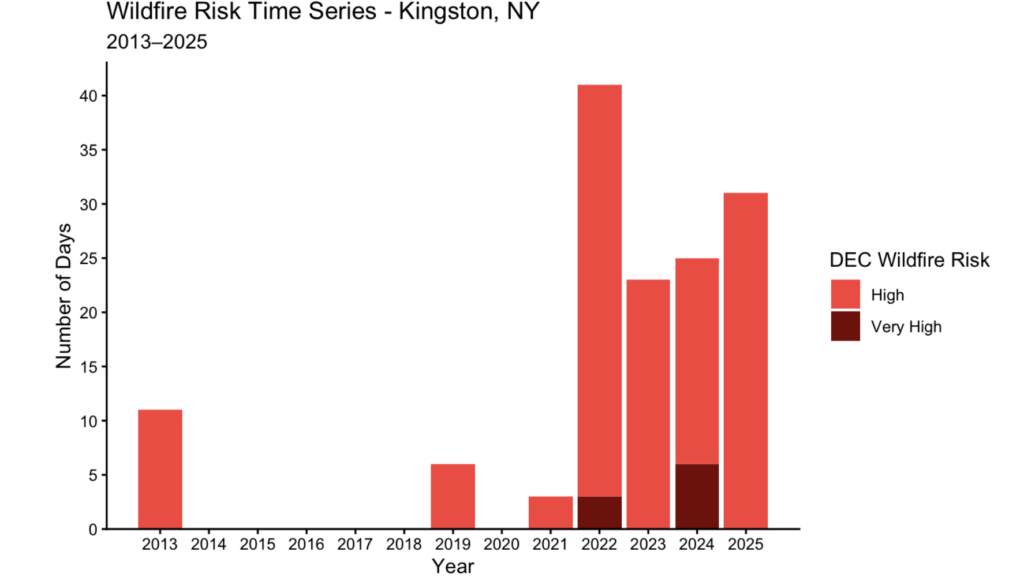
The proposal would take effect when the DEC designates Kingston as being at “high fire danger” risk — conditions where fine fuels ignite easily and fires spread rapidly, often becoming difficult to control. According to data compiled from the DEC Fire Danger Map, Kingston’s number of “high fire danger” days has increased from 0–1 days in 2013 to 38 days in 2022 and 31 days in 2025, reflecting the growing need for proactive action.

This conversation is not new. The Common Council first considered a burn ban in summer 2025, and the Administrative Code already prohibits brush fires and the creation of dense smoke within city limits year-round (§135-3 Prohibition of emission of dense smoke; exceptions). This proposal builds on those existing protections by addressing additional sources of ignition during periods of high fire danger.

The Kingston Common Council is seeking public input at a public hearing on August 26 at 6:00 PM at Kingston City Hall. Please attend, sign up to speak, and make your voice heard.

If you are planning to speak at the public hearing or submit a comment, consider sharing why you support a proactive, temporary outdoor burn ban during periods of high fire danger. You might talk about what the increasing risk of wildfire means for Kingston, why prevention matters, and why communities should take action before an emergency happens. Your comments do not need to be long. Personal experiences, local knowledge, and your reasons for supporting proactive action are valuable.