A Potent Opioid Is Being Sold at Gas Stations. What Can Ulster County Do?

Photo credit: The Lakeville Journal

By Rebecca Martin and Kathleen (kt) Tobin

According to the U.S. Food and Drug Administration (FDA), 1 “Kratom is a tropical tree that is native to Southeast Asia. Products prepared from kratom leaves are available in the U.S. online and in brick-and-mortar stores. Kratom is often used to self-treat conditions such as pain, coughing, diarrhea, anxiety and depression, opioid use disorder, and opioid withdrawal.” The Centers for Disease Control and Disease Prevention (CDC) recently reported that 5 million Americans have used kratom and that, in the past five years, there has been, “an increase of approximately 1,200% in kratom-related exposure reports, including a marked surge in 2025.” 2

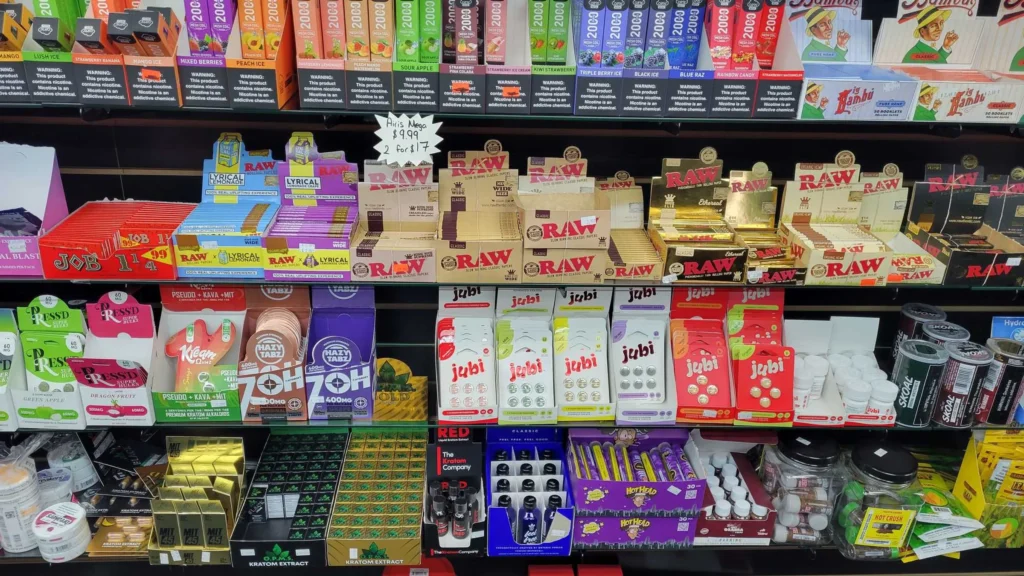
It is scientifically and medically accurate to say that kratom has opioid activity because its active compounds bind to the same brain receptors targeted by traditional opioid drugs. Despite that, kratom products are being sold openly in gas stations, convenience stores, smoke shops, and online marketplaces. Kratom is sold as tablets, gummies, drink mixes, drinks, and powders.

The FDA describes kratom products as potent opioid products that have not been proven safe or effective for any use. But to date, the concern from federal regulators has been particularly focused on kratom that is concentrated and has synthetic 7-hydroxymitragynine, or 7-OH, additives. Federal actions have been aimed at elevated concentrations of 7-OH and synthetic derivatives, not ordinary botanical kratom containing naturally occurring 7-OH that is below the federal threshold.

That distinction does not mean that natural kratom is harmless or without risks; it means that these are different products that may need to be considered separately. Even without added 7-OH, natural kratom can lead people with addictive tendencies to kratom addiction, illegal opioid use, or jumpstart a recovering addict’s opioid relapse because kratom contains active chemical compounds that interact with the exact same brain pathways as prescription opioids and heroin. 3 Pharmacologically, natural kratom functions as a partial opioid agonist, despite being marketed as a “natural” or “safe” herbal supplement. 4

This raises the question of whether the current regulatory framework is keeping pace with these products. Products with opioid-active compounds can be widely available in ordinary retail settings while failing under a different regulatory framework than conventional opioid drugs. For consumers and local governments, that can look like a regulatory gap: the federal government is now moving to address the most concentrated and synthetic forms, while other kratom products remain readily available. The question is whether the current framework is adequate for products whose potency and effects can vary, and whether manufacturers should have to demonstrate safety before these products reach consumers. 

The stakes are high.  The growing availability of products with potent opioid effects in ordinary retail settings—including gas stations, smoke shops, and convenience stores—is particularly concerning, putting these products within easy reach of young people and people struggling with addiction. 

The Federal Government Is Moving

On July 1, 2026, the Drug Enforcement Administration (DEA) announced that it was beginning the process of temporarily placing 7-OH above a specified threshold and three synthetic 7-OH-related substances into Schedule I under the federal Controlled Substances Act. In August, the DEA issued a temporary scheduling order for the three synthetic derivatives. The separate process for 7-OH above the proposed threshold has involved additional federal review and public comment over what concentration should trigger scheduling. 5

The federal landscape is therefore moving, but it is not completely settled.

That uncertainty is one reason why some local governments are having difficulty deciding exactly what they can and should regulate, how a local law would interact with federal scheduling, and who would enforce it. 

New York State Has Already Acted

New York has already taken some steps to address kratom. In December 2025, Governor Kathy Hochul signed legislation prohibiting the sale of Kratom products to anyone under 21 and requiring every kratom product manufactured, distributed or sold in New York to carry a consumer warning label and a full list of ingredients. The warning must state that the product may be addictive and may interact with certain medications, drugs, and controlled substances. 6

The State Legislature has now gone further. Assembly Bill A.9156B, 7 sponsored by Assemblymember Phil Steck, and its Senate counterpart, S.8925A, 8 sponsored by Senator Christopher Ryan, would prohibit the sale of products containing 7-OH above specified thresholds: more than 2 percent of total alkaloids or more than one milligram per serving. The legislation also establishes civil penalties for businesses that knowingly sell, offer for sale or deliver prohibited 7-OH products.

That gives New York counties something concrete to prepare for and act on right now: the Governor is expected to sign these bills that have already passed both houses before the end of the year.

This past June, both Sarahana Shrestha and Michelle Hinchey, Ulster County’s state legislators, voted in support of the legislation that is awaiting Governor Hochul’s signature. 

The Precautionary Principle and the Federal Role

The precautionary principle is a decision-making framework that involves risk assessment to determine whether or not “an activity raises threats of harm to human health or the environment, (and that) precautionary measures should be taken even if some cause-and-effect relationships are not fully established scientifically.” 9

Kratom regulation is an example of why adopting the precautionary principle is critical. When products can pose serious health risks, the burden should not fall on the public to prove they are dangerous after they are already on the market and readily available. Companies that manufacture and market kratom products should have had to demonstrate their safety before those products reach consumers—not after harm has occurred. 

There are no FDA-approved over-the-counter drugs or dietary supplements containing kratom that are legally marketed in the U.S. In fact, the FDA warns consumers not to use kratom because of “the risk of serious adverse events, including liver toxicity, seizures, and substance use disorder (SUD).” 10  Yet kratom products are still widely sold by companies that market them outside the FDA-approved drug or dietary supplement framework. In other words, the absence of FDA approval does not prevent these products from reaching consumers. 

That is an important question for our local members of Congress, Pat Ryan and Josh Riley, to raise at the federal level. The precautionary principle should also be part of any local memorializing resolution adopted by a county or municipality addressing kratom: companies should bear the burden of demonstrating safety before these products reach consumers, rather than leaving consumers, families, communities and taxpayers to bear the consequences after the fact.

What Other Counties Are Doing

In the Mid-Hudson region, there has been a mix of responses to kratom regulation. 

Dutchess County has acted, but not without a difference of opinion over how far to go. On August 10, 2026, the Dutchess County Legislature adopted a local law prohibiting the sale and distribution of concentrated and synthetic 7-OH products while allowing adults to continue to purchase natural leaf kratom. 

County Executive Sue Serino initially proposed a much broader approach – a ban on the sale of all kratom products. 11 The County Legislature ultimately adopted a narrower law, Local Law No. 6 of 2026: Prohibiting the Sale and Distribution of Concentrated and Synthetic 7-Hydroxymitragynine (7-OH) Kratom Products in Dutchess County. 12

The difference between the County Executive’s original proposal and the Legislature’s final law shows that a county does not necessarily have to resolve every question about kratom before taking action on the products at the center of the current federal concern. The scope of a proposed law can be debated, narrowed, and worked through the legislative process.

Dutchess County held its required public hearing, heard from constituents and advocates, consulted with its Department of Health and ultimately adopted the narrower legislation. Serino acknowledged that the legislation did not go as far as the complete ban she had proposed, while indicating that she would continue to explore additional action.

Sullivan County is developing its own policy. County documents show that Sullivan County has drafted a county mandate proposal addressing kratom policy as part of its broader work on substance-use treatment and prevention. It has not enacted a county kratom ban. 13

Orange County provides another example of the different routes to regulation local counties are taking with kratom. In 2025, Orange County moved to prohibit the sale of kratom to people under 21 before New York enacted its statewide age restriction. But shortly after the county acted, the state law took effect. County officials subsequently explained that the local law did not proceed through the remaining process because the state legislation had superseded the need for it. By spring 2026, the County Department of Health was waiting for state guidance on its role in enforcing the new state requirements and was developing public information about kratom and the distinction between natural and synthetic products. 14

Outside of our region, there are several examples of New York State counties banning all forms of kratom. Albany, Nassau, Oneida, Rensselaer, and Washington counties have all bypassed the state-level regulations to enact complete, local retail bans on all forms of kratom. Saratoga County will have its final public hearing in October and is currently moving through the legislative process to finalize its own total ban. 15 16 17 18 19 20

Despite these examples, in our region, counties are struggling to move this issue forward. We understand that state and federal law are changing quickly and that local laws can be overtaken by state legislation. Questions about preemption, enforcement authority and the appropriate regulatory threshold remain. And county health departments may not have authority or capacity to enforce a law regulating a substance that falls outside their existing jurisdiction. But counties that have enacted full bans are working through those same challenges, and their experiences can help inform a path forward for Ulster County. Given the life-and-death nature and speed with which this kratom crisis is escalating, challenges are a reason to work through the details, not a reason to stop looking for solutions. If other counties are finding ways to move forward, Ulster County should learn from what they are doing. 

There are also certainly short, mid, and long-term actions that can be taken to move toward the goal of restricting access to kratom, even as the state and federal landscape continues to evolve. Those next steps need to be identified, understood, and made clear to the public. The community has the most at stake here, and people need to know what is being considered, what can be done now, what will take more time, and where their voices and actions can make a difference.

A Regional Problem Needs Regional Solutions

This is bigger than a question of where these products can be sold. If people are becoming dependent on them, then access to treatment has to be part of the conversation too.

Ulster County is part of a regional system. The response should consider not only what happens at the point of sale, but also what happens when someone develops a substance-use problem and needs help.

People who develop dependence on kratom or concentrated 7-OH products may need substance-use treatment, including detoxification and recovery services. Treatment providers in the region are increasingly encountering kratom-related dependence, while access to detox beds remains a challenge. Ulster County has not had any certified inpatient hospital detox beds since 2021 when the last remaining beds in Ulster were moved to Dutchess County. 21  Community members who need detox or recovery services may have to leave their own county to get them, including seeking treatment in Dutchess County.

At the same time, critics of county-by-county restrictions have raised concerns about spillover effects – that is, that people could simply cross county lines to obtain products that are restricted in their home county. Whether that is happening in practice is a question worth examining, but the underlying policy gap is that a product that cannot be sold in one county may remain readily available a short drive away.

That means the availability of these products, access to treatment, and policies in neighboring counties are all part of the same regional picture. The costs should not fall entirely on families, communities, treatment systems, and taxpayers. The companies making, marketing, and profiting from these products should bear responsibility for the costs associated with the harm they create.

We urge our Mid-Hudson county leaders to bring the issue to the New York State Association of Counties (NYSAC) 22 to propose and create a coordinated regional and statewide approach. If the goal is to restrict access to kratom, counties can begin talking now about how to address gaps between neighboring counties, enforcement challenges, treatment capacity, and what can be done if state or federal action stalls or does not address the issue fully.

Where Ulster County Stands

Ulster County was poised to bring Proposed Local Law No. 16 of 2026 23  to a public hearing. The proposed law would prohibit the sale and distribution of concentrated and synthetic 7-OH kratom products in the County. Instead, on September 3, the Health, Human Services and Human Rights Committee voted 5–2 to postpone Resolution No. 480, which would have set the public hearing. The legislation remains before the County, but the public hearing, and the opportunity for community members to weigh in, has been put on hold.

Legislator Bill Murray, the sponsor of Proposed Local Law No. 16, 24 has been clear about the need for action. In a recent press release, 25 he called for Ulster County to “immediately ban the sale and distribution of high concentrations and synthetic kratom” while state and federal action moves forward, citing concerns about its addictive nature, misleading marketing and misinformation. By putting the legislation forward and publicly calling for action, Murray has helped bring this issue to the County’s attention. The next step is to bring that legislation to the public and do the work needed to make it effective. 

The County Executive’s Office raised concerns about the rapidly changing state and federal legal landscape. The County Department of Health also explained that it does not currently have enforcement authority over drugs and would not have the capacity to police possession or online sales. 

But postponing the public hearing does not resolve those questions. It delays the opportunity to hear from the public and work through them in an open process. Legislator Craig Lopez and others were correct that a public hearing is tied to a specific proposed local law. But that does not mean the County has to wait until every detail is settled before engaging the public. The proposed law can be developed, revised and improved through the legislative process, with additional public hearings as it evolves. 

For an issue this new to Ulster County, several rounds of discussion and public input are reasonable. The cost is time and work, but that work has value. A public process can educate the community, build understanding and buy-in, surface practical solutions, and identify what the County needs to make the law work. It may even lead the public and their legislative stewards to determine that additional resources or funding are needed for enforcement, education or other aspects of implementation. That is exactly what a public process is supposed to do: bring the community and its elected representatives together to work through new and complicated issues and develop the strongest response possible. 

We support a full kratom ban, as has already been enacted in Albany, Nassau, Oneida, Rensselaer, and Washington counties. Those counties have paved the way and provide a road map for Ulster to learn from and follow. 

Additionally, Ulster County, at this moment in time, does not have to choose between working on its local law and taking action now. There are both short-term and longer-term actions the County can take while the state and federal landscape continues to evolve.

In the short-term, the County Legislature can adopt a memorializing resolution urging Governor Hochul to sign S.8925A/A.9156B, the 7-OH legislation that has passed both houses of the State Legislature. The resolution could also call on our house representatives to raise two important issues at the federal level: the precautionary principle and producer responsibility. Companies making, marketing and profiting from products with potent opioid effects should bear responsibility for the harms and costs associated with those products, rather than leaving them to consumers, families, communities, treatment systems and taxpayers. 

Longer-term, Ulster County can continue developing its own local response. Proposed Local Law No. 16 raises important questions about who has enforcement authority, how online sales would be addressed, and how a county law would interact with state and federal requirements. Any questions can and should be worked through publicly as the legislation evolves. The half a dozen counties that have enacted full bans should be used as models for working towards taking the same actions in Ulster County. 


Take Action

  • Ask that the Ulster County Legislature immediately pass a memorializing resolution urging Governor Hochul to sign S.8925A/A.9156B and to include language about the precautionary principle, producer responsibility, and the need for adequate treatment capacity in the County’s response.
  • Urge the Ulster County Legislature to bring Local Law No. 16 of 2026 back for a public hearing and continue improving it through the public process, which may include additional public hearings.
  • Support your Ulster County legislators to move forward with a collaborative public awareness campaign involving the County Legislature, County Executive, Department of Health and Sheriff’s Office addressing kratom, and all other addictive substances as a public health and public safety issue.
  • Urge Mid-Hudson county leaders to bring kratom to New York State Association of Counties (NYSAC) and work toward a coordinated regional and statewide approach, including addressing gaps between neighboring counties, enforcement challenges, treatment capacity and what to do if state or federal action falls short.
  • Show up, speak out and stay engaged as the County works through its next steps.

Footnotes

  1. FDA and Kratom
  2. Increases in Kratom-Related Reports to Poison Centers — National Poison Data System, United States, 2015–2025 
  3. In full disclosure, in March 2022, after several months off of opioids, co-author Tobin’s son Padraig Flusser died of “acute intoxication due to the combined effects of Fentanyl, Flourofentanyl, Alprazolam, Clonzipan, and Mitragynine.” Mitragynine is the primary active chemical compound (alkaloid) found in kratom. 7-OH kratom did not come on the market until 2023. Natural kratom leaf is rarely a singular cause of death, but rather a compounding factor that worsens respiratory failure when combined with other drugs. Kratom usage interacts with the same brain pathways as other opioids and heroin and can lead to relapse. The level of Mitragynine (260ng/ml)  in Padraig’s autopsy toxicology report indicates heavy or frequent kratom use.
  4. Bin Abdullah MFIL. Kratom Dependence and Treatment Options: A Comprehensive Review of Literature. Curr Drug Targets. 2020;21(15):1566-1579. doi: 10.2174/1389450121666200719011653. PMID: 32682371.
  5. DEA to Temporarily Schedule 7-OH and Related Substances to Protect Public Safety
  6. Governor Hochul Signs Two Pieces of Landmark Legislation to Protect New Yorkers Against the Harmful Effects of Commercial Herbal Product Known as Kratom
  7. Prohibits the sale of products that contain 7-hydroxymitragynine at a level that exceeds 2% of total alkaloids or one milligram per serving; establishes fines for the sale of such products
  8. Senate Bill S8925A: Prohibits the sale of 7-hydroxymitragynine products
  9. Hayes AW. The precautionary principle. Arh Hig Rada Toksikol. 2005 Jun;56(2):161-6. PMID: 15968832.
  10. FDA and Kratom
  11.  County Executive Sue Serino Letter to Legislature
  12. Local Law No. 6 of 2026: Prohibiting the Sale and Distribution of Concentrated and Synthetic 7-Hydroxymitragynine (7-OH) Kratom Products in Dutchess County
  13. Sullivan County Drug Task Force Update
  14. Orange County Introductory Local Law No.8 of 2025 
  15. Rensselaer County Legislature votes to ban sale of kratom
  16. Nassau Legislative Democrats Announce Kratom Ban Legislation as Health Concerns Mount
  17. Spectrum News: Albany County’s kratom ban goes into effect
  18. Picente Signs Local Law Prohibiting Sale of Kratom
  19. Another Capital Region community bans kratom; doctor calls for statewide ban
  20. Saratoga County the latest in New York to weigh a ban on kratom
  21. First mental health urgent care opens in Ulster County
  22. New York State County Executives’ Association
  23. September 3, 2026 Health, Human Services and Human Rights Committee (starts at 25:52)
  24. Proposed Local Law Number 16 Of 2026
  25. Ulster County Officials Warn About the Dangers of Kratom Use, Including Concentrates and Synthetic Variants, And Take Action To Ban The Sale In Ulster County
Kingston Public Hearing August 26: Take Action for a Proactive Burn Ban During High Fire Danger

By Lorraine Farina and Rebecca Martin
This is a follow-up to Lorraine Farina’s guest post,  “Kingston Needs a Proactive Burn Ban During High Fire Danger” (June 22).


WHAT

The Kingston Common Council is considering a proactive, temporary outdoor burn ban in Kingston during times of high fire danger, as determined by the NYS Department of Environmental Conservation (NYSDEC). The proposed temporary burn ban would prohibit: “All outdoor burning, including bonfires, campfires, warming fires, outdoor fireplaces, chimneys and cooking fires in city limits until further notice.”

By working together during periods of elevated fire risk, Kingston can reduce preventable sources of ignition and help protect our community before an emergency occurs.

WHEN
Public Hearing: August 26 at 6:00 PM

WHERE
Kingston City Hall
420 Broadway
Kingston, NY

HOW TO PARTICIPATE
Attend the public hearing and sign up to speak.

You can also email the Kingston Common Council (please indicate your Ward/alderperson) to share your support for a proactive, temporary burn ban when DEC designates Kingston at “high fire danger” by writing to: co***********@*********ny.gov and em*****@*********ny.gov

Please blind cc HVAQ on your communications:
hv***********@***il.com

ADDITIONAL RESOURCES
WARD MAPS


Last November, Ulster County experienced the largest and most numerous wildfires in recent history. In response, surrounding communities took action and put temporary outdoor burn bans in place.

The reality is that the conditions around us are changing. The Kingston Common Council is considering a proactive approach that would allow our community to reduce risk during the most dangerous conditions: a temporary outdoor burn ban during periods of high fire danger as determined by the NYS Department of Environmental Conservation (DEC). This is an opportunity for our community to work together to reduce preventable risks and protect our neighborhoods, residents, first responders, and the environment we all share.

Worsening climate change has increased fire danger risks here in Kingston. Our city has unique characteristics that create additional concerns, similar to the conditions that existed in Altadena, California before the devastating 2025 Los Angeles wildfires. Kingston is a densely populated city with predominantly wood-framed homes, located in a valley that can trap air and wildfire smoke. New research is changing how we understand urban wildfire risk: in urban wildfires, houses become the fuel. Our urban fire departments are prepared for more frequent, smaller-scale fire events, but they are not traditionally equipped to respond to the comparatively rare but potentially devastating large-scale events that climate change is making more likely.

The proposed temporary burn ban would reduce preventable sources of ignition during the periods when fire conditions are most dangerous. It would prohibit: “All outdoor burning, including bonfires, campfires, warming fires, outdoor fireplaces, chimneys and cooking fires in city limits until further notice.”

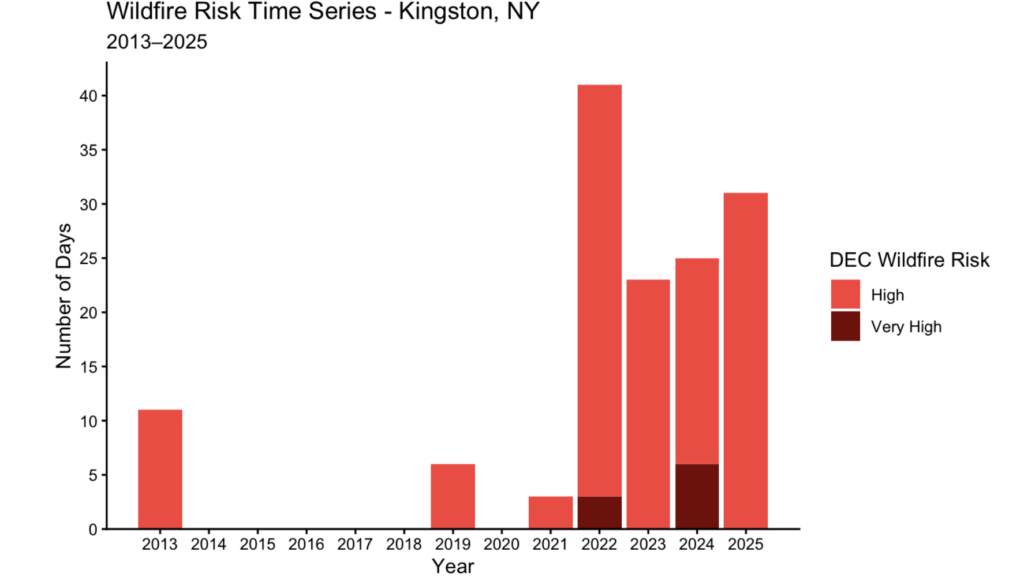
The proposal would take effect when the DEC designates Kingston as being at “high fire danger” risk — conditions where fine fuels ignite easily and fires spread rapidly, often becoming difficult to control. According to data compiled from the DEC Fire Danger Map, Kingston’s number of “high fire danger” days has increased from 0–1 days in 2013 to 38 days in 2022 and 31 days in 2025, reflecting the growing need for proactive action.

This conversation is not new. The Common Council first considered a burn ban in summer 2025, and the Administrative Code already prohibits brush fires and the creation of dense smoke within city limits year-round (§135-3 Prohibition of emission of dense smoke; exceptions). This proposal builds on those existing protections by addressing additional sources of ignition during periods of high fire danger.

The Kingston Common Council is seeking public input at a public hearing on August 26 at 6:00 PM at Kingston City Hall. Please attend, sign up to speak, and make your voice heard.

If you are planning to speak at the public hearing or submit a comment, consider sharing why you support a proactive, temporary outdoor burn ban during periods of high fire danger. You might talk about what the increasing risk of wildfire means for Kingston, why prevention matters, and why communities should take action before an emergency happens. Your comments do not need to be long. Personal experiences, local knowledge, and your reasons for supporting proactive action are valuable.

Kingston’s Noise Ordinance Exists But Is It Being Enforced?

Click on image to hear construction noise after 6:00pm.

By Rebecca Martin

Imagine being jolted awake at 7:00 a.m. on a weekday by the sound of heavy machinery and the persistent, high-pitch truck backup alarms—not once, but week after week for months. This is the reality for at least one Midtown Kingston resident, who is dealing with the ongoing noise from new construction in their neighborhood. They report that construction often begins before the city’s legally allowed start time, disrupting early mornings and weekends. The noise ordinance specifies the maximum decibel levels allowed, yet construction regularly exceeds those limits on a daily, weekly, and monthly basis. Despite filing complaints with the Kingston Planning Department, contacting their Common Council representative, and calling the Kingston Police Department multiple times, the noise persists.

Under Kingston’s municipal code, construction is allowed to take place Monday through Friday, from 8:00 a.m. to 6:00 p.m., excluding holidays. If a developer or contractor wishes to work outside of those hours, they must apply for a special permit and demonstrate an “unreasonable hardship” that justifies the exception. This safeguard is meant to protect residents from excessive noise and disruption during times traditionally reserved for rest.

In this case, it appears that these special permits are being issued without requiring proof of hardship, and that 7:00 a.m. start times are regularly approved. This is happening despite a previous decision by the city’s Laws and Rules Committee, which, as we understand it, reviewed and declined a proposal to change the official start time to 7:00 a.m., maintaining the 8:00 a.m. start as a standard that best serves the interests of Kingston’s residents. (Minutes from the January 2018 meeting are not readily available on the City of Kingston’s website).

These claims point to a significant gap between what the ordinance requires and how it is being implemented. The result, the resident says, has been ongoing exposure to high-decibel construction noise for 55 or more hours per week, with limited opportunities for relief. They also report calling the Kingston Police Department on multiple occasions when work began before 8:00 a.m., and that in many instances, police intervened and stopped the work, suggesting that violations had, in fact, occurred.

This situation raises broader concerns about the city’s enforcement mechanisms. Is it appropriate for the police to be solely responsible for responding to construction noise violations? Officers already carry heavy workloads, and their presence may not be the most effective or proportional response to ongoing quality-of-life issues like this. There may be a need for additional oversight, accountability, or alternative avenues of enforcement within the Building Department or other city structures.

Importantly, the Planning Department and Planning Board must ensure that construction plans are reasonable and feasible within the allowed hours and decibel levels so that “emergencies” like excessive rain in the spring do not constitute a “hardship.” Permitting exceptions without scrutiny not only undermines the ordinance, it also places the burden on residents to prove that something is wrong. 

It’s important to recognize that managing noise on construction sites—and adhering to the city’s noise ordinance hours—helps protect construction companies from fines, lawsuits, and reputational damage. The cost of doing business should include investments in site preparation and noise-reducing measures. While many construction companies worry about costs, staying compliant with noise regulations can prevent bigger problems down the road.

There is growing research on the psychological effects of chronic noise exposure, showing a strong correlation with increased stress, sleep disruption, anxiety, and even increased rates of violent crime. This isn’t just a matter of inconvenience—it’s a public health issue. 

This experience mirrors other complaints we’ve heard in recent years and highlights the importance of transparency and accountability in how construction permits are managed. The core issue remains: residents have a right to quiet enjoyment of their homes, and if city departments are issuing permits that conflict with the law—or failing to require the documentation the law demands—residents deserve to know.

We’ve seen firsthand that individual residents can drive meaningful change when it comes to noise issues. In 2021, Kingston resident Lisa Darling confronted a different kind of disruption: the relentless sound of high-pitched backup alarms coming from a nearby NYS Department of Transportation (DOT) facility operating through the night. When she first raised the issue, she was told nothing could be done. But through persistence, collaboration with neighbors, and support from local and state officials, Darling succeeded in persuading the DOT to pilot—and ultimately adopt—quieter, OSHA-approved white noise alarms. Her advocacy didn’t just bring relief to her neighborhood; it led to a policy change affecting 60 DOT facilities statewide. Her story is a powerful reminder of what’s possible when residents speak up, stay engaged, and push for solutions through the right channels.

The point isn’t to stop construction or block development. It’s to ensure that progress doesn’t come at the expense of the people who already live here. Ordinances like Kingston’s construction noise rules exist to protect public health and community livability. If they are being ignored or circumvented, then residents have every right to ask why and to demand better.

If you are experiencing similar issues, for now, you can report noise violations by calling the Kingston Police Department’s non-emergency line at (845) 331-1671. You can also contact the City Planner’s office at (845) 334-3957 or email pl******@*********ny.gov. Finally, consider reaching out to your Common Council representative to share your concerns and request that the issue be addressed at the policy level.

As always, we encourage residents to engage with their local government, ask questions, and push for transparency. Your voice matters—and your peace of mind does, too.

VIDEO: UCRRA Host Informational Meeting on Single-Stream Recycling Rate Hikes and Discontinuation of Program.

CITIZEN REQUEST

Plan to attend the upcoming public hearing on June 14th at the Ulster County Legisaltive Chambers at 5pm to speak to UCRRA’s proposed plan to discontinue single-stream recycling (in 2019) and to raise rates in the meantime (effective July 1st, 2018) as well as to click on the following ************@**********ny.us, Ly*********@**********ny.us, db********@***oo.com, Br***********@**********ny.us, tr***********@*******nk.net, ma*****@*ol.com, tr**@***ra.org, ma***@*********ny.gov?subject=CITIZEN%20REQUEST%3A%20%20UCRRA%2C%20Single%20Stream%20Recycling%20and%20the%20UCL.&body=As%20a%20Citizen%20of%20Ulster%20County%2C%20I%20would%20like%20to%20make%20the%20following%20request%20to%20members%20of%20the%20Ulster%20County%20Legislature%20leading%20up%20to%20UCRRA’s%20scheduled%20public%20hearing%20on%20June%2014th.%20%0A%0A1.%20That%20UCRRA%20research%20regional%20collection%20sites%20single-stream%C2%A0recycling%20and%20provide%20a%20report%20to%20the%20public%20on%20its%20findings.%0A%0A2.%20That%20the%20Ulster%20County%20Legislature%20reconvene%20its%20Recycling%20Oversight%20Committee%20in%202018.%0A%0A3.%20That%20the%20Ulster%20County%20Legislature%20and%20UCRRA%20finish%20what%20is%20currently%20a%20%22draft%22%20Solid%20Waste%20Management%20Plan%20from%202011%20to%20take%20a%20countywide%2C%20holistic%20approach.%20%C2%A0(The%20last%20’final’%20solid%20waste%20management%20plan%20was%20completed%20in%201991.)%0A%0A4.%20That%20the%20Agency%20postpone%20its%20vote%20on%20the%20proposed%20fee%20increases%20and%20not%20consider%20a%20fee%20increase%20to%20go%20into%20effect%20until%20January%201%2C%202019%2C%20to%20allow%20participating%20municipalities%20time%20to%20budget%20appropriately%20or%20consider%20alternative%20options.%0A%0A5.%20That%20the%20Ulster%20County%20Legislature%20Energy%20and%20Environment%20Committee%20take%20up%20the%C2%A0issue%20of%20flow%20control%20over%C2%A0recycling%20by%20asking%20for%20the%20authority%20from%20the%20state.%0A%C2%A0%0AThank%20you.%0A%0AName%0ACity%2FTown%2FVillage” target=”_blank” rel=”noopener” data-cke-saved-href=”mailto:ma********@***oo.com” data-original-string=”MKTTlH+TD13jq/PuCC81qw==c31idOOiAGRi5lzPBZGtuk8253mJ5CgFA6r5D0BFtzBme4=” title=”This contact has been encoded by Anti-Spam by CleanTalk. Click to decode. To finish the decoding make sure that JavaScript is enabled in your browser., Jo************@**********ny.us, Ly*********@**********ny.us, db********@***oo.com, Br***********@**********ny.us, tr***********@*******nk.net, ma*****@*ol.com, tr**@***ra.org, ma***@*********ny.gov?subject=CITIZEN%20REQUEST%3A%20%20UCRRA%2C%20Single%20Stream%20Recycling%20and%20the%20UCL.&body=As%20a%20Citizen%20of%20Ulster%20County%2C%20I%20would%20like%20to%20make%20the%20following%20request%20to%20members%20of%20the%20Ulster%20County%20Legislature%20leading%20up%20to%20UCRRA’s%20scheduled%20public%20hearing%20on%20June%2014th.%20%0A%0A1.%20That%20UCRRA%20research%20regional%20collection%20sites%20single-stream%C2%A0recycling%20and%20provide%20a%20report%20to%20the%20public%20on%20its%20findings.%0A%0A2.%20That%20the%20Ulster%20County%20Legislature%20reconvene%20its%20Recycling%20Oversight%20Committee%20in%202018.%0A%0A3.%20That%20the%20Ulster%20County%20Legislature%20and%20UCRRA%20finish%20what%20is%20currently%20a%20%22draft%22%20Solid%20Waste%20Management%20Plan%20from%202011%20to%20take%20a%20countywide%2C%20holistic%20approach.%20%C2%A0(The%20last%20’final’%20solid%20waste%20management%20plan%20was%20completed%20in%201991.)%0A%0A4.%20That%20the%20Agency%20postpone%20its%20vote%20on%20the%20proposed%20fee%20increases%20and%20not%20consider%20a%20fee%20increase%20to%20go%20into%20effect%20until%20January%201%2C%202019%2C%20to%20allow%20participating%20municipalities%20time%20to%20budget%20appropriately%20or%20consider%20alternative%20options.%0A%0A5.%20That%20the%20Ulster%20County%20Legislature%20Energy%20and%20Environment%20Committee%20take%20up%20the%C2%A0issue%20of%20flow%20control%20over%C2%A0recycling%20by%20asking%20for%20the%20authority%20from%20the%20state.%0A%C2%A0%0AThank%20you.%0A%0AName%0ACity%2FTown%2FVillage”>EMAIL hyperlink to send the following request to members of the Ulster County Legislature, UCRRA Executive Director and City of Kingston Mayor.

    1. Request that UCRRA research regional collection sites single-stream recycling and provide a report to the public on its findings“It would be helpful to put some real numbers together…what Mayor Noble asked you was, you stated what we’re making but it would be valuable to know the nearest single stream Material Recovery Facility (MRF) that are investing in the equipment and labor, to do a cost comparative” – Ulster County Legislator Manna Jo Greene
    2. Request that the Ulster County Legislature reconvene the Recycling Oversight Committee in 2018.“I want to make a recommendation that we consider reconvening an existing body which is called the Recycling Oversight Committee that the Legislature created to see which new materials we could add as mandatory recyclables. We’ve met a few times over the past decade…we’re now at a point where the markets are difficult, there is an international component. Because the Recycling Committee was so inclusive with citizens, environmental groups and the City of Kingston,  we should seriously consider doing a consensus building process for the long run.  I want to find a mechanism to work together.”
       – Ulster County Legislator Manna Jo Greene
    3. Request that the Ulster County Legislature and UCRRA finish what is currently a “draft” Solid Waste Management Plan from 2011 to take a countywide, holistic approach.  (The last ‘final’ solid waste management plan was completed in 1991.)“The point of the agency is to manage the county’s waste stream. With the Ulster County recycling law it tells the agency that it’s your responsible to manage recycling in the county….a prerogative of the agency, and the agency has invested alot of resources over the years. Recycling has changed, but the agency has not (to meet those changes). This is a countywide issue. How many county residents out of 180,000 people do single stream recycling?  My guess is a large majority of the county are served by single-stream. Transfer stations are a smaller number than they were 30 years ago. The question is, how do we look at solid waste going forward? Do we have a county plan?”  
      – City of Kingston Mayor Steve Noble
    4. The Agency postpone its vote on the proposed fee increases and not consider a fee increase to go into effect until January 1, 2019, to allow participating municipalities time to budget appropriately or consider alternative options.“It took (the City of Kingston) 4 years to implement single-stream recycling in the city. We just finished this year, and there are still business districts that don’t have their totes. To get them back to this new way, with three bins that doesn’t include composting which would make it four bins. How do we do that by January, 2019?”
      – City of Kingston Mayor Steve Noble
    5. Request that the Ulster County Legislature Energy and Environment Committee take up the issue of flow control over recycling by asking for the authority from the state.“It’s a state law in your enabling legislation. If we can get the state to amend it, the county should have a plan for recycling so that we can be in charge of our own destiny.”
      – City of Kingston Mayor Steve Noble.


By Rebecca Martin

On Thursday, May 23rd, the Ulster County Recovery Resource Agency (UCRRA) held an informational meeting on the current climate of single-stream recycling,  it’s plan to raise rates as of July 1, 2019, and to discontinusingle-stream recycling as of January 1st, 2019.

What is UCRRA?

According to their website, “In 1986, the Ulster County Legislature obtained authorization from the State Legislature for the creation of the Ulster County Resource Recovery Agency (the “Agency”), a public benefit corporation which was formed for the purpose of developing, financing, and implementing a comprehensive Countywide solid waste management program. In the mid-1980’s, after new initiatives to close non-complying exiting landfills were undertaken by the NYSDEC and strict requirements for the siting, construction, and operation of new disposal facilities were enacted, many communities found it beyond their financial and managerial capability to continue to dispose of waste in traditional ways. Consequently, many of the local municipalities in Ulster County requested that the Ulster County government assume the responsibility for solid waste management, and the Agency was created by the New York State Legislature pursuant to Chapter 936 of the Public Authorities Law approved December of 1986. The Agency’s organizational structure consists of a five-member Board of Directors; an Executive Director; Agency Counsel; and thirty administrative and operations personnel.”

UCRRA Proposes to Raise Rates and Discontinue Single Stream Recycling.

According to a chart presented during the meeting, UCRRA became aware of a changing Chinese market for single stream recycled materials in October of 2017.  As I understand it, although potential rate hikes had been discussed at around this time between UCRRA Executive Director Timothy Rose and City of Kingston Mayor Steve Noble, the decision for the county authority to discontinue single-stream recycling was learned from in a newspaper article released only one month ago.


VIDEO #1: Click on Image to View

1:01 – 16:19:   David Gordan, UCRRA Vice Chair
Presentation

Currently, the City of Kingston pays $20 per ton for comingled recycling materials. UCRRA claims that new categories have been formed, where rates will be $56 per ton for a ‘clean load’ (minimum contamination) or $107 per ton for a ‘dirty load’ (maximum contamination).

16:20 – 20:15:   City of Kingston Mayor Steve Noble
“We don’t know what companies are selling materials for after the single-stream plant processes it?” 

“We are presuming that the market is functioning honestly.” – David Gordan

“The Chinese market has decided to not accept our contaminated materials any longer.”   – Tim Rose, Executive Director, UCRRA

“When we talk numbers, I was wondering if your $400 a ton included the cost to the agency to get that amount…I don’t think that’s included. ” – CoK Mayor Steve Noble

22:51 – 25:51: UC Legislator David Donaldson, City of Kingston
“The plastic doesn’t get contaminated in single-stream…you still will receive money for plastic and cans.”

“Material Recovery Facility’s (MRF) are extremely expensive to operate. You are looking at labor costs, electrical costs.”    Description of an MRF is here: 24:10 – 25:05. 

“Plastic bags are a big issue.” (25:08 – 25:30)

25:52 – 28:47:  UC Legislator Manna Jo Green
“It would be helpful to put some real numbers together…what Mayor Noble asked you was, you stated what we’re making but it would be valuable to know the nearest single stream MRF that are investing in the equipment and labor, to do a cost comparative…I want to make a recommendation that we consider reconvening an existing body which is called the Recycling Oversight Committee that the Legislature created to see which new materials we could add as mandatory recyclables. We’ve met a few times over the past decade…we’re now at a point where the markets are difficult, there is an international component. Because the Recycling Committee was so inclusive with citizens, environmental groups and the City of Kingston,  we should seriously consider doing a consensus building process for the long run.  I want to find a mechanism to work together.”

38:12 – 38:44:  Charlie Landi, UCRRA Treasurer
“When the RRA first came to being, its losses were subsidized by the county through a net service fee. If the county wants to go back to that, we can work with that.”

46:25 – 48:46: Citizen
“Over the past 6 months when you’ve seen the direction we were going, dramatic change in where the ss is going, has that influenced private haulers?  Can you stop taking it from private haulers?”

“We can’t take any more single stream materials then we are taking. I am maxed out.” – Tim Rose, ED UCRRA

“Can you stop taking it from the haulers? – Citizen

“That’s what we’re discussing tonight. We are an authority, we can’t discriminate. We are talking about not taking it at all.” – Tim Rose

49:07 – 49:39: Introducing the UCRRA Board

29:48 – 54:39: UC Legislator Manna Jo Greene
“What are the options for the City of Kingston and haulers who are collecting single stream now?”

“(The SS recycling facilities) are limiting us to 2-3 trucks a day, 4 days a week. On Wednesday, it is only 2 trucks a day. We had to beg with them today, because we had 3 truck loads. I had no place to put it.” – Tim Rose, ED UCRRA

“Options for the CoK could be a couple of things. We could collect one type material one day then another on another day. There is 0 tipping fees for dual recycled materials.  Or you they can load it themselves and deliver it to a single stream facility.” – Tim Rose, ED UCRRA


VIDEO #2: Click on Image to View

00:00 – 2:25:  City of Kingston Mayor Steve Noble
“The point of the agency is to manage the county’s waste stream. With the Ulster County recycling law it tells the agency that it’s your responsible to manage recycling in the county….a prerogative of the agency, and the agency has invested alot of resources over the years. Recycling has changed, but the agency has not (to meet those changes). This is a countywide issue. How many county residents out of 180,000 people do single stream recycling?  My guess is a large majority of the county are served by single stream. Transfer stations are a smaller number than they were 30 years ago. The question is, how do we look at solid waste going forward? Do we have a county plan?”

2:26 – 3:12:  On the Flow Control Law, CoK Mayor Steve Noble
“I do want to make a point of clarification on net service fees. I indicted that the county took on a $2 million dollar burden before flow control took it back. That $2 million was placed on the backs of the residents of the city and towns that pay the tipping fees.  We went from $70 to $103 per ton.  The amount really just moved from the county as a whole to the city residents when flow control occurred. “

3:13 – 7:33:  Charles Landi, UCRRA Board Member
“There is another shortcoming of our flow control law, three years ago when it passed here – recycling was left out of it. We have no control over recycling. If we’re ever going to get the MRF running, we would need that flow. We need an amendment to our flow control law to include recycling.”

“It’s a state law in your enabling legislation. If we can get the state to amend it, the county should have a plan for recycling so that we can be in charge of our own destiny.” – CoK Mayor Steve Noble.

“Another option you have, talking to your engineering department, you have a transfer station that has a footprint of 8 acres which means that you have room to store single stream recycling.” – Charles Landi

“The point I believe of UCRRA is to have a coordinated countywide approach. The reason the agency came into existance was so that individual towns in the coutny wouldn’t be in charge of managing their own solid waste or recycling…with a proposal to stop accepting single stream and for the City to deal with it themselves and work with the same vendors that the coutny is working with, is again starting to shift their responsibility of countywide solid waste management to individual towns and communities. That’s a large policy shift, and the residents of the county should have a more robust dialogue…..my transfer station is only open 1 1/2 days a week and we only have one way master. We are only talking about 2,000 tons of single stream recycling per year. That’s 30 tons a week. We have 8,000 tons of trash. The cost of managing 2,000 tons a year of single-stream, there is an efficiency of scale…if we stopped bringing single stream to you all, I don’t think you’d be laying off employees.  It fits into the work load of the agency. it would just be passing that cost on to the city. Some of tipping fee ($103 per ton) goes to the agency operation.  We help pay for overhead, the MRF, any other activities.  We are already contributing as well as paying the $20 a ton.” – City of Kingston Mayor Steve Noble.

11:07 – 15:40: Town of Ulster Supervisor James Quigley
“It was suggested at the end of June you were going to cease (taking SS recycling) There were some timelines thrown out, price changes, then the goal of stopping accepting single stream recycling. The ToU has to make a decision, so can you lay out a time line for what you may be visioning as to when you are going to make a decision about what you are going to do?”

“In an April resolution, we discussed hiking prices to $40 per ton, and to eliminate single stream as of January 1st….what we are now looking at now our regular meeting on May 30 is to settle on two resolutions: a price change and one considering ending single-stream recycling on January 1, 2019.  If we do a price change, it will take effect on July 1, 2018 – but that hasn’t been decided yet. It will be decided after we put it up for public consideration in a public hearing on June 14th.  The Board will vote on both resolutions on June 27th at 5pm.” – David Gordan

“The City of Kingston, Town of Ulster and Town of Saugerties equals approximately 35 – 40% of recycling. The balance is from private haulers, not including Waste Management and County Waste. Welsh is about 45%. The City of Kingston about 35%. The rest is the Town of Ulster and Saugerties.”

“The Town of Ulster is proposing to move from single-stream?” – David Gordan

“I’m not proposing anything, I’m considering. Big difference.” – Town of Ulster Supervisor James Quigley

16:25 – 21:18:  Town of Ulster Supervisor James Quigley
“What’s the probability of a tipping fee increase for next year?”

“Our five-year contract with Senaca falls is up in a year…landfills are closing around the state, so I’m nervous about what will happen next year that will take effect as of January 1, 2020.  We’ve done our due diligence. I’ve known this was coming down the pike, and we’ve been saving for this time.  Agency is planning to operate with a deficit to move things up incrementally.  The good news is that we’ll keep the tipping fee the same for another year….though the  landfill may be at capacity at 2025.

21:26 -25:30: City of Kingston Mayor Steve Noble
“Dual stream materials are sorted, in the end you end up with some materials you shouldn’t have to begin with. With the amount of single stream brought to you, is your line not able to process cans, bottles and glass and in the end, have a heaping pile of paper? If you are already sorting out trash in the line, what’s the difference in sorting paper our of the line, too?”

“With dual stream there is little garbage, I usually need only one guy.” – Tim Rose, ED UCRRA

25:31 – 34:22:  Emilie Hauser
“What has the DEC done or what do you have to do to.keep with your permit, how much recycling can you store?”

“There is a certain amount that we can take, 80 tons a day, 400 tons stored. We’ll store bales of material when the market is low, and watch the market to decide the best time to sell. The market can be low enough when we hold onto materials. If we don’t accept single stream, it will be a benefit for us, as we’ll have more space. We can store when times are bad, and sell when sales are high. This can help to keep the tipping fees low.” – Tim Rose, ED UCRRA.

34:23 – 37:58:  City of Kingston Mayor Steve Noble
“What is the financial impact on the taxpayers of Ulster county?”

“We can’t pass laws, there’s no flow control on recycling.  The vast majority doesn’t come to us. The impact on taxpayers, hardly any difference at all.” – Tim Rose, ED UCRRA

“Just us.”  – City of Kingston Mayor Steve Noble

“When we do something fiscally responsible for us, it’s fiscally responsible for the county as a whole. If a municipality (like the city of Kingston) has chosen to invest in this way (single-stream), they may have problems. The real question is do we take those problems off of your hands?” – David Gordan

37:59 – 41:35: UC Legislator Tracey Bartels
“I agree with the Mayor that we have to take up the issue of flow control over recycling and ask for the authority from the state, we know it’s a problem going forward. As these markets dry up, we have two big haulers that are taking their single-stream out of the county because we don’t have flow control. I want to raise the concern that the agency exercise its responsibility of enforcement that that material is actually being recycled. If materials are leaving the county and going into the system and it becomes cheaper to go into their waste stream somewhere else, that would be against our county law…right now we have thousands of tons leaving the county saying ‘yes, we’re recycling’ but not a confirmation from the agency.  The city of Kingston is at a disadvantage because there is nowhere to hide…we want to make sure these private companies are actually recycling these materials.”

41:36 – 46:01: COK Resident
“How difficult would it be for the CoK to go back to dual stream recycling and also, did the state encourage SS recycling, or was it because it was easier to obtain it?”

“Currently over the past 5 years, we have purchased 96 gallon totes for everyone in the city to place single-stream recycling in that tote. At that time our recycling went up 30%. Prior to that, the agency stopped providing recycling containers. There wasn’t a coordinated recycling effort in the city.  We spent 1/2 million +.  The bins are picked up every two weeks. Trash pick-up every week. Yard waste on the off week. 35 members (of the DPW) to do that work. With a dual-stream system, there will be another set of bins (three large bins in total) that would require another weekly pick-up. We don’t necessarily feel that is something we can afford to do, nor do we have the manpower. Why did we get into this? For one, over the last 20 years, single-stream recycling has been in the market. We were the last community to go towards single stream recycling. When the agency accepted it, we said why can’t we do it too, and the agency said ”you can” and we launched our program. ” – City of Kingston Mayor Steve Noble

46:02 -48:09: CoK Resident
“We either have to go to dual stream, or find a market for SS. Seems like the Agency has decided that they are not going to accept it. Am I right about that?”

“We are listening to everyone. The problem is the Chinese market has decided not to accept it.” – Dave Gordan

48:16 – 58:00: CoK Resident
“I wanted to understand whether the Chinese market has absolution stopped taking it, or is it that they are being more selective?  What do they do with the materials? Are they just putting it in their landfills? If that’s the case, that’s really expensive garbage.”

“…the Chinese market now has 24 categories of things that they will not accept, and among them is single-stream…as of January. 1 (2018)” – David Gordan

58:01- 59:50: UC Legislator Manna Jo Greene
“Our Economic Development people have got to start incentivizing here in NY and the US. For us to be dependent on China is foolhardy…I would like for us to find a grant to purchase the extra bins. We have to be solution oriented.”

VIDEO #3: Click on Image to View

00:00 – 1:45:  City of Kingston Mayor Noble
“If the city of Kingston was to go that route, it took us 4 years to implement ss recycling in the city. we just finished this year, and there are still business districts that still don’t have them. To get them back to this new way, with three bins that doesn’t include composting, and makes four bins. How do we do that by January, 2019?” 


Lincoln Park Grid Support Center (a Gas-Fired Power Plant proposed in the Town of Ulster) and SEQR.


Citizen Call To Action 

Please attend the upcoming Town of Ulster (ToU) Regular Town Board Meeting on Thursday, December 21st at 7:00pm and request the following during public comment (*)

  1. Support the Town of Ulster Town Board to declare a positive declaration for the proposed Lincoln Park Grid Support Center project.  VIEW our Facebook Event
  2. Suggest that the proposal that seeks to reconnect natural gas infrastructure consider creating a 100% renewable project with battery storage.

(*) Citizens are invited to give public testimony at the beginning of the regular ToU Town Board meeting on any items that are listed on the agenda (at this time, the agenda is not yet posted. We will update the public on our Facebook event page when it is available.  Please ‘like’ our event for updates VIEW). Citizens will have another opportunity to speak that evening on items not on the agenda at the end of the Town Board meeting.  We ask that citizens be respectful when addressing the Town Board, and particularly those who do not live in the municipality.  Keep your testimony to 3 minutes or less. 

###

On Thanksgiving day while making a holiday meal for friends and family, I received news from a guest that a gas-fired power plant had recently been proposed in the Town of Ulster.

“Fracked gas” they said.

In addition, the Town of Ulster had its regular Town Board meeting a few days prior to the Thanksgiving holiday where the applicant and consultant gave a short presentation followed by the Town of Ulster making a request to be Lead Agency in SEQR (State Environmental Quality Review). That gave Involved Agencies only a 30 day window starting before one holiday to another (figures) to dispute their request, if applicable.

After eleven years, I had planned to step away from my volunteer work at KingstonCitizens.org to focus my efforts solely on my part time position in Water Quality at Riverkeeper (which I love, by the way) and my music career, come 2018. The news certainly dashed my plans.  The balancing act continues!

A peaker project in the Town of Ulster.  It wasn’t unfamiliar to me. In February of 2015, when Niagara Bottling pulled their proposal from a Tech City location in the Town of Ulster,  I remembered hearing rumors of such a project and thinking to myself that after coordinating an intense five month citizen campaign and now having to find a way to move a timely charter change to address water powers with a referendum in the fall of that year, I’d have to come back to it if or when it appeared.

In November of 2017, here it was.

Didn’t Ulster County just recently install a large solar array near this location (and that feeds into the Lincoln Park substation, the same substation that would be used by this proposed project)?  Furthermore, in December of 2016, Ulster County was prominently featured by National Geographic  to highlight some of the County’s environmental achievements.  That’s international coverage. So how would a natural gas power plant fit into our progress? Who attracted a midwestern company to come to the Town of Ulster with such confidence to propose such a thing?  At the December 7th Town or Ulster Town Board Workshop meeting during public testimony, a citizen called it a ‘tale of two cities’. “How do you have a solar array project on one end of a property and a natural gas power plant on the other?”

READ the Environmental Assessment Form (EAF)

I’m about to get into a whole bunch of technical stuff to the best of my ability, only because I want readers to understand how the coalition letter came to pass as well as our call to action.  SEQR is nothing new. I’m hoping that you will recall some of this language from the Niagara Bottling and/or the Pilgrim Pipeline proposals.  If you need a refresher, you can go here  VIEW

In the project’s environmental assessment form (link above), the “Lincoln Park Grid Support Center” is described, in part, in this way:

“The Applicant, Lincoln Park DG, LLC, is under contract to acquire three tax parcels between NYS Route 32 and US Route 9W in the Town of Ulster which total 120.92 acres, and proposes to construct the Lincoln Park Grid Support Center on a 4± acre portion of the property, with access from Frank Sottile Boulevard. The proposed facility is a natural gas-fired power plant that will supply power to the electric grid in the region….The facility will include a system of containerized batteries and a reciprocating engine generator system that is fueled by natural gas, with the capability to use on-site diesel when the gas supply is disrupted. The generator system will be housed within a steel Butler building and will require two exhaust stacks for combustion emissions which will be a maximum of 100 feet in height. The system will be available to the grid 24 hours a day and will operate based on the needs of the grid, with very little operation on some days and continuous operations on other days. The facility is expected to operate an average of 6 to 14 hours per day. Fuel combustion will result in primary emissions of carbon dioxide (CO2), nitrogen oxides (NOX), and carbon monoxide (CO), and will require an air permit from the NYSDEC. Some ancillary waste will also be produced including used lubricating oil and reagent as part of equipment maintenance.”

On first glance looking at the list of Involved Agencies, the NYS Department of Environmental Conservation (NYSDEC) seemed the best choice for a project that could be seen as a regional one, with potential environmental impacts that include air emissions, visual impacts, wetlands, the project footprint being within close proximity of a principal aquifer, cultural resources and threatened/endangered species  There might be others. As a local matter, there were potential inconsistencies in the Town’s comprehensive plan and zoning code and concerns of something like this being built only approx. 600 feet away from a residential area.

Once a Lead Agency is designated, they may make a determination of significance for the proposed action (project) as being a positive declaration (pos dec) or negative declaration (neg dec) in SEQR.  A pos dec in simple terms means that the project may result in having one or more significant adverse environmental impacts, triggering a full scoping process (to identify all of the potential impacts) with opportunities for public comment and then for appropriate studies to be identified and paid for by the applicant.   A neg dec, means that the proposed action benefits “outweigh its adverse impacts” and would move the project to its site plan without any public comment. As a side note, a neg dec allows the applicant to apply/secure any public funding that might be available to its project.

Read more…

(Amended) GUIDANCE FOR TESTIMONY: Proposed Central Hudson Gas Regulating Substation in Kingston, NY

Item #3: #245 Washington Avenue SPECIAL PERMIT to install a gas regulating station. SBL 56.90-6-20. SEQR Determination. Zone R-1. Ward 3. Central Hudson Gas & Electric; Applicant/owner

Recently, a citizen of the City of Kingston who lives near a new proposed Gas Regulating System to be located at 245 Washington Avenue by Central Hudson contacted us with some concerns.  Gas and Electric Magnetic Field (EMF) Substations are a part of our landscape in Kingston, given the need for gas and electric in our daily lives.

But process is key, and it was the process that peeked our interest.

Read more…