
This is the latest in our ongoing series following efforts to close the Leachate Loophole.
By Rebecca Martin
We’ve written about Kingston’s role in New York’s landfill leachate problem, and the issue has received significant press attention. But people are still learning about what is happening here—and there is an important reason to pay attention right now.
Leachate is “garbage water”—the contaminated liquid created when rain moves through buried waste and is collected at the bottom of a landfill. It can contain PFAS, heavy metals, pesticides, industrial chemicals, and other pollutants.
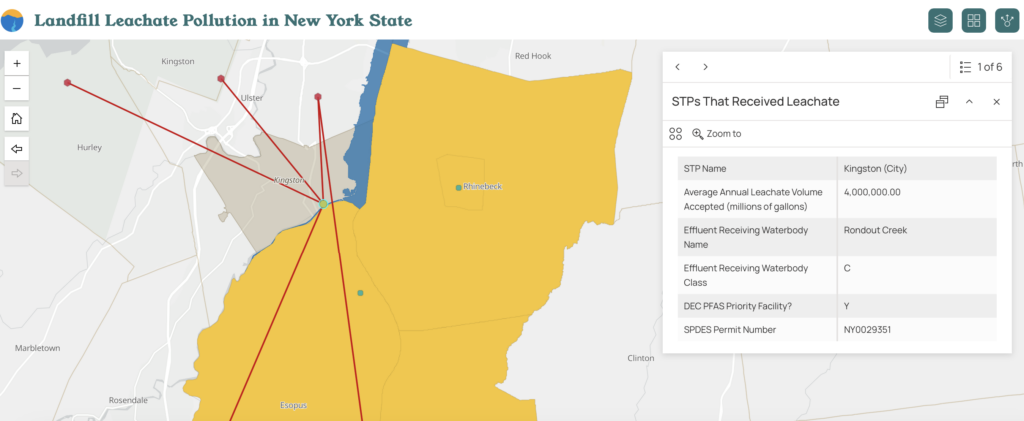
According to New York River Watch’s statewide analysis, approximately 4 million gallons of this contaminated garbage water are sent to Kingston’s sewage treatment plant every year. From there, the discharge enters Rondout Creek and ultimately flows into the Hudson River—a drinking-water source for more than 107,000 people downstream.
Kingston has already raised concerns.
In early 2025, the City of Kingston notified the Town of Hurley that it would no longer accept its landfill leachate from the Hurley landfill, a NYS Superfund site*. Following state-required testing, however, Kingston ultimately continued accepting it.
The City was working from a single sample tested for only three contaminants, providing a very limited picture of what may be present in landfill leachate. The state subsequently told the City that the results were below the applicable thresholds for the three contaminants tested and therefore met current standards. It is difficult to understand how “meeting current standards” can be considered an adequate threshold when sewage treatment plants are not monitoring for or designed to remove the full range of toxic chemicals that are present in leachate. Dilution is not the solution to this pollution.
The Proposed Rules Exempt Inactive Landfills—Including Those Sending Leachate to Kingston
There is another serious problem for Kingston. Every landfill currently sending leachate to the City of Kingston’s sewage treatment plant is inactive. Yet the proposed regulations, as currently written, exempt inactive landfills from the new treatment requirements. That means that if the regulations are adopted as written, every landfill currently sending leachate to Kingston could remain exempt from the new source-treatment requirements—allowing this flow of pollution to continue for another generation.
A landfill does not stop producing contaminated leachate simply because it stops accepting garbage. The chemicals and other pollutants remain in the buried waste, and leachate can continue to be generated for decades.
If New York is going to establish new requirements for landfill leachate, those requirements need to apply to active, inactive, and closed landfills.
Now is the time for action.
The state’s proposed regulations present a once-in-a-generation opportunity to require treatment at the source—before landfill leachate leaves a landfill.
As far as we are aware, we have not yet seen public engagement in this rulemaking from Kingston’s elected or appointed officials, Ulster County legislators representing affected communities, or the County Executive’s Office. If they have submitted comments, taken a position, or otherwise engaged, we would welcome being informed so we can share that information with the community.
There is still time, and participating is easy. The public and officials can submit comments, call for the regulations to apply to inactive landfills, support stronger source-treatment requirements, and ask the state for a transition plan for municipalities like Kingston that currently receive landfill leachate.
Ulster County Resource Recovery Agency Executive Director Marc Rider has signed onto the statewide coalition letter supporting stronger regulations. We appreciate his participation. We hope Kingston and Ulster County officials will use this opportunity as well.
The public comment deadline is September 9. This is an important opportunity for our local leaders to make their positions known—and help ensure that the state’s new regulations actually address the problem.
* Correction: The Town of Hurley landfill is a state Superfund site, not a federal Superfund site.
If you represent an organization: Sign on to New York River Watch’s public comment letter by September 8 and join the 75+ organizations that have already signed on.
If you are an individual: Visit New York River Watch’s Action page to submit a public comment.
If you would like to submit your own comments directly: Visit the NYSDEC’s public comment page for information on how to participate.