
This is the latest in our ongoing series following efforts to close the Leachate Loophole.
By Rebecca Martin
We’ve written about Kingston’s role in New York’s landfill leachate problem, and the issue has received significant press attention. But people are still learning about what is happening here—and there is an important reason to pay attention right now.
Leachate is “garbage water”—the contaminated liquid created when rain moves through buried waste and is collected at the bottom of a landfill. It can contain PFAS, heavy metals, pesticides, industrial chemicals, and other pollutants.
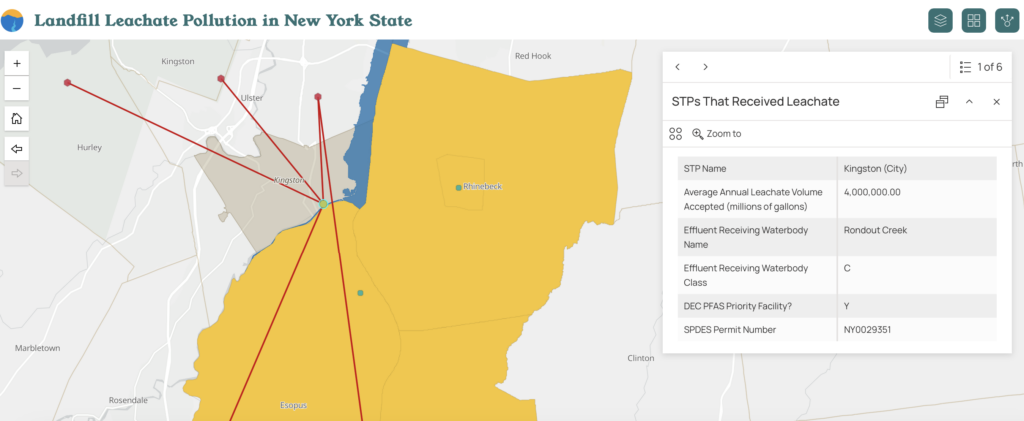
According to New York River Watch’s statewide analysis, approximately 4 million gallons of this contaminated garbage water are sent to Kingston’s sewage treatment plant every year. From there, the discharge enters Rondout Creek and ultimately flows into the Hudson River—a drinking-water source for more than 107,000 people downstream.
Kingston has already raised concerns.
In early 2025, the City of Kingston notified the Town of Hurley that it would no longer accept its landfill leachate from the Hurley landfill, a NYS Superfund site*. Following state-required testing, however, Kingston ultimately continued accepting it.
The City was working from a single sample tested for only three contaminants, providing a very limited picture of what may be present in landfill leachate. The state subsequently told the City that the results were below the applicable thresholds for the three contaminants tested and therefore met current standards. It is difficult to understand how “meeting current standards” can be considered an adequate threshold when sewage treatment plants are not monitoring for or designed to remove the full range of toxic chemicals that are present in leachate. Dilution is not the solution to this pollution.
The Proposed Rules Exempt Inactive Landfills—Including Those Sending Leachate to Kingston
There is another serious problem for Kingston. Every landfill currently sending leachate to the City of Kingston’s sewage treatment plant is inactive. Yet the proposed regulations, as currently written, exempt inactive landfills from the new treatment requirements. That means that if the regulations are adopted as written, every landfill currently sending leachate to Kingston could remain exempt from the new source-treatment requirements—allowing this flow of pollution to continue for another generation.
A landfill does not stop producing contaminated leachate simply because it stops accepting garbage. The chemicals and other pollutants remain in the buried waste, and leachate can continue to be generated for decades.
If New York is going to establish new requirements for landfill leachate, those requirements need to apply to active, inactive, and closed landfills.
Now is the time for action.
The state’s proposed regulations present a once-in-a-generation opportunity to require treatment at the source—before landfill leachate leaves a landfill.
As far as we are aware, we have not yet seen public engagement in this rulemaking from Kingston’s elected or appointed officials, Ulster County legislators representing affected communities, or the County Executive’s Office. If they have submitted comments, taken a position, or otherwise engaged, we would welcome being informed so we can share that information with the community.
There is still time, and participating is easy. The public and officials can submit comments, call for the regulations to apply to inactive landfills, support stronger source-treatment requirements, and ask the state for a transition plan for municipalities like Kingston that currently receive landfill leachate.
Ulster County Resource Recovery Agency Executive Director Marc Rider has signed onto the statewide coalition letter supporting stronger regulations. We appreciate his participation. We hope Kingston and Ulster County officials will use this opportunity as well.
The public comment deadline is September 9. This is an important opportunity for our local leaders to make their positions known—and help ensure that the state’s new regulations actually address the problem.
* Correction: The Town of Hurley landfill is a state Superfund site, not a federal Superfund site.
If you represent an organization: Sign on to New York River Watch’s public comment letter by September 8 and join the 75+ organizations that have already signed on.
If you are an individual: Visit New York River Watch’s Action page to submit a public comment.
If you would like to submit your own comments directly: Visit the NYSDEC’s public comment page for information on how to participate.
Susan,
Appreciate the response and points made.
Protections embedded in State Constitution are clearly discriminatory and unfair and inequitable.
Would be interesting to see what justifications beneficiaries of this legacy provision would explain – Retired and Future State Officers including Elected Officials and Employees who receive/will receive in excess of $ 100,000 per year while reminding us of the pressure on School and Government services because of lack of revenue. I understand that you and your team would receive pushback from the organized lobbies of the “embedded beneficiaries”, but you have the power and audience – to ask.
Best to all!
Bill
From: Arbetter, Susan J
Sent: Wednesday, September 2, 2026 1:09 PM
To: wberardi@cpa.com
Subject: Re: [EXTERNAL] Does $ buy your Silence ?
Hi Bill,
The reason that pensions aren’t taxed in New York is because they are protected by the New York State Constitution (Article XVI/Section 5) which explicitly states that pensions paid to officers and employees of the state can’t be diminished, and that public pensions are exempt from state and local income taxes.
It doesn’t seem fair now; but when it was embedded into law the salaries of state workers were low, and they needed that sweetener to attract workers.
I hope this answers your question.
Warmly,
Susan
Sign in
Susan Arbetter
Anchor, “Capital Tonight”
518-915-3488
susan.arbetter@spectrum.com
104 Watervliet Avenue Extension
Albany, NY 12206
From: “wberardi@cpa.com”
Date: Monday, August 31, 2026 at 3:39 PM
To: “Arbetter, Susan J”
Subject: RE: [EXTERNAL] Does $ buy your Silence ?
CAUTION: The e-mail below is from an external source. Please exercise caution before opening attachments, clicking links, or following guidance.
Susan,
All good except the word I boldfaced and italicized and underlined – I would delete that.
Thanks again to you and all your team!
Bill
From: Arbetter, Susan J
Sent: Monday, August 31, 2026 1:21 PM
To: wberardi@cpa.com
Subject: Re: [EXTERNAL] Does $ buy your Silence ?
Hi there,
Just getting clarity on the question that you want asked. Is this the question? If so, let me know.
Why is it fair for minimum wage workers to pay New York State and City Income Taxes while Government Pensioners (including retired elected officials), some who make in excess of $ 100,000 per year pay from taxpayer funded pensions “legally” pay nothing to support our essential Government and School services?
Thank you,
Susan
Susan Arbetter
Anchor, “Capital Tonight”
518-915-3488
susan.arbetter@spectrum.com
104 Watervliet Avenue Extension
Albany, NY 12206
From: “wberardi@cpa.com”
Date: Monday, August 31, 2026 at 12:03 PM
To: “7OnYourSideNina@abc.com” , “Arbetter, Susan J”
Subject: [EXTERNAL] Does $ buy your Silence ?
CAUTION: The e-mail below is from an external source. Please exercise caution before opening attachments, clicking links, or following guidance.
Gender discrimination not permitted in Income Tax law – why not Occupational discrimination?
Ruth Bader Ginsburg’s landmark gender discrimination tax case was Moritz v. Commissioner of Internal Revenue (1972). She and her husband, Martin D. Ginsburg, represented Charles Moritz, a single Denver man denied a caregiver tax deduction for caring for his invalid mother solely because he was a man.The Case DetailsThe Client: Charles Moritz, an unmarried man and traveling salesman, paid for full-time care for his elderly, dependent mother.The Disputed Law: Internal Revenue Code Section 214 allowed a tax deduction for dependent care expenses, but strictly limited it to women, widowers, divorced individuals, and married men whose wives were incapacitated.The Ruling: The U.S. Court of Appeals for the Tenth Circuit ruled in 1972 that denying the deduction to a never-married man constituted unconstitutional sex discrimination under the Due Process Clause.Strategic SignificanceProving Sex Discrimination Hurts Men: Ginsburg strategically chose to represent a male plaintiff to show all-male panels of judges that gender-based stereotypes and archaic laws penalized everyone, not just women.The Foundation for Future Equality: Winning Moritz v. Commissioner served as the launching pad for Ginsburg’s broader campaign for equal protection under the law, establishing a blueprint she later used in landmark Supreme Court cases like Frontiero v. Richardson and Weinberger v. Wiesenfeld.
Top of Form
Have asked Susan Arbetter of Spectrum News, and Nina Pineada of “7OnYourSide” whose teams do a great job on Susan’s “Capitol Tonight” and Nina on her 7OnYourSide” programs to air a brief mention of this to have a candidate or official to explain why it is fair for minimum wage workers to pay New York State and City Income Taxes while Government Pensioners (including retired elected officials), some who make in excess of $ 100,000 per year pay from taxpayer funded pensions “legally” pay nothing to support our essential Government and School services? No luck so far – but maybe a few more squeaky wheels may do it? or do Campaign Contributions to Candidates accepted from Public Unions buy silence?
•
•
•
•
•
Bottom of Form
William F. Berardi CPA, MBA, PFS
Berardi, Gottstine & Miller CPAs PC
MAILING ADDRESS: PO Box 5030
Kingston, NY 12402-5030
(845)338-1619 x1
Fax (845) 338-2458
http://www.bgmcpas.com