By Rebecca Martin and Kathleen (kt) Tobin
According to the U.S. Food and Drug Administration (FDA), 1 “Kratom is a tropical tree that is native to Southeast Asia. Products prepared from kratom leaves are available in the U.S. online and in brick-and-mortar stores. Kratom is often used to self-treat conditions such as pain, coughing, diarrhea, anxiety and depression, opioid use disorder, and opioid withdrawal.” The Centers for Disease Control and Disease Prevention (CDC) recently reported that 5 million Americans have used kratom and that, in the past five years, there has been, “an increase of approximately 1,200% in kratom-related exposure reports, including a marked surge in 2025.” 2
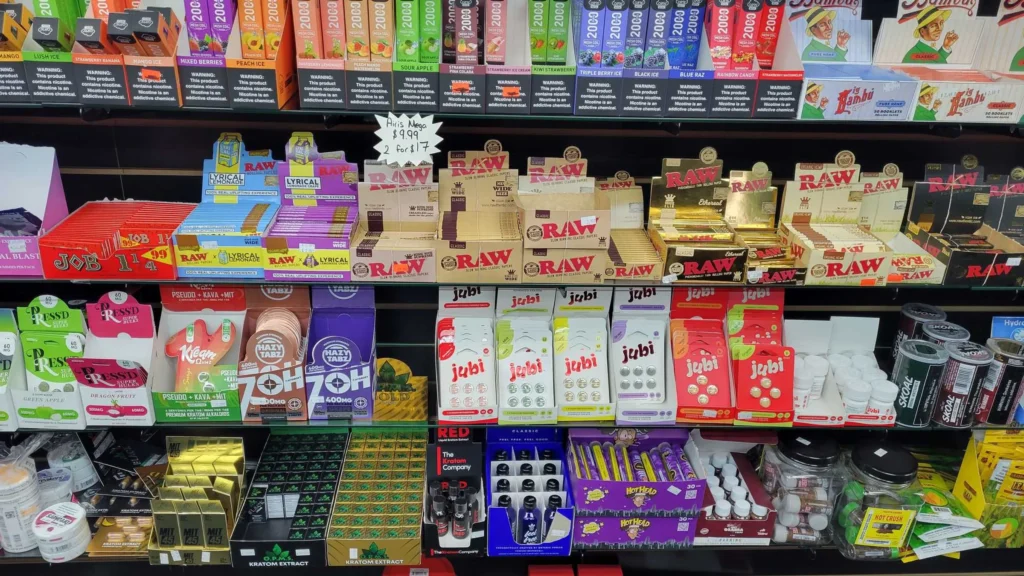
It is scientifically and medically accurate to say that kratom has opioid activity because its active compounds bind to the same brain receptors targeted by traditional opioid drugs. Despite that, kratom products are being sold openly in gas stations, convenience stores, smoke shops, and online marketplaces. Kratom is sold as tablets, gummies, drink mixes, drinks, and powders.
The FDA describes kratom products as potent opioid products that have not been proven safe or effective for any use. But to date, the concern from federal regulators has been particularly focused on kratom that is concentrated and has synthetic 7-hydroxymitragynine, or 7-OH, additives. Federal actions have been aimed at elevated concentrations of 7-OH and synthetic derivatives, not ordinary botanical kratom containing naturally occurring 7-OH that is below the federal threshold.
That distinction does not mean that natural kratom is harmless or without risks; it means that these are different products that may need to be considered separately. Even without added 7-OH, natural kratom can lead people with addictive tendencies to kratom addiction, illegal opioid use, or jumpstart a recovering addict’s opioid relapse because kratom contains active chemical compounds that interact with the exact same brain pathways as prescription opioids and heroin. 3 Pharmacologically, natural kratom functions as a partial opioid agonist, despite being marketed as a “natural” or “safe” herbal supplement. 4
This raises the question of whether the current regulatory framework is keeping pace with these products. Products with opioid-active compounds can be widely available in ordinary retail settings while failing under a different regulatory framework than conventional opioid drugs. For consumers and local governments, that can look like a regulatory gap: the federal government is now moving to address the most concentrated and synthetic forms, while other kratom products remain readily available. The question is whether the current framework is adequate for products whose potency and effects can vary, and whether manufacturers should have to demonstrate safety before these products reach consumers.
The stakes are high. The growing availability of products with potent opioid effects in ordinary retail settings—including gas stations, smoke shops, and convenience stores—is particularly concerning, putting these products within easy reach of young people and people struggling with addiction.
The Federal Government Is Moving
On July 1, 2026, the Drug Enforcement Administration (DEA) announced that it was beginning the process of temporarily placing 7-OH above a specified threshold and three synthetic 7-OH-related substances into Schedule I under the federal Controlled Substances Act. In August, the DEA issued a temporary scheduling order for the three synthetic derivatives. The separate process for 7-OH above the proposed threshold has involved additional federal review and public comment over what concentration should trigger scheduling. 5
The federal landscape is therefore moving, but it is not completely settled.
That uncertainty is one reason why some local governments are having difficulty deciding exactly what they can and should regulate, how a local law would interact with federal scheduling, and who would enforce it.
New York State Has Already Acted
New York has already taken some steps to address kratom. In December 2025, Governor Kathy Hochul signed legislation prohibiting the sale of Kratom products to anyone under 21 and requiring every kratom product manufactured, distributed or sold in New York to carry a consumer warning label and a full list of ingredients. The warning must state that the product may be addictive and may interact with certain medications, drugs, and controlled substances. 6
The State Legislature has now gone further. Assembly Bill A.9156B, 7 sponsored by Assemblymember Phil Steck, and its Senate counterpart, S.8925A, 8 sponsored by Senator Christopher Ryan, would prohibit the sale of products containing 7-OH above specified thresholds: more than 2 percent of total alkaloids or more than one milligram per serving. The legislation also establishes civil penalties for businesses that knowingly sell, offer for sale or deliver prohibited 7-OH products.
That gives New York counties something concrete to prepare for and act on right now: the Governor is expected to sign these bills that have already passed both houses before the end of the year.
This past June, both Sarahana Shrestha and Michelle Hinchey, Ulster County’s state legislators, voted in support of the legislation that is awaiting Governor Hochul’s signature.
The Precautionary Principle and the Federal Role
The precautionary principle is a decision-making framework that involves risk assessment to determine whether or not “an activity raises threats of harm to human health or the environment, (and that) precautionary measures should be taken even if some cause-and-effect relationships are not fully established scientifically.” 9
Kratom regulation is an example of why adopting the precautionary principle is critical. When products can pose serious health risks, the burden should not fall on the public to prove they are dangerous after they are already on the market and readily available. Companies that manufacture and market kratom products should have had to demonstrate their safety before those products reach consumers—not after harm has occurred.
There are no FDA-approved over-the-counter drugs or dietary supplements containing kratom that are legally marketed in the U.S. In fact, the FDA warns consumers not to use kratom because of “the risk of serious adverse events, including liver toxicity, seizures, and substance use disorder (SUD).” 10 Yet kratom products are still widely sold by companies that market them outside the FDA-approved drug or dietary supplement framework. In other words, the absence of FDA approval does not prevent these products from reaching consumers.
That is an important question for our local members of Congress, Pat Ryan and Josh Riley, to raise at the federal level. The precautionary principle should also be part of any local memorializing resolution adopted by a county or municipality addressing kratom: companies should bear the burden of demonstrating safety before these products reach consumers, rather than leaving consumers, families, communities and taxpayers to bear the consequences after the fact.
What Other Counties Are Doing
In the Mid-Hudson region, there has been a mix of responses to kratom regulation.
Dutchess County has acted, but not without a difference of opinion over how far to go. On August 10, 2026, the Dutchess County Legislature adopted a local law prohibiting the sale and distribution of concentrated and synthetic 7-OH products while allowing adults to continue to purchase natural leaf kratom.
County Executive Sue Serino initially proposed a much broader approach – a ban on the sale of all kratom products. 11 The County Legislature ultimately adopted a narrower law, Local Law No. 6 of 2026: Prohibiting the Sale and Distribution of Concentrated and Synthetic 7-Hydroxymitragynine (7-OH) Kratom Products in Dutchess County. 12
The difference between the County Executive’s original proposal and the Legislature’s final law shows that a county does not necessarily have to resolve every question about kratom before taking action on the products at the center of the current federal concern. The scope of a proposed law can be debated, narrowed, and worked through the legislative process.
Dutchess County held its required public hearing, heard from constituents and advocates, consulted with its Department of Health and ultimately adopted the narrower legislation. Serino acknowledged that the legislation did not go as far as the complete ban she had proposed, while indicating that she would continue to explore additional action.
Sullivan County is developing its own policy. County documents show that Sullivan County has drafted a county mandate proposal addressing kratom policy as part of its broader work on substance-use treatment and prevention. It has not enacted a county kratom ban. 13
Orange County provides another example of the different routes to regulation local counties are taking with kratom. In 2025, Orange County moved to prohibit the sale of kratom to people under 21 before New York enacted its statewide age restriction. But shortly after the county acted, the state law took effect. County officials subsequently explained that the local law did not proceed through the remaining process because the state legislation had superseded the need for it. By spring 2026, the County Department of Health was waiting for state guidance on its role in enforcing the new state requirements and was developing public information about kratom and the distinction between natural and synthetic products. 14
Outside of our region, there are several examples of New York State counties banning all forms of kratom. Albany, Nassau, Oneida, Rensselaer, and Washington counties have all bypassed the state-level regulations to enact complete, local retail bans on all forms of kratom. Saratoga County will have its final public hearing in October and is currently moving through the legislative process to finalize its own total ban. 15 16 17 18 19 20
Despite these examples, in our region, counties are struggling to move this issue forward. We understand that state and federal law are changing quickly and that local laws can be overtaken by state legislation. Questions about preemption, enforcement authority and the appropriate regulatory threshold remain. And county health departments may not have authority or capacity to enforce a law regulating a substance that falls outside their existing jurisdiction. But counties that have enacted full bans are working through those same challenges, and their experiences can help inform a path forward for Ulster County. Given the life-and-death nature and speed with which this kratom crisis is escalating, challenges are a reason to work through the details, not a reason to stop looking for solutions. If other counties are finding ways to move forward, Ulster County should learn from what they are doing.
There are also certainly short, mid, and long-term actions that can be taken to move toward the goal of restricting access to kratom, even as the state and federal landscape continues to evolve. Those next steps need to be identified, understood, and made clear to the public. The community has the most at stake here, and people need to know what is being considered, what can be done now, what will take more time, and where their voices and actions can make a difference.
A Regional Problem Needs Regional Solutions
This is bigger than a question of where these products can be sold. If people are becoming dependent on them, then access to treatment has to be part of the conversation too.
Ulster County is part of a regional system. The response should consider not only what happens at the point of sale, but also what happens when someone develops a substance-use problem and needs help.
People who develop dependence on kratom or concentrated 7-OH products may need substance-use treatment, including detoxification and recovery services. Treatment providers in the region are increasingly encountering kratom-related dependence, while access to detox beds remains a challenge. Ulster County has not had any certified inpatient hospital detox beds since 2021 when the last remaining beds in Ulster were moved to Dutchess County. 21 Community members who need detox or recovery services may have to leave their own county to get them, including seeking treatment in Dutchess County.
At the same time, critics of county-by-county restrictions have raised concerns about spillover effects – that is, that people could simply cross county lines to obtain products that are restricted in their home county. Whether that is happening in practice is a question worth examining, but the underlying policy gap is that a product that cannot be sold in one county may remain readily available a short drive away.
That means the availability of these products, access to treatment, and policies in neighboring counties are all part of the same regional picture. The costs should not fall entirely on families, communities, treatment systems, and taxpayers. The companies making, marketing, and profiting from these products should bear responsibility for the costs associated with the harm they create.
We urge our Mid-Hudson county leaders to bring the issue to the New York State Association of Counties (NYSAC) 22 to propose and create a coordinated regional and statewide approach. If the goal is to restrict access to kratom, counties can begin talking now about how to address gaps between neighboring counties, enforcement challenges, treatment capacity, and what can be done if state or federal action stalls or does not address the issue fully.
Where Ulster County Stands
Ulster County was poised to bring Proposed Local Law No. 16 of 2026 23 to a public hearing. The proposed law would prohibit the sale and distribution of concentrated and synthetic 7-OH kratom products in the County. Instead, on September 3, the Health, Human Services and Human Rights Committee voted 5–2 to postpone Resolution No. 480, which would have set the public hearing. The legislation remains before the County, but the public hearing, and the opportunity for community members to weigh in, has been put on hold.
Legislator Bill Murray, the sponsor of Proposed Local Law No. 16, 24 has been clear about the need for action. In a recent press release, 25 he called for Ulster County to “immediately ban the sale and distribution of high concentrations and synthetic kratom” while state and federal action moves forward, citing concerns about its addictive nature, misleading marketing and misinformation. By putting the legislation forward and publicly calling for action, Murray has helped bring this issue to the County’s attention. The next step is to bring that legislation to the public and do the work needed to make it effective.
The County Executive’s Office raised concerns about the rapidly changing state and federal legal landscape. The County Department of Health also explained that it does not currently have enforcement authority over drugs and would not have the capacity to police possession or online sales.
But postponing the public hearing does not resolve those questions. It delays the opportunity to hear from the public and work through them in an open process. Legislator Craig Lopez and others were correct that a public hearing is tied to a specific proposed local law. But that does not mean the County has to wait until every detail is settled before engaging the public. The proposed law can be developed, revised and improved through the legislative process, with additional public hearings as it evolves.
For an issue this new to Ulster County, several rounds of discussion and public input are reasonable. The cost is time and work, but that work has value. A public process can educate the community, build understanding and buy-in, surface practical solutions, and identify what the County needs to make the law work. It may even lead the public and their legislative stewards to determine that additional resources or funding are needed for enforcement, education or other aspects of implementation. That is exactly what a public process is supposed to do: bring the community and its elected representatives together to work through new and complicated issues and develop the strongest response possible.
We support a full kratom ban, as has already been enacted in Albany, Nassau, Oneida, Rensselaer, and Washington counties. Those counties have paved the way and provide a road map for Ulster to learn from and follow.
Additionally, Ulster County, at this moment in time, does not have to choose between working on its local law and taking action now. There are both short-term and longer-term actions the County can take while the state and federal landscape continues to evolve.
In the short-term, the County Legislature can adopt a memorializing resolution urging Governor Hochul to sign S.8925A/A.9156B, the 7-OH legislation that has passed both houses of the State Legislature. The resolution could also call on our house representatives to raise two important issues at the federal level: the precautionary principle and producer responsibility. Companies making, marketing and profiting from products with potent opioid effects should bear responsibility for the harms and costs associated with those products, rather than leaving them to consumers, families, communities, treatment systems and taxpayers.
Longer-term, Ulster County can continue developing its own local response. Proposed Local Law No. 16 raises important questions about who has enforcement authority, how online sales would be addressed, and how a county law would interact with state and federal requirements. Any questions can and should be worked through publicly as the legislation evolves. The half a dozen counties that have enacted full bans should be used as models for working towards taking the same actions in Ulster County.
Take Action
- Ask that the Ulster County Legislature immediately pass a memorializing resolution urging Governor Hochul to sign S.8925A/A.9156B and to include language about the precautionary principle, producer responsibility, and the need for adequate treatment capacity in the County’s response.
- Urge the Ulster County Legislature to bring Local Law No. 16 of 2026 back for a public hearing and continue improving it through the public process, which may include additional public hearings.
- Support your Ulster County legislators to move forward with a collaborative public awareness campaign involving the County Legislature, County Executive, Department of Health and Sheriff’s Office addressing kratom, and all other addictive substances as a public health and public safety issue.
- Urge Mid-Hudson county leaders to bring kratom to New York State Association of Counties (NYSAC) and work toward a coordinated regional and statewide approach, including addressing gaps between neighboring counties, enforcement challenges, treatment capacity and what to do if state or federal action falls short.
- Show up, speak out and stay engaged as the County works through its next steps.
Footnotes
- FDA and Kratom
- Increases in Kratom-Related Reports to Poison Centers — National Poison Data System, United States, 2015–2025
- In full disclosure, in March 2022, after several months off of opioids, co-author Tobin’s son Padraig Flusser died of “acute intoxication due to the combined effects of Fentanyl, Flourofentanyl, Alprazolam, Clonzipan, and Mitragynine.” Mitragynine is the primary active chemical compound (alkaloid) found in kratom. 7-OH kratom did not come on the market until 2023. Natural kratom leaf is rarely a singular cause of death, but rather a compounding factor that worsens respiratory failure when combined with other drugs. Kratom usage interacts with the same brain pathways as other opioids and heroin and can lead to relapse. The level of Mitragynine (260ng/ml) in Padraig’s autopsy toxicology report indicates heavy or frequent kratom use.
- Bin Abdullah MFIL. Kratom Dependence and Treatment Options: A Comprehensive Review of Literature. Curr Drug Targets. 2020;21(15):1566-1579. doi: 10.2174/1389450121666200719011653. PMID: 32682371.
- DEA to Temporarily Schedule 7-OH and Related Substances to Protect Public Safety
- Governor Hochul Signs Two Pieces of Landmark Legislation to Protect New Yorkers Against the Harmful Effects of Commercial Herbal Product Known as Kratom
- Prohibits the sale of products that contain 7-hydroxymitragynine at a level that exceeds 2% of total alkaloids or one milligram per serving; establishes fines for the sale of such products
- Senate Bill S8925A: Prohibits the sale of 7-hydroxymitragynine products
- Hayes AW. The precautionary principle. Arh Hig Rada Toksikol. 2005 Jun;56(2):161-6. PMID: 15968832.
- FDA and Kratom
- County Executive Sue Serino Letter to Legislature
- Local Law No. 6 of 2026: Prohibiting the Sale and Distribution of Concentrated and Synthetic 7-Hydroxymitragynine (7-OH) Kratom Products in Dutchess County
- Sullivan County Drug Task Force Update
- Orange County Introductory Local Law No.8 of 2025
- Rensselaer County Legislature votes to ban sale of kratom
- Nassau Legislative Democrats Announce Kratom Ban Legislation as Health Concerns Mount
- Spectrum News: Albany County’s kratom ban goes into effect
- Picente Signs Local Law Prohibiting Sale of Kratom
- Another Capital Region community bans kratom; doctor calls for statewide ban
- Saratoga County the latest in New York to weigh a ban on kratom
- First mental health urgent care opens in Ulster County
- New York State County Executives’ Association
- September 3, 2026 Health, Human Services and Human Rights Committee (starts at 25:52)
- Proposed Local Law Number 16 Of 2026
- Ulster County Officials Warn About the Dangers of Kratom Use, Including Concentrates and Synthetic Variants, And Take Action To Ban The Sale In Ulster County