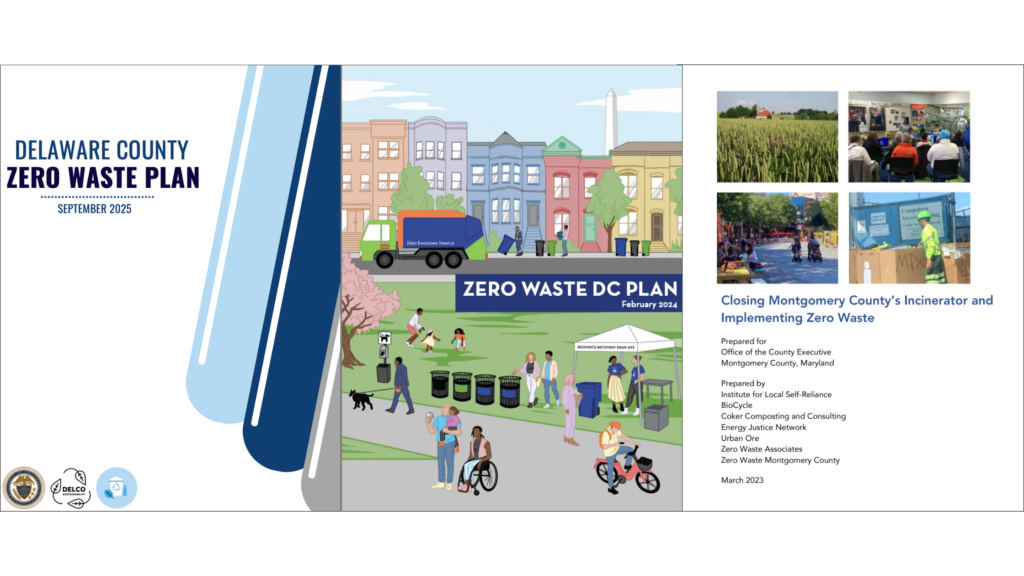
This is the latest in our ongoing series following efforts to move Ulster Toward Zero Waste. The images above are examples of Zero Waste Implementation Plans, and can all be found for review at: https://energyjustice.net/zerowaste/
By Rebecca Martin
There is an important and encouraging development in Ulster County’s zero waste planning: community members now have a seat at the table—at least for a couple of months.
The Ulster County Resource Recovery Agency (UCRRA) Zero Waste Committee selected four community members to help develop a Preliminary Zero Waste Implementation Plan (ZWIP): Shabazz Jackson, Manna Jo Greene, Claudia Joseph, and me, representing KingstonCitizens.org.
Chaired by Chris Hurlbert, the committee recently opened non-voting seats to community members interested in contributing to the planning process. It is a positive step toward bringing community voices into recommendations for a more credible, practical, and sustainable zero waste future.
Because our participation is limited, we have a lot to learn and accomplish in a short period of time. We need to understand what UCRRA is doing, where it is headed, and how our work can best support recommendations to its Board.
Managing Waste vs. Reducing Waste
UCRRA has established 30/60/90 goals: reducing waste 30% by 2030, 60% by 2040, and 90% by 2050.
Its Local Solid Waste Management Plan (LSWMP) is updated every ten years and addresses how the county manages its solid waste system—including collection, transfer, recycling, disposal, and infrastructure. The next plan is expected to be adopted in time for 2030, which is why we are working now to help incorporate zero waste initiatives into it. But adding zero waste initiatives to an LSWMP is not a substitute for actually planning how we will reduce waste. The initiatives need a plan behind them.
A ZWIP, which Ulster County urgently needs, serves a different purpose. It provides the roadmap for reducing the amount of waste we generate and send into the system in the first place. That means establishing measurable reduction and diversion targets, identifying the policies and programs needed to reach them, assigning responsibility, identifying investments, and creating a way to measure and adjust progress.
The zero waste committee heard that UCRRA may already be at or beyond its 30% reduction goal ahead of 2030. However, the “current data is unreliable” to establish exactly where the county stands.
That is exactly the kind of work that a ZWIP should analyze to establish a reliable baseline, examine the data we already have, identify what is missing and create a transparent way to track what is being reduced, diverted, and ultimately sent to disposal.
Why a Real ZWIP is a Worthy Investment
Hiring an experienced consultant for a ZWIP could be one of the smartest investments the county makes. Ulster County has already invested millions in its transfer station system. A ZWIP can help maximize that investment by identifying how those facilities can do more to prevent, separate, reuse, compost, and recycle materials before they become waste for disposal.
This is an issue we have to get right. It affects our land, water, and air, as well as the way we produce, consume, and ultimately dispose of materials. New Paltz is already moving forward with approaches to reduce and divert waste; the next step is to evaluate what is working there and determine how those lessons can be adapted across the other 18 municipal transfer stations in Ulster County.
A good consultant could help identify which strategies will have the greatest impact, and establish what our communities, businesses, institutions, UCRRA, and county government each need to do to make them work.
An investment of approximately $80,000–$100,000 could provide that foundation. The key will be creating a strong RFP based on Zero Waste Hierarchy and selecting a consultant with a demonstrated track record in zero waste implementation—not simply waste management.
That is smart leveraging of the investment that has already made. Before committing to a major new infrastructure, we should first understand what we can achieve through waste prevention, reuse, source separation, composting, recycling, and other strategies—and what infrastructure is actually needed after those opportunities are maximized.
If UCRRA Sees Global NRG as a Pathway to Zero Waste, It Belongs in the Zero Waste Committee Conversation
The question becomes particularly important now, because UCRRA is considering a proposed $125 million + Global NRG project. Global NRG is the proposed large-scale mixed-waste processing facility that would take municipal solid waste and use mechanical and other technologies to recover materials and divert from disposal.
As UCRRA Executive Director Marc Rider described it, the public presentation was intended to share UCRRA’s targets—not the specific work needed to reach the end goals. The question is how we get from those targets to actually achieving them.
After a decade or more of zero waste work in Ulster County, we should have a ZWIP that documents what has been accomplished, what remains to be done, and how the county will get from its current position to 30/60/90. We do not have that plan yet, and we need one
During the meeting, Rider described Global NRG as “…one of the main projects to get us to Zero Waste.” If that’s the case, it belongs in the Zero Waste Committee’s conversation. That is a significant claim for a project carrying a $125 million + price tag and potentially requiring imported waste to keep it operating. We all want to avoid sending waste to Seneca Meadows, and some believe that we may ultimately need to consider a landfill in our own county—but we don’t know that yet.
That is precisely why we need to first determine how much waste we can eliminate and divert locally. We should not kick the can down the road by building a system that depends on a steady supply of waste to feed it
The committee is not being asked to approve or reject Global NRG; its role is to develop recommendations for the UCRRA Board. To do that responsibly, members need to understand how this proposed infrastructure fits with source reduction, reuse, source separation, composting, recycling, and other strategies—and whether it is actually necessary to achieve 30/60/90.
Connecting the Pieces
Right now, several pieces are moving forward: the Zero Waste Committee is developing zero waste “initiatives” for consideration in UCRRA’s LSWMP, while the Ulster County Legislature is developing zero waste policy guidance.
These efforts should reinforce one another. UCRRA brings operational expertise; the Legislature can advance policy; the Zero Waste Committee can develop practical initiatives; community representatives can bring public experience and accountability; and a qualified zero-waste consultant can help identify gaps, evaluate alternatives, and bring these pieces together into a measurable implementation plan.
But the county needs to do the planning before it locks itself into the “put or pay” infrastructure for 20-25 years.
Get Involved and Take Action
The next UCRRA Zero Waste Committee meeting is Thursday, September 10 at 5:00 PM at UCRRA, 999 Flatbush Road in Kingston, with a livestream available on UCRRA’s YouTube channel, @ucrra5008. The committee meets publicly, and there is an opportunity for public comment at every meeting. The next meetings are October 15, November 12, and December 3. Meeting materials are posted by UCRRA before each meeting.
Attend these meetings. Ask questions. Use public comment.
But most importantly, contact your Ulster County Legislator and ask for two things:
- Fund a ZWIP. Support a 2027 budget amendment of $80,000–$100,000 to hire a qualified zero-waste consultant to establish a baseline, identify realistic ways to reduce and divert waste, evaluate alternatives, and determine what infrastructure is actually needed.
- Pause Global NRG. Ask the Legislature to support pausing the $125 million + project until this work is completed. While UCRRA is responsible for the project, its financial and long-term impacts will be felt by Ulster County communities and taxpayers. You can also reach out to your local municipal government officials to ask them to advocate for the same.
Let’s do the planning first—and make the major infrastructure decisions after we know what our communities can actually achieve.