GUEST POST Sleepless in Kingston: What I Learned about Train Horns and the Search for Quiet Zones

By Dan Nelson

My partner and I moved back to the East coast in spring 2023 after 35 and 25 years, respectively, living in Oakland, California. We managed to find a rental in Kingston (not easy!), which fortunately turned out to be a loft, so it had built-in studio space. Otherwise we would have been looking for studios in a market where they’re more expensive than the Bay Area (!). Our neighborhood in Oakland was mostly quiet at night, but some nights and early mornings featured muscle cars peeling out, fireworks (almost nightly in the 2-3 months leading up to July 4th), public fights, crazy people yelling on the sidewalk, etc. We were no strangers to sleep disturbance, but we had no idea about the freight trains of Kingston.

For about a year in 2024-25 we were looking for a house to buy. After looking at fifty-ish houses in person, being outbid on two, withdrawing a bid on one money pit, and unsuccessfully asking for a small contingency on the fourth house, the fifth house we bid on became ours. We knew it was one block from a rail crossing, but we had heard only one train pass during a brief daytime visit to the house, and were ready to end the search. We moved into the house, about 450 ft. from the Flatbush Ave. rail crossing, in February. 

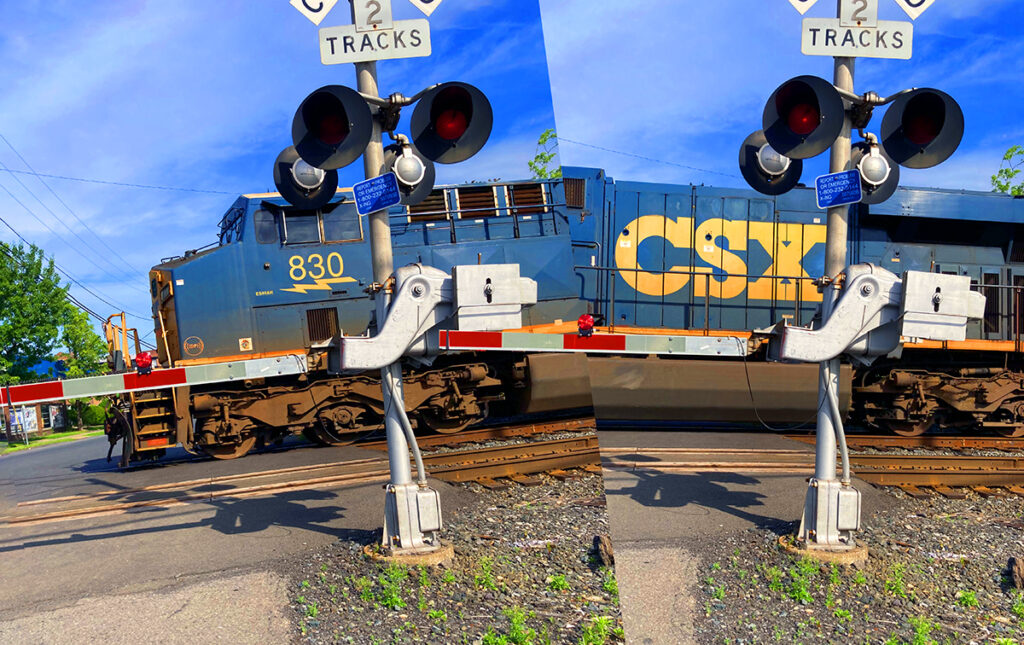
As is probably obvious to anyone living here, there are many trains at all hours of the day and night. Kingston seems to be the only town or city of any size between Albany and New York City through which freight trains pass, all of which are operated by CSX. There are six rail crossings in Kingston proper, all in a one-mile stretch through our most densely-populated neighborhood. Publicly available info showed that there are 20 to 30 trains passing through Kingston in any given 24-hour period.

In March, after looking into what the law dictated about train signals, the first person I messaged about train noise was Suzanne Cahill, the Planning Director for the City of Kingston: “Despite only being required to sound one short and one longer horn (of undefined lengths) at each crossing, the trains routinely sound many blasts of an average of four seconds each, before during and after crossings. These blasts are of the same length and frequency at 4 AM as they are at 4 PM, in other words, regardless of the amount of vehicle and pedestrian traffic. The vibrations—a result of poorly maintained tracks, some say—shake our entire house, rattling mirrors and furniture and waking us up a few times per night…..”

Peter Criswell, a former co-worker of mine who had since become an Ulster County representative, directed me to Bob Dennison, the Alderman for Ward 6 on the City of Kingston Common Council. In response to the first of several emails I would send, Bob (CC-ing Mayor Steve Noble and Kingston Common Council President Andrea Shaut) included a link to the Ulster County Quiet Zone Study (2024). I had already stumbled upon a study from 2006. He summarized the City’s take on it: 

“The cost of establishing a Quiet Zone in the City is significant and beyond the resources of the City at this time. 

“As you know, sounding the train horn is required when a train crosses a public street. There are four city streets crossing the tracks at grade close to your house which is part of the problem. 

“I know the Mayor is in conversation about the trains moving through the city with CSX but they are regulated by the Federal Government and mostly outside of our control. I suggest you contact our federal representatives for more information. 

“I understand and share your frustration. I hope the study is useful.”

A friend of a friend, who lives in Midtown near the Foxhall and Ten Broeck crossings and who was losing as much sleep as we were, had also been in contact with the City, and his take was that they were not prepared to do anything. Though it at first felt like the City was brushing us off, my impression now is that they are concerned and had already done a lot to look into possible solutions, including applying for a federal grant to establish a quiet zone.

Having read the 2006 study and noting that the busiest and most accident-prone crossings were Foxhall and Flatbush, my takeaway was that, in the 45-year period covered by the report, there were about 15 incidents involving vehicles or pedestrians being struck by trains, resulting in 4 fatalities and a number of injuries. It also appears that many, if not all, of these incidents occurred before the installation of the enhanced crossing protections that exist today, including the flashing crossing gates that were added roughly a decade ago (if anyone can confirm this, I would appreciate it). I asked myself and the City: 

  • What specific safety risks are the train horns intended to address, and are there alternative safety measures that could provide comparable protection while reducing noise impacts on nearby residents? 
  • How has the anticipated safety benefit of the horns been evaluated against the potential impacts on the thousands of residents who may be affected by nighttime noise throughout the year? 
  • What evidence exists regarding the frequency and likelihood of incidents that train horns are intended to prevent, and how was that weighed against the public health and quality-of-life impacts of routine horn use? 
  • How does the decision-making process balance the goal of preventing rare but serious incidents with the ongoing impacts that noise may have on residents, particularly during overnight hours? 

I still wanted to know what the City was prepared to do to address this chronic problem. I’d been in touch with Natalie Lincoln at Congressman Pat Ryan’s office and, while I was encouraged that they were looking into the matter, the conversation seemed to be going in circles. 

One thing that stood out was that neither the City nor Peter Criswell had mentioned the $1M grant secured by Senators Schumer and Gillibrand for the Safe & Accessible Flatbush & Foxhall Project. Even though a huge benefit to establishing a quiet zone was to eliminate train honking, the stated goal of it was to replace safety measures like horns with other safety measures in the form of physical markings and barriers to keep people and cars from wandering onto the tracks. I naturally wondered whether elements of a future quiet zone were already being contemplated as part of that work. At a minimum, there seemed to be potential overlap between the two efforts. If the City is already investing in crossing safety improvements, it seems reasonable to ask whether those improvements could also advance the long-term goal of reducing or eliminating routine train horn noise through a quiet zone designation. 

Natalie, who was extremely helpful and responsive, shared a substantial amount of information from the FRA (Federal Railway Administration), which I tried navigating. But by that point, I felt as though I was being bounced between different levels of government. The City had directed me to my federal representatives, and the FRA materials seemed to show that the necessary steps would ultimately need to be initiated and carried out at the local level. It started to feel a bit like a classic “Ask your mother” / “Ask your father” situation!

Natalie also explained that Kingston would likely be less competitive for the next round of Consolidated Rail Infrastructure and Safety Improvements (CRISI) Program funding than larger communities such as Port Jervis. That made me wonder what steps the City could take on its own, or in partnership with state and federal agencies, rather than waiting for a future grant opportunity that may or may not materialize. 

Bob Dennison burst my bubble: 

“The Safe and Accessible Flatbush Foxhall Project does not include work necessary to establish a quiet zone. It’s primarily a pedestrian safety improvement project. It will include improvements to rail crossing but not to the extent necessary to make a quiet zone. 

“The biggest hurdle to a quiet zone is cost. In my experience the railroad will not participate in the cost of establishing a quiet zone. The list of requirements the FRA sent you is intimidating and it is typically their expectation that the local government will do the work and bear the cost necessary to establish the zone. 

“Some of the requirements, like closing low volume crossings, can be done by local government. Other improvements like new gates and fencing the railroad right of way are expensive and need cooperation of the railroad. 

“Of course the Railroad’s preference is to grade separate the crossings which is very costly and very difficult to implement, requiring  Right of Way acquisition and years to accomplish. As well as significant impact to the surrounding area. [“Grade separation” means to put passenger and freight traffic on different levels using overpasses and underpasses.]

“I suggest you reach out to the NYSDOT Rail Safety Unit in Albany. The Director is Ray Hessinger. I know this sounds like another hand off, but I understand your concern and think you will find them helpful.”

The list of infrastructure needed to establish a quiet zone didn’t seem particularly long: flashing gates, center lane delineators, safety markings, signage, and fencing. Hadn’t the City already implemented the flashing gates sometime between the 2006 and 2024 safety studies? If so, couldn’t this grant help fund some of the remaining items? It sounded like fencing around some of the crossings would be a significant expense, but the report focused that need mainly in the area around Broadway, where high school students cut across the tracks–a daytime activity, right?

At the end of the day, maybe the simplest, cheapest and easiest solution would be for trains to just not blow the horn more than they needed to. 

Meanwhile, Natalie assured me that the City was assiduously pursuing grant opportunities on more than one front:

Consolidated Rail Infrastructure and Safety Improvements (CRISI) Program. The last round was in 2024 in the Biden Administration. We are waiting on the next round to be announced. It may be a combo FY25-FY26 Grant which combines two funding years into one application. 

Railroad Crossing Elimination Grant Program: This program provides funding for highway-rail or pathway-rail grade crossing improvement projects that focus on improving the safety and mobility of people and goods. Same timeline as the CRISI Program, keeping an eye on the latest found round. You can read about the funding we helped secure for Port Jervis through this program below.

“It is a little bit of a chicken/egg issue, but I know the safety concerns on Flatbush/Foxhall are being taken very seriously by the city. 

“I think the Ulster County Transportation Council might be a good place to direct some of these questions. You can read their old study on Kingston Quiet Zones from 2006 which might provide some helpful background too.“  

I filled Natalie in on what I’d learned from the City and she said:  “I think Bob is right, the hardest part is the cooperation of the railroad [CSX]. They really throw a wrench in the gears….”

At this point it was clear that there was not very much in the way of persuasion or cajoling that could be done. It all seemed to boil down to the willingness – and the funding – to implement the specific physical improvements required for a quiet zone,  all without any participation from CSX. 

Which brings us to the May 8th Town of Ulster council meeting, where not only did some citizens complain about the train noise, but Councilman Mike Schatzel did as well. Schatzel, who lives approximately 1,000 feet from the tracks and/or a crossing, spoke about the issue from his own experience. (Again, we live half that distance from a crossing.) The meeting was covered by the Daily Freeman, which reported that Schatzel: 

…acknowledged that reports of homeless people being near the tracks could be related to the change in horn use.

“There is no consistency on how the horns are blown,” he said. “Sometimes it’s one or two (short horns), sometimes they don’t let off on it until they get to Staples, maybe even farther. … There’s one particular guy that (on) Sunday night he just likes to lay on it from (Neighborhood Road) to Dunkin’ Donuts in Kingston [about 2 miles – DN]. He just won’t let up.”

Some residents said the issue is “extremely disruptive.”

“We have noticed a significant and concerning increase in train traffic along with unusually loud noise levels,” wrote residents Simone Garzella and Robert Canfield.

“Some trains in particular have been extremely disruptive at all hours of the day and night,” they wrote. “We are routinely being woken up between midnight and 5 a.m. During the day, it often feels as though we are living inside a train station.”

The piece quoted Town of Ulster Supervisor James Quigley, who had said CSX has been told of the complaints but received only standard responses.

“As a government, we jokingly call trying to deal with the railroads as trying to talk to God,” he said. “They don’t talk back. When I sent the email the other day to the representative that I usually communicate with at CSX, his short reply was ‘Thank you, but we comply with all federal railway administration requirements.’”

Quigley said a study previously undertaken by Kingston to determine whether rail crossings, including some in the town of Ulster, should be updated to allow train conductors to limit the number of times a horn is needed.

“Those intersections would require major engineering improvements,” he said. “If you were to go on to Grant Avenue, which is a four-lane crossing of the CSX tracks with a median, a grass median, and curbing in the middle, a quiet zone would produce gates that absolutely prevent any vehicle from entering onto the crossing, which gives the CSX railroad the right to change the horn patterns.”

Schatzel’s observation that there was a lot of inconsistency in horn use, and at times some particularly aggressive-sounding train horns, resonated with us. I think of it in the context of car drivers: the difference between a brief tap of the horn to signal that the light has changed and laying on the horn for five seconds is significant. A long horn blast communicates urgency, anger or danger. When you are on the receiving end of that sound, note your physiological response. Now imagine that same response occurring while you are asleep. How does the body react on a subconscious level?

The CSX Media Relations Director Austin Staton was at the meeting. The article noted his claim that the federal regulations give guidelines “…with specific guidance on timing and volume….” He’s correct that horn volume is specific: between 96 and 110 dB. The “timing” specifies a certain distance, confusingly not a linear distance but a time to destination: 15 to 20 seconds before the train’s lead car reaches the crossing. But in the “two long, one short and one long blast” at each crossing, the regulations don’t specify the duration of the blasts.

In CSX’s view, one or both of these things would need to happen to change their behavior: enhanced safety infrastructure such as gates and medians, and concrete information about when and how long CSX engineers are sounding their horns. In fact, after a couple of exhausting months dealing with this issue, I was ready to give up and accept what many people had said: “You’ll get used to it.” Until, that is, Staton said,

 “If you can’t give me specific locations and times I can’t speculate on this,” he said. “We understand the frustration of the community but…if you want me to give an answer, I need specific locations and timing.”

Well I’m a musician, and I’ve made recordings. My first idea to see – and raise – Staton’s bluff was to put a microphone outside our window and connect it to a laptop with a program that is sound-activated and could record horn frequency, duration, and decibels. What I ended up doing was pointing a Zoom recorder toward the crossing and recording about ten nights in a row between 8 PM and 8 AM, as well as several 24-hour periods, capturing train signals. The times, frequency, and durations can now be noted in a spreadsheet. 

Next will be to set up a decibel meter next to the crossing, one that can connect to an app and be sound activated, ideally also noting the time. Walking to work in the Rondout a few days a week, on different routes that take me past two to three crossings, I’m only sometimes able to catch a decibel reading. The last one was 109.5, just 0.5 dB below the maximum – and equivalent to, for example, a hair brushing against skin.

Note that, as is clearly stated on the websites of companies like Union Pacific and BNSF, railroads appear to be uniformly and strongly opposed to quiet zones, which they claim is for safety reasons.

I emailed Councilman Schatzel about my efforts on May 13th, expecting a swift response and imagining that we might be clinking beer steins in solidarity before long, but three weeks later and still no reply. 

I’d copied Natlie (from Congressman Pat Ryan’s office) who responded that the Railroad Crossing Elimination (RCE) and Consolidated Rail Infrastructure and Safety Improvements (CRISI) programs had released their FY25-26 Notices of Funding Opportunity (NoFOs!). In other words, grants were now open for applications. I passed this along to Bob Dennison, who forwarded it to Ruth Ann Devitt-Frank, Director of Grants Management for Kingston, and John M. Schultheis, P.E., City Engineer. 

What they had to say was disappointing. After pinning my hopes on what seemed like the only viable tool available to encourage CSX to change its behavior—federal funding to help Kingston meet federal safety requirements —Ruth Ann said that the project cost of the quiet zone project would fall way below the amount of the grant, and so would not be eligible: 

“The Crossing Elimination program requires a minimum total project cost of $1 million. City Engineer John Schultheis estimated that closing Gage and Ten Broeck and constructing embankments to create Quiet Zones would be about $20,000 – we could also include new signage, but would not be near the minimum. John’s recommendation is that we instead consider adding the project to the city budget to be handled by city staff. We’ll request consideration for the 2027 budget and continue to look for other funding sources.

“John has also done some exploration about the 4-quadrant gates solution and concluded it isn’t desirable as there’s a high upfront cost with ongoing annual maintenance. The City would be responsible for covering that cost estimated to be $15,000 a year. His recommendation is that the City look at installation of non-traversable medians instead of gates.  

“We could apply for these measures under the CRISI program instead of the Crossing Elimination Program. However, a benefit cost analysis (BCA) is required as part of the CRISI application; the City doesn’t currently have the staff capacity to take on development of a BCA. We’re also not convinced the outcome of a BCA would be competitive enough to win an award.

“All that said, we do hear and share your frustration.”

So a quiet zone would cost the City too much, but not enough to qualify for a grant.

John clarified:

“…Closing Gage and Ten Broeck alone will not allow the city to request establishment of a quiet zone.  Additional work would be needed at 4 other crossing locations. Those may or may not be solved by the non-traversable medians, closure, or other means.  Further, one of the crossing locations is a private road in the cemetery and is not under city control.  More study is needed to determine whether a quiet zone is possible and if so the best path.”

At that point, I was left confused—weren’t there already four-quadrant gates at all six crossings? And it began to sound like the goalposts were moving, with medians and other measures being framed as either sufficient or insufficient depending on the location. 

On May 18th, my email to Ray Hessinger at the NYSDOT got a response from his colleague Brian Galvin, an Intermodal Transportation Specialist. Brian requested more information, which I immediately provided. As of June 1st, I hadn’t heard back. 

One question I have not yet raised directly is whether a noise ordinance could apply here. Cities can regulate noise from music, car horns, lawn equipment and power tools, so why not trains? Looking closely at Kingston’s noise ordinance suggests it applies to private entities, which would likely exclude CSX or be preempted by federal law. 

Natalie, in response to Ruth Ann and John’s messages, said, 

“It seems the City has done its due diligence to look into the programs, sadly it is a complicated set of programs and they are extremely competitive. I work with the City’s grants team often and they are experts!

“I just attended a briefing  by the FRA with other Congressional staff on both programs and they shared that the FY2023-2024 application round received  374 applications totaling $10,278,893,840.16 in requests  but they only had $2,478,391,050.00 in funding available. I am flagging this for my colleague to see if we can identify future opportunities to help Kingston study the quiet zone.”

Or the City could just tell CSX to divert the tracks around Kingston? Couldn’t they? It’s not clear how Kingston is benefitting at all from its “relationship” with CSX.


Take action: 

  1. If you’d like to join our growing group to discuss this issue and identify solutions, please contact Dan Nelson at thedannelson [at] proton.me. 
  2. Attend KingstonCitizens.org’s upcoming webinar on rail safety on Wednesday, June 17 at 6:00pm with Jess Conard of Rail Watch.

 

Request a Zero Waste Implementation Plan Before Ulster County Commits to New Costly Waste Projects


By Rebecca Martin

Recently, a coalition of partners sent a letter to Ulster County urging the completion and public release of a Zero Waste Implementation Plan (ZWIP) before any major new waste infrastructure projects move forward — like the proposed Global NRG facility.  Submission (redacted) and Cost Proposal (redacted).

Ulster County promised Zero Waste back in 2019, committing to reduce waste, reuse materials, compost organics, and protect the environment. Yet more than six years later, there is still no clear plan showing how the County will get there. Now, Ulster County Resource Recovery Agency (UCRRA) is preparing to move forward with a massive anaerobic digestion facility — a $100 million “put-or-pay ” project that would process all of the County’s municipal solid waste and potentially accept waste from neighboring counties.

What are the concerns?

  • The facility would rely on mixed-waste inputs, risking contamination of compost and soil amendments.
  • Contracts could include long-term “put-or-pay” obligations, locking the County into decades of disposal and limiting future waste reduction.
  • The plan includes injecting biomethane into the existing fracked-gas system, raising environmental and climate concerns.
  • High costs could divert funding away from proven Zero Waste strategies like reduction, repair, reuse, recycling, and composting.

Without a completed ZWIP, Ulster County risks overbuilding expensive infrastructure that could undermine its Zero Waste goals. The County’s own UCRRA Reform Committee has confirmed that new systems and laws, including separating food scraps and organics, are needed to meet Zero Waste targets. These changes cannot happen without a guiding, publicly adopted plan.

What a credible Zero Waste Implementation Plan must do:

  • Follow the internationally recognized Zero Waste Hierarchy, prioritizing reduction, reuse, repair, recycling, and composting — prohibiting incineration.
  • Include clear timelines, measurable milestones, and phased pilot programs.
  • Invest in core infrastructure like Resource Renovation/Reuse and Repair Centers.
  • Be regularly updated and publicly reviewed, with stable funding mechanisms.

The request:

  • Pause all new major waste infrastructure decisions until the ZWIP is complete and formally adopted.
  • Remove the silos and convene a collaborative planning process with the Legislature, County Executive, UCRRA, community advocates, and other stakeholders.
  • Complete, adopt, and publicly release a plan that ensures infrastructure decisions support, rather than undermine, the County’s Zero Waste commitment.

The Zero Waste Hierarchy is achievable, operationally defined as a 90% reduction in landfill disposal without incineration, and communities around the world are proving it works. Ulster County residents deserve a transparent, credible roadmap before any irreversible infrastructure decisions are made.

TAKE ACTION TODAY

SIGN OUR PETITION Request a Zero Waste Implementation Plan Before Ulster County Commits to Costly New Waste Infrastructure.

IF YOU LIVE IN ULSTER COUNTY:  Pass a memorializing resolution in your community to support the completion and adoption of an Ulster County Zero Waste Implementation Plan.
If you live in a municipality within Ulster County, we’ve developed this tool kit that provides our coalition letter, an FAQ and draft memorializing resolution calling on “Ulster County to Complete and Adopt a Zero Waste Implementation Plan Prior to Advancing Major Waste Infrastructure Projects”

Kingston’s Zoning Board of Appeals reverses its June DAR House decision, siding with the HLPC—and why this case matters to every Kingston resident 

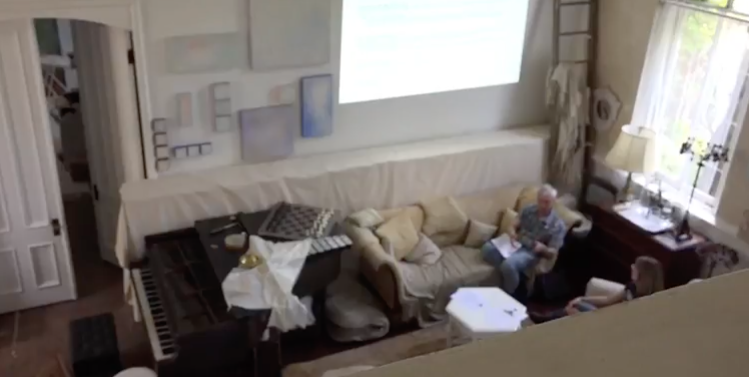
Screenshot of Zoom recording from Dec. 11 ZBA meeting

By Marissa Marvelli

On Thursday, December 11, nearly six months after its last deliberation, the five-member Zoning Board of Appeals (ZBA) unanimously reversed its June 12 decision regarding the historic Sleight-Tappen/DAR House windows. Over three hours, the board, led by chair Anthony Tampone Jr., carefully applied the preservation review criteria that guide the Historic Landmarks Preservation Commission (HLPC) in evaluating changes to landmark-designated buildings and districts. Members repeatedly cited the extensive record compiled since 2021, when the Wiltwyck Chapter of the Daughters of the American Revolution (DAR) was first notified that exterior work on the building required review. Assistant Corporation Counsel Matt Jankowski aided the board in drafting a detailed decision typical of the HLPC.

During deliberations, Tampone and other members acknowledged that the board had been misled back in June about the proposed replacement windows. Contrary to the DAR’s prior assertions, the windows are not “exact replicas” of the existing historic windows; they are generic replacements. Tampone explained that he personally confirmed  this by contacting a Marvin window representative, who said that the measurements that were taken were only of the overall openings, and not any of the other window details. The board engaged in a lengthy discussion about the special qualities of historic windows, how they differ from modern replacements, and how the cumulative effect of 32 rigidly square contemporary windows would diminish the architectural integrity of one of the Stockade’s significant historic buildings. Members also noted that, in a 2023 affidavit, the DAR itself admitted that restoring the historic windows would have been more cost-effective. Board members struggled to understand why they did not go that route. The costs associated with replacements have undoubtedly increased since the chapter engaged in a protracted legal dispute.

The DAR’s attorney, James Bacon, a sitting judge in New Paltz, was the sole representative of the applicant present. The board permitted him to testify before their deliberation began. Much of his case consisted of recycled arguments already refuted or dismissed by both the ZBA and HLPC. Most notably, Bacon again asserted—incorrectly—that only federal recognition of a building’s individual significance permits regulatory control over exterior features. The City of Kingston, a certified local government with a historic preservation ordinance, has the authority to carry out municipal responsibilities for its historic preservation program. It is largely carried out by its trained and qualified commission, the HLPC, which reviews and approves exterior changes to its locally designated landmarks and in local historic districts. The DAR House is both an individually designated landmark (since 1969) and a contributing building in the Stockade Historic District. The building’s—or district’s—listing on the National Register of Historic Places is irrelevant to the City’s authority in this matter.

Generously interpreting an old brochure of preservation guidelines, Bacon repeated the DAR’s justification for failing to seek HLPC approval before expending $65,000 on Marvin replacement windows in March 2022, the same month Kingston Planning Director Suzanne Cahill contacted the chapter for a second time to confirm that exterior work required review. The DAR has previously admitted that it did not consult the City of Kingston’s administrative code before proceeding.

The credibility of the DAR’s case was further undermined when Chair Tampone questioned Bacon’s submission of what was plainly an AI-generated query summary as an exhibit for the record. Under questioning, Bacon explained that he was unaware the document was AI-generated and that it had come from Kaaren Davis, the chapter’s treasurer, and originated with her son, Harley Davis, whom Bacon stated is also the contractor for the window replacement project. Bacon agreed it should be removed from the record, adding that he would not have accepted such a submission in his own court.

What was made abundantly obvious last night is the urgent need to address the ambiguity in Kingston’s administrative code. A questionable interpretation by the Corporation Counsel forced the ZBA to serve as a de facto landmarks commission without the requisite training, expertise, or experience. While the ZBA members should be applauded for their thoughtful deliberation last night, they should never have been put in the position of re-deciding the HLPC’s certificate of appropriateness decision rather than its subsequent hardship denial. A code amendment is now being prepared for Common Council adoption in the new year.

What’s Next?

The unanimous ZBA decision is not the end of this advocacy effort. The DAR will likely return to court for judicial relief, where a single judge, Honorable Sharon Graff, could overrule the hundreds of hours expended by city staff, volunteers on the HLPC and ZBA, and advocates to review, uphold, and defend Kingston’s preservation law. Graff is more likely to side with the DAR—and possibly award them financial compensation—in the absence of a response from City of Kingston’s Corporation Counsel Barbara Graves-Poller, who, to date, has not publicly acknowledged the DAR’s article 78 petition filed in State Supreme Court on July 25, despite the frivolous nature of the suit.

Civic engagement is not episodic; it’s a daily practice. Meaningful change, whether in historic preservation, zoning reform, affordable housing, or charter reform, is a long game that depends on sustained public participation. Almost without exception, high-stakes conflicts like the DAR House case expose the weaknesses in our democracy. Here, that weakness is Kingston’s strong-mayor form of government, codified in our three-decades-old “city manager” charter. Just weeks after receiving a controversial $30,000 salary increase, Graves-Poller continues to operate within a system in which her office serves at the mayor’s pleasure. With Mayor Steve Noble up for re-election in 2027, this structure inherently discourages independent representation of the Common Council when disagreements between the two branches arise. The DAR House case is simply the latest instance in which this flaw has been exposed.


Call to Action: 

  1. Demand a strong legal defense. Write to Mayor Steve Noble and urge him to direct the Corporation Counsel’s office to defend the hard work of the HLPC, ZBA, and city staff on the DAR matter in court. These volunteer boards and public servants followed the law and deserve the city’s full backing in court. Letters can be emailed to SN****@*********ny.gov or mailed to Office of the Mayor, 420 Broadway, Kingston, NY 12401.
  2. Show up and speak out. Use the public comment period at monthly Common Council meetings to urge the Council to have its own staff, specifically, an independent counsel and independent clerk. This independence is essential for good governance and for the Council to effectively carry out its responsibilities, especially as it prepares to oversee the city charter review process in 2026-2027, a process the Mayor recently declined to support. The next council meeting is on Wednesday, December 17. The following hearing will be Tuesday, January 6, when four new council members, including myself, will be sworn in.


Background Reading

Preserving Our History and the Laws That Protect It  KingstonCitizens.org, Aug. 20, 2025

Local Chapter of the Daughters of the American Revolution Battling Against Kingston’s Historic Preservation Law”   KingstonCitizens.org, July 3, 2025

Kingston slaps stone house with stop-work order over window renovations  by Brian Hubert, Daily Freeman, July 25, 2025.


Correction (December 15, 2025): This post previously misstated the year of the Mayoral election. It is in 2027 and has been corrected here.

Register today: Civics 101: The People’s Guide to Local Government


Registration open!  Civics 101:  The People’s Guide to Local Government 
Facilitated by Rebecca Martin, co-founder of KingstonCitizens.org

Strong communities start with an informed public. Civics 101 gives everyone in Kingston the tools to understand, engage with, and shape local government — strengthening good government and building people power.

  • Explore the City of Kingston’s website and learn how local government works.

  • Hear directly from staff and elected officials as they share their expertise and explain the processes they oversee.

  • Gain practical tools and strategies to participate confidently in public life.

We especially encourage young people to attend — as elders, we are mentors, and we want to help you learn how to engage. Your current and future participation is critical! If you are a teacher in the Kingston City School District or a professor at Bard College, please share this opportunity with your students. We’re working on a Spanish translator and will provide a living document of all topics and resources discussed for future reference.

It’s free. It’s virtual. It’s for everyone.  Register today and help build a stronger, more engaged Kingston.

For more information, visit KingstonCitizens.org or contact ou*********@***il.com


2026 Sessions 

REGISTER: Tuesday, January 13, 6-8pm
Second hour: Discussion on school and property tax
With special Guest: Town Supervisor Tim Rogers

REGISTER: Monday, April 13, 6-8pm
Second hour: City of Kingston Charter Reform
With special Guests: Ward 9 Council member Michele Hirsch

REGISTER: Tuesday, July 14, 6-8pm (POSTPONED)
Second hour: Discussion on City of Kingston’s Payments-in-Lieu of Taxes (PILOTs) 
With special Guest: City of Kingston Assessor Daniel P. Baker

REGISTER:  Tuesday, October 13, 6-8pm (POSTPONED)
Second hour: Discussion on City of Kingston’s Boards, Committees and Commissions
With special Guest: City of Kingston Mayor Steve Noble


###

About Rebecca Martin: Rebecca is a seasoned organizer and advocate with over 20 years of experience in coalition-building, strategic communications, and civic engagement. Originally from Maine, she has lived in the Hudson Valley since 2000, where she has worked to empower communities and promote government transparency. In Kingston, NY, she co-founded KingstonCitizens.org, leading initiatives such as the successful campaign to stop Niagara Bottling from purchasing the city’s municipal water supply and a Water Powers Referendum to secure public oversight of future water sales. As the first Executive Director of the Kingston Land Trust, she launched nationally recognized programs in urban agriculture, rail trail development, and the protection of African-American heritage sites.  At Riverkeeper, she served as Campaign Manager and Director of Community Partnerships, where she helped establish the Hudson 7, and co-founded the Water Justice Lab in Troy, NY.  She currently serves as Source Water Protection Coordinator for the Hudson 7 and managed a major report on the threat of landfill leachate to drinking water. In 2025, she joined Beyond Plastics as Director of Community Partnerships and Training, where she is building a Community Partnerships Program and leading grassroots advocacy and speaker trainings in the fight against plastic pollution.

Thanks to local artist Anna Gilmore for her work in designing our civics logo.

The People’s Guide to Local Government​: Civics 101 – How to Engage with Power, Process, and Purpose in the City of Kingston


KingstonCitizens.org is gearing up to sponsor a free, quarterly, remote training series, open to all levels of experience. These trainings are designed to help Kingston community members better understand how local government works and to equip them with the knowledge, tools, and confidence to be informed, effective, and engaged civic participants.

There has never been a more important time to be a collaborative, informed community member at the local level. We’ll be announcing training dates soon.

To stay informed and receive updates, join our mailing list or follow us on Facebook.

Support Zero Waste in Ulster County and Reject Polluting Incineration and So-Called “Waste-to-Energy” Projects

In a recent post titled “Stop Exporting Waste, Oppose Polluting Incineration, and Tackle Waste at the Source in Ulster County” KingstonCitizens.org and TownOfUlsterCitizens.org exposed a troubling development: a bipartisan group of Ulster County legislators recently toured ReWorld’s so-called “waste-to-energy” incinerator in Hempstead, Long Island. The plant, formerly owned by Covanta but since acquired by Reworld, takes in more than 2,600 tons of primarily residential trash a day and after incineration produces up to 650 tons of ash, which is then dumped – in part if not all – at the Brookhaven Landfill.

The Brookhaven Landfill sits in the backyard of our friend Monique Fitzgerald—an environmental justice organizer and co-founder of the Brookhaven Landfill Action and Remediation Group (BLARG). Monique lives in North Bellport, a predominantly Black and Latino community with the lowest life expectancy on Long Island and the second-highest asthma rate in Suffolk County. “The Brookhaven Landfill is the site of a major crisis,” Monique says, “polluting the air, land, and water of surrounding communities.”

In a recent letter to The Suffolk Times: “Waste to Energy Argument Doesn’t Hold Up, she warned: “Labeling incineration as ‘renewable energy’ rewards polluters and harms vulnerable communities…Covanta (Reworld) Hempstead has repeatedly violated environmental standards. DEC’s failure to conduct in-stack monitoring has left critical gaps in understanding the true extent of pollution from this site. The Town of Brookhaven’s $1 million settlement falls far short of remediating the harm done to the community.”

Currently, Ulster County legislators are in talks with Sullivan County about exploring the potential of a ReWorld incinerator in Sullivan County that would require 500,000–900,000 tons of waste per year.  Sullivan produces just 120,000; Ulster produces 140,000. They’d need additional counties to partner in order to get their waste tonnage to meet ReWorld’s required threshold for operation. A 20-year commitment would lock both counties into a polluting system, and seriously undermine any credible path toward Zero Waste.

This is not an easy subject, and there are many moving parts around managing Ulster County’s waste.  For now, please consider attending tomorrow’s Ulster County Legislature meeting to speak during public comment. 

Take action. 

The public must act now to shut down any discussions about polluting incineration or so-called “waste-to-energy” projects for our trash in Ulster County, whether proposed in our county or elsewhere. Although these talks are currently happening in committee and not yet on the full county legislature’s agenda, the public can still make its voice heard. Community members are encouraged to show up at legislative meetings and speak during the public comment period on this issue before harmful decisions are made in the background.


WHAT

Provide public comment during Ulster County Legislature meetings

WHERE

Ulster County Legislative Offices located at 244 Fair Street, 6th floor

WHEN

The next one is Tuesday, May 20 at 6:45pm. They meet third Tuesday of each month

HOW

Sign-up to speak after 6:00pm on the 6th floor of the county building.  Comments must be no more than 2-minutes in length (approximately 260 words)


TALKING POINTS

To help you further, we’ve created this FACT SHEET with more information.   

    • Manage Waste Locally and Responsibly: Ulster County must take responsibility for its own waste instead of sending it to other communities that bear the environmental and health impacts. 
    • Say No to Incineration and so-called “Waste-to-Energy”: Incinerators and so-called “waste-to-energy” facilities pollute the air, harm frontline communities, and undermine real solutions to the waste crisis. These private businesses profit by burning more trash – not less – discouraging recycling, composting, and waste reduction. 
    • Ulster County 2020 Solid Waste Plan: The county’s 2020 Solid Waste Management Plan focused on zero waste strategies and not incineration. That commitment should be upheld, not reversed. 
    • Support a Zero Waste Implementation Plan: Ulster County Resource Recovery Agency (UCRRA) is working toward a Zero Waste Implementation Plan. They must be supported to finalize this plan and create a public, transparent timeline so residents and legislators can track progress, support efforts, and avoid unexpected policy shifts. 
    • Support Proven Waste Reduction Strategies: Ulster County should explore successful models like Vermont’s Universal Recycling Law (Act 148), fully implemented by 2020,  bans food scraps from landfills, significantly increasing composting efforts and reducing greenhouse gas emissions and implement initiatives such as “pay-as-you-throw” programs. These approaches incentivize waste reduction and help shift us away from a throwaway culture toward more responsible, sustainable behavior.

Stop Exporting Waste, Oppose Polluting Incineration, and Tackle Waste at the Source in Ulster County


WHAT
Provide public comment during Ulster County Legislature meetings

WHERE
Ulster County Legislative Offices located at 244 Fair Street, 6th floor

WHEN
The next one is Tuesday, May 20 at 6:45pm. They meet third Tuesday of each month

WHY
Urge the Ulster County Legislature to focus on managing our waste locally and transparently.  They must say no to polluting incineration or so-called “waste to energy” projects that are toxic, polluting and false solutions.  The public deserves a clear, accessible roadmap that outlines the county’s plans, proposed policies, and legislation posted on a public-facing web page. These steps should be guided by the Zero Waste Hierarchy, prioritizing waste reduction, reuse, and responsible resource management.”

HOW
Sign-up to speak after 6:00pm on the 6th floor of the county building.  Comments must be no more than 2-minutes in length (approximately 260 words)

__________________________________________________________

A collaborative post by KingstonCitizens.org and TownOfUlsterCitizens.org

New York State is known for its progressive environmental policies, but its waste management practices tell a different story. Every day, trash from cities like Kingston is hauled more than 500 miles round trip to Seneca Meadows, the state’s largest landfill, located in Seneca Falls, a small community of approximately 8,800 people.  These residents unfairly bear the burden of much of New York State’s waste – pollution, heavy truck traffic, foul odors, and long-term environmental degradation.  With the landfill’s permit up for renewal, residents are calling for its closure by December 31, 2025, 2 and we fully support their demand.  

Despite knowing for nearly a decade about the impending closure of Seneca Meadows, Ulster County still lacks a clear county-wide plan for responsibly managing its own waste.

Ulster County Resource Recovery Agency (“UCRRA”) currently sends 140,000 tons of Municipal Solid Waste (“MSW”) and Construction & Demolition (“C&D”) debris to the Seneca Meadows landfill in Seneca Falls, which is approximately 253 miles each way, averaging 12 trips a day, six days a week. 3

At the same time, several of our Ulster County Legislators think incineration and other so-called “waste-to-energy” projects are a solution to waste management, but incineration is just another harmful approach that exposes those living nearby to toxic pollutants like dioxins, mercury and other highly toxic metals, nitrogen oxides (triggers asthma attacks) and fine particulate matter that threaten public health and the environment.  The process also generates toxic ash that is also being landfilled in a more concentrated, dangerous form. Incineration doesn’t solve our waste problem; it compounds it. 

Furthermore, it is inefficient at producing energy. For instance, the trash incinerator in Peekskill (the largest in the Hudson Valley) produces only 1/10th as much electricity as the Cricket Valley gas-fired power plant. 4

“Trash incineration is the most expensive and polluting way to manage waste or to make energy,” said Mike Ewall, Executive Director of Energy Justice Network and one of our longstanding, key partners. “It is dirtier than landfilling and, as the state has documented, is more polluting than coal burning.”5

The disparity in New York’s environmental policies

The push for incineration and then the continued reliance on exporting our trash to landfills and incinerators in other counties and states reminds us of our fracking moratorium. In 2014, the state banned hydraulic fracturing (fracking) due to its environmental and health risks. However, we continue to import fracked gas from other states.

New York’s climate goals also expose another contradiction: the Champlain Hudson Power Express (CHPE) project. This hydropower initiative brings energy from Quebec to New York, but it comes at the cost of flooding rivers and disrupting ecosystems in Canada, displacing Indigenous communities in the process. 6 

If we are serious about environmental justice, New York must stop neglecting the communities bearing the brunt of our waste. The state has a history of greenwashing – promising change while allowing harmful practices to persist. Real progress means addressing our waste locally, not shifting the burden onto others. And instead of relying on harmful waste management methods like incineration or exporting trash to landfills and incinerators in other counties and states, we must focus on reducing waste at its source through systemic change, and develop our own in-county, publicly-owned disposal capacity to handle our own waste responsibly. This includes mandating composting to divert organic material from landfills and incinerators, banning single-use plastics and excessive packaging, and holding manufacturers accountable for the waste their products generate. Public education is crucial, as people need to understand the environmental impact of their consumption and what they can do to reduce it. Waste management solutions should be localized, equitable, and designed to serve, not burden, communities.

In Ulster County, composting should be mandatory, just like wearing a seatbelt. Just as seatbelt laws protect public safety, mandatory composting is essential for reducing waste, cutting methane emissions, and conserving valuable resources. It’s an easy, effective way for everyone to contribute to responsible waste management because, like seatbelt laws, it’s about the collective good, not just individual choice.

Reducing waste instead of investing in polluting alternatives

In 2024, the Sullivan County Legislature began exploring the development of a so-called “Waste to Energy” plant in the county. In January, Ulster County Legislator Kevin Roberts persuaded Sullivan County to pass a resolution opposing a landfill in Wawarsing, suggesting that Ulster County might instead partner with Sullivan to bring a Covanta facility to the region. 7

In April, a bipartisan group of Ulster County legislators and guests toured Covanta’s incinerator in Westbury, Long Island – a troubling sign that outdated, polluting waste management strategies are still being considered. Since the tour, proponents have been actively circulating Covanta presentations and research in support of a regional so-called “waste to energy” facility. At the May meeting of the Energy and Environment Committee, committee members – including three legislators who participated in the tour – held an extended discussion on the potential benefits of bringing this polluting plant to the region. 8

Let’s be clear: incineration is not a solution. Studies have shown that incineration (and landfilling toxic ash) is 2-3 times more harmful for health and environment than going directly to landfills without burning first, and most of the landfill impacts can be reduced if we keep food scraps and yard waste out of them by composting.  Instead of doubling down on harmful infrastructure, our leaders need to work with the public to develop systems that reflect the principles of the Zero Waste Hierarchy. This framework defines Zero Waste as the conservation of all resources by means of responsible production, consumption, reuse, and recovery of products, packaging, and materials without burning and with no discharges to land, water, or air that threaten the environment or human health. It offers a guide for real systemic change that prioritizes waste prevention and community well-being. 

Ulster County already has a promising composting program, with plans in the works for its expansion. Our county legislators should focus on engaging the public to support the Ulster County Resource Recovery Agency in investing in this program, rather than touring incinerators.  It’s a non-starter.

Take action. 

The public must act now to shut down any discussions about polluting incineration or so-called “waste-to-energy” projects for our trash in Ulster County, whether proposed in our county or elsewhere. Although these talks are currently happening in committee and not yet on the full county legislature’s agenda, the public can still make its voice heard. Community members are encouraged to show up at legislative meetings and speak during the public comment period on this issue before harmful decisions are made in the background.

WHAT
Provide public comment during Ulster County Legislature meetings

WHERE
Ulster County Legislative Offices located at 244 Fair Street, 6th floor

WHEN
The next one is Tuesday, May 20 at 6:45pm. They meet third Tuesday of each month

WHY
Urge the Ulster County Legislature to focus on managing our waste locally and transparently.  They must say no to  incineration or so-called “waste to energy” projects that are toxic, polluting and false solutions.  The public deserves a clear, accessible roadmap that outlines the county’s plans, proposed policies, and legislation posted on a public-facing web page. These steps should be guided by the Zero Waste Hierarchy, prioritizing waste reduction, reuse, and responsible resource management.”

HOW
Sign-up to speak after 6:00pm on the 6th floor of the county building.  Comments must be no more than 2-minutes in length (approximately 260 words)


CITATIONS

(1) https://www.census.gov/quickfacts/fact/table/senecafallstownsenecacountynewyork/PST045224
(2) https://spectrumlocalnews.com/nys/central-ny/politics/2025/04/02/demonstrators-protest-seneca-falls-town-board-s-approval-of-landfill-operating-permit
(3) https://extapps.dec.ny.gov/fs/projects/SWMF/Annual%20Reports_Solid%20Waste%20Management%20Facility/Annual%20Reports_by%20Activity%20Type/Landfill/Landfill%20Annual%20Reports%20-%202023/R8/50S08_Seneca_Meadows_msw_R8_2023.2024-3-1.AR.pdf
(4) https://www.eia.gov/electricity/data/eia923/
(5) https://energyjustice.net/incineration/
(6) https://www.youtube.com/watch?v=efSb1H2Aq0I
(7) https://citizenportal.ai/articles/2144459/Sullivan-County/New-York/Ulster-County-leaders-urged-to-oppose-controversial-landfill-near-Sullivan-County-border
(8) https://www.youtube.com/watch?v=AmAKJyOriuI


ADDITIONAL RESOURCES 

VIDEO: SEQR 101 Public Educational Forum

By Rebecca Martin

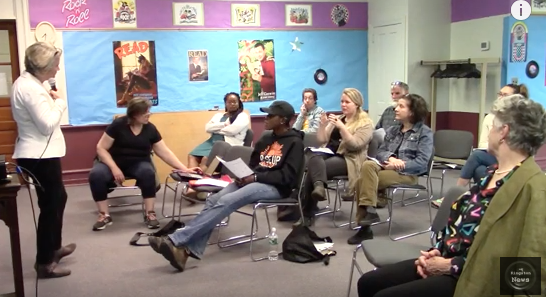
On Tuesday, May 21, KingstonCitizens.org in partnership with the Kingston Tenants Union hosted a public educational forum on SEQR 101.  Video from our event was created by The Kingston News brought to you by KingstonCitizens.org.

The event’s AGENDA is available with valuable links to resources on page two.

Thanks to Jennifer O’Donnell for bringing her knowledge and experience on the subject to our community.

Read more…

Zoning, the Mixed Use Overlay District, Comprehensive Plans and the Kingstonian Project

A comprehensive plan is a powerful document in New York State that creates a framework for making important decisions while guiding growth and development. Kingston’s own plan, adopted by the Common Council in April 2016, quite forcefully calls for an affordable housing requirement in new developments:

“Strategy 1.1.2: Require affordable housing for any new or expanded residential building or development project.  The City should consider expanding the number of projects that must provide a ‘fair share’ of affordable housing. Currently, affordable housing is only required for projects taking advantage of the mixed-use overlay district provisions.” (p. 21, Kingston 2025)

The City of Kingston continued to promote that goal in its 2017 Downtown Revitalization Initiative (DRI) application in which the Kingstonian Project was proposed:

“Housing development in the Stockade Business District (SBD) has been limited, and a significant percentage of renters in the SBD and surrounding area are cost burdened, spending more than 30% of their incomes on housing costs.”  (Executive Summary of the City of Kingston’s 2017 DRI application).

However, in February of 2019, the developers of the Kingstonian Project submitted an application that includes 129 market-rate residential units in the Stockade District. The mandate for affordable housing that is outlined in Kingston’s Comprehensive Plan seems to be ignored with this substantial project.

Read more…

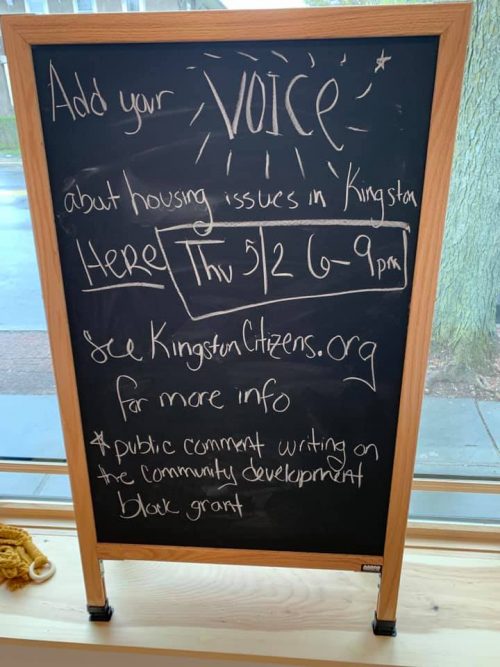
VIDEO/GOOGLE DOC: Public Comment Workshop for the Five Year CDBG Consolidated Strategy Plan

“Why does the city suggest that SEQR is viewed as a barrier when it’s a passive voice? By whom is it viewed as a barrier? The language should be more specific if that is the case….The environmental reviews are a part of doing business. A municipality should be careful about characterizing it negatively in a report as it is something that protects the environment, economic and social factors in our community.”   a comment from the public during the recent workshop re: the five year CDBG Consolidated Strategic Plan

By Rebecca Martin

Last week, KingstonCitizens.org in partnership with the Kingston Tenants Union and the Kingston Land Trust hosted a public comment workshop event for the Five-Year CDGB Consolidated Plan, Fair Housing Plan, and Annual Action Plan Federal Fiscal (2019).  With about 20 citizens in attendance, the group outlined 57 new comments that we’ll be submitting (along with more we hope) when the public comment closes on May 15th.

The City of Kingston extended the public comment deadline for 10 days (to May 15th) on the afternoon of our workshop. This will allow the public more time to look over and to comment on the plan.  It’s so important for the public to do so, as it is only created just once every five years.

Read more…

KingstonCitizens.org presents a Public Educational Forum “Historic Preservation in the City of Kingston: Rethinking the Review Process”

Photo courtesy of Friends of Historic Kingston.

KingstonCitizens.org presents the public educational forum “Historic Preservation in the City of Kingston: Rethinking the Review Process” on Monday, May 14th from 6 – 8 pm at Kingston City Hall in partnership with the City of Kingston and Friends of Historic Kingston.  Guest panelists will include the Mayor of Kingston and experts from the Kingston Historic Landmarks Preservation Commission, Heritage Area Commission, New York State Historic Preservation Office (SHPO) and Preservation League of New York.

Kingston, NY.  KingstonCitizens.org, in partnership with the City of Kingston and the Friends of Historic Kingston, will host the public educational forum “Historic Preservation in the City of Kingston: Rethinking the Review Process” on Monday, May 14th from 6 – 8 pm at Kingston City Hall, Council Chambers located at 420 Broadway in Kingston.

Panelists will include City of Kingston Mayor Steve Noble; Marissa Marvelli, Vice Chair of the City of Kingston Historic Landmarks Preservation Commission; Hayes Clement, Chair and Kevin McEvoy, Secretary of the City of Kingston Heritage Area; Linda Mackey, SHPO CLG (Certifed Local Government) Representative for Ulster County of NYS SHPO; and Erin Tobin, Vice President for Policy and Preservation of the Preservation League of New York.

The group was assembled to share best practices for streamlining Kingston’s Historic Commissions in response to recent legislation introduced to the Kingston Common Council by the Mayor’s office. Streamlining Historic Commissions was a recommendation made by the consultant Shuster and Turner in their document “Comprehensive Amendments to the City of Kingston’s Zoning Law” hired by the City of Kingston in 2013 to lead its first Comprehensive Planning process since 1961.

A public question and answer period will follow the panelist presentations. This event will be filmed by The Kingston News.

“We are pleased to work with our community partners to share best practices in historic preservation and explore the challenges and opportunities ahead as we consider updates to our City commissions,” said Mayor Steve Noble. “It is fitting that this educational forum will be held in one of Kingston’s most notable historic preservation projects- our beautiful City Hall. Its restoration is a testament to Kingston’s ability to work together for the betterment of our community.”“

“Kingston’s Historic Landmarks Preservation Commission was created in 1966 in direct response to the urban renewal-driven destruction of the Rondout.” said Marissa Marvelli, the Vice Chair of Kingston’s Historic Landmarks Preservation Commission, who will also be a panelist on the 14th.  “The drafting of the city’s first preservation laws and amendments was a collaborative effort of preservation-minded citizens and members of the Common Council. Today’s Landmarks Commission continues its original purpose: ‘for the promotion of the educational, cultural, economic, and general welfare of the public through the protection, enhancement, perpetuation, and preservation of Landmarks and Landmarks Districts.’ The effectiveness of the city’s preservation program is dependent on the strength and clarity of its ordinance.”

“There are many pressing issues in the City of Kingston, and assuring the protection of our historic assets is certainly one of them,” says Rebecca Martin, lead organizer and, co-founder of KingstonCitizens.org, who will also moderate the event. “With legislation on the table, creating an opportunity to take an in-depth look at Kingston’s historic preservation is both timely and essential.”

For more information, contact Rebecca Martin at re*****@**************ns.org or call 845/750-7295

###

About KingstonCitizens.org.  Established in 2006, KingstonCitizens.org is a community-based group committed to improving the quality of life of Kingston residents through accountability and transparency of local government. By providing citizens with timely and factual information, our work is meant to nurture citizen participation and empowerment through projects, education, and advocacy.

About the City of Kingston.  Kingston, dating to the arrival of the Dutch in 1652, is a vibrant city with rich history and architecture, was the state’s first capital, and a thriving arts community.

About Friends of Historic Kingston.  The Friends of Historic Kingston are charged in preserving historical and architecturally significant buildings and sites in the City of Kingston; To promote and foster interest in the historical heritage and beauty of Kingston and, to acquire, preserve and exhibit materials relating to regional history and culture.

About the City of Kingston Historic Landmarks Preservation Commission. The Historic Landmarks Preservation Commission (HLPC) is a quasi-judicial body of Kingston citizens whose duties and procedures are outlined in Chapter 405, Article IX of the city’s administrative code. Its seven volunteer members are appointed by the mayor to administer the designation and preservation of Kingston’s individual landmarks and four historic districts. Current members have expertise in preservation planning, historic architecture, restoration arts, law, history, and real estate. The commission holds public hearings the first Thursday of each month where it reviews applications for work to historic properties and discusses matters related to public education about the protection and perpetuation of the city’s built heritage.

About the City of Kingston’s Heritage Area Commission.  The Heritage Area Commission is charged with the responsibility of advising the Mayor and the Common Council on all matters related to the Kingston Heritage Area and its programs in a manner consistent with the concepts, goals and objectives set forth in relevant state and local legislation regarding New York State Heritage Areas and in the Urban Cultural Park Management Plan.

About the State Historic Preservation Office (SHPO).  The SHPO works with governments, the public, and educational and not-for-profit organizations to raise historic preservation awareness, to instill in New Yorkers a sense of pride in the state’s unique history and to encourage heritage tourism and community revitalization.  The SHPO administers programs authorized by both the National Historic Preservation Act of 1966 and the New York State Historic Preservation Act of 1980. These programs, including the Statewide Historic Resources Survey, the New York State and National Registers of Historic Places, the federal historic rehabilitation tax credit, the Certified Local Government program, the state historic preservation grants program, state and federal environmental review, and a wide range of technical assistance, are provided through a network of teams assigned to territories across the state.

About the Preservation League of New York.  The Preservation League of New York State invests in people and projects that champion the essential role of preservation in community revitalization, sustainable economic growth and the protection of our historic buildings and landscapes. We lead advocacy, economic development and education programs across the state.

A More Democratic Approach to Public Meeting Discussions in the City of Kingston.

By Hillary Harvey
hi*****@**************ns.org

The Historic Landmarks Preservation Commission (HLPC) recently chose to change its format to allow the public an opportunity to participate on applications in real time, creating a more democratic format for both the applicant and the public. The changes provide a model of a more participatory meeting format that all City of Kingston boards, committees and commissions  might consider applying.

Currently, in the City of Kingston, the majority of committees and subcommittees offer public speaking at the discretion of the committee chair.  It is possible to reach out to the chair ahead of a meeting to let him/her know that citizens would like time to present comments or questions.

Read more…

VIDEO: KingstonCitizens.org 2017 Educational Series “On Public Education”

                                         Click on image to view video


By Rebecca Martin

We are just about half way through our educational series this year, with this recent panel on “Public Education” that was so enlightening.  Did you know that every summer, the Kingston City School District re-writes curriculum to supplement “Engage NY” by selected teachers in the district? Or that only 1% of the school district’s budget is federal dollars?

A special thanks to Robin Jacobowitz and James Shaugnessy for their time and service to our community.  As always, to Julie, Peter, Matthew and staff at “Church Des Artistes” for hosting us.

Read more…

PARTICIPATE! Attend Regular Ulster County Legislature and City of Kingston Council Meetings.

By Rebecca Martin

How can we improve local government? By becoming more civic-minded rather than a single issue participant and attending regular, monthly meetings of both the Ulster County Legislature and City of Kingston Common Council.  That’s a potent and simple place to start.

To help you to get on your way, KingstonCitizens.org has put together a schedule of 2017  for both elected bodies.   “Many hands make light work” as they say. If each of us attended one or two meetings a year and shared what we witnessed – the landscape would look and feel very different.

Here are simple steps you can take to become a more engaged, local citizen.

  1. Sign up for the dates and times that are most convenient for your schedule (see below)
  2. Attend meetings. Make sure you check the calendar prior to attending, as all dates/times are subject to change (see below).  Make sure you add the dates to your personal calendar so you are reminded of your commitments.
  3. Write a one-page (or more) summation of your experience.  What happened that evening? How many citizens were present? Did you speak during public comment? What issues were discussed?  What significant decisions were made?  What did you learn and what outcome would you like to see on the issues that were discussed that evening?
  4. Submit your piece to KingstonCitizens.org:  re*****@**************ns.org to be shared in our “Citizen Opinions” section (rules apply).
  5. We can help you to identify your council and legislative representatives and will encourage you to send a copy of your report directly to them as well.


Get Started. 

  1. Ulster County Legislature:  Dem/Rep Caucus and Regular Legislative Session
    1. VIEW:  Visit this link and choose dates and times that work for your schedule.
    2. VIEW:   Check the Ulster County Legislature Calendar a week prior to your meeting. Dates/times may be subject to change.  You can also access an agenda at the legislative site.
  2. Kingston Common Council: Caucus and Regular Meeting
    1. VIEW  Visit this link and choose dates and times that work for your schedule.
    2. VIEW: Check the City of Kingston municipal calendar a week prior to your meeting. Dates/times may be subject to change. You can also access an agenda at the City of Kingston website.

If you have any questions, please don’t hesitate to reach out.  Join us in becoming familiar with local government.

FAQ Sheet and Call To Action: Proposed Ban on Memorializing Resolutions Vote April 18.

CALL TO ACTION.

Legislative Members  VIEW

Please call your Ulster County Legislator today and ask that they reject Resolution No. 91 “Amending The Rules Of Order To Prohibit Memorializing Resolutions” on April 18th.     “It is important to me that you do not support a ban on the memorializing resolution process. A ban is undemocratic and infringes on my first amendment right to petition.”

Plan to attend the next Ulster County regular legislative meeting on Tuesday, April 18th at 7:00 pm at the Ulster County Office Building located at 244 Fair Street, 6th Floor in Kingston, NY.  Arrive at 6:30 pm to sign-up to speak and to get a seat.  Citizens are encouraged to create a two (2) minute testimony that is respectful and succinct.

###

In March of 2017, Resolution No. 91, a proposed ban on memorializing resolutions,  had its first reading (see video below).  In order to change a local law, that’s step one in the process.  On April 18th, the resolution will be read a final time before it goes to vote.

Here are the facts. (**)

Is a letter from the legislature as effective as a memorializing resolution?

No. Memorializing resolutions must be submitted to the Clerk of the Legislature by the sponsor(s), along with all other business of the session, by a specific deadline.  The appropriate standing committee is chosen based on the issue.  It is placed on the committee agenda and discussed at the regularly scheduled meeting, which is open to the public.  The members of the committee have the opportunity to discuss the MR in committee before voting to send it to the “floor” of the legislature for a vote in the upcoming session.  A letter is not an act of the legislature that invites group discussion in committee, requires a vote by that committee to be sent to the floor, and is then a part of the public process where the public sees the memorializing resolution and can attend the session to weigh in.

Why do proponents of the ban on Memorializing Resolutions claim that they take up too much time during regular legislative sessions?

In 2016, the rules were changed prohibiting discussion on Memorializing Resolutions during the legislative session.  However, procedure allows for members to call for a “long roll” (i.e., a one-by-one vote) so that they may speak on the issue.  KingstonCitizens.org believes that engaging in debate in a way that represents and involves the public is the legislature’s business. They are protecting our “right to petition” by creating an opportunity for our voices to be heard and for our petitions to have a real forum. A ban on memorializing resolutions discredits public participation, civic dialogue, due process and the First Amendment.

Why are memorializing resolutions important? 

Memorializing resolutions are statements of principles that do not become a local law or policy. They are “non-binding”. It is, effectively, a petition by one legislative body to other legislative bodies and lawmakers to provide a mechanism that allow citizens and the legislature to take a stand on important issues.

Why do the ban’s sponsors claim that Memorializing Resolutions have been used as a political tool? 

The sponsors have said that memorializing resolutions were used recently by the Democratic Caucus to polarize the legislative body over issues we have no control over.  Memorializing resolutions are a governing tool. Governing tools are non-partisan.

Two controversial memorializing resolutions were recently sponsored by Republicans and passed by the majority of the Ulster County Legislature. One, in fact,  just occurred in March of this year.  It was Resolution No. 92 “Requesting The New York State Legislature Introduce Legislation Expanding The Hate Crimes Law, New York Penal Law §485.05” (March 22, 2017). The other was  Resolution No. 253  “Opposing The Process Of Enactment And Certain Provisions Contained Within The New York SAFE Act”  (June 16th, 2015).


SOURCES  (**)

VIEW  “Commentary:  Ban on Memorializing Resolutions in Ulster County Legislature is Undemocratic” by Jennifer Schwartz Berky (Kingston Times, March 22, 2017)

VIDEO:  Ulster County Laws and Rules Committee Discuss Prohibiting Memorializing Resolutions Legislative Session

VIDEO: Ulster County Legislature 3/22/17: First Reading of Proposed Ban on Memorializing Resolutions