DEC Finalizes SEQRA Rulemaking to Implement Environmental Justice Siting Law

By Rebecca Martin

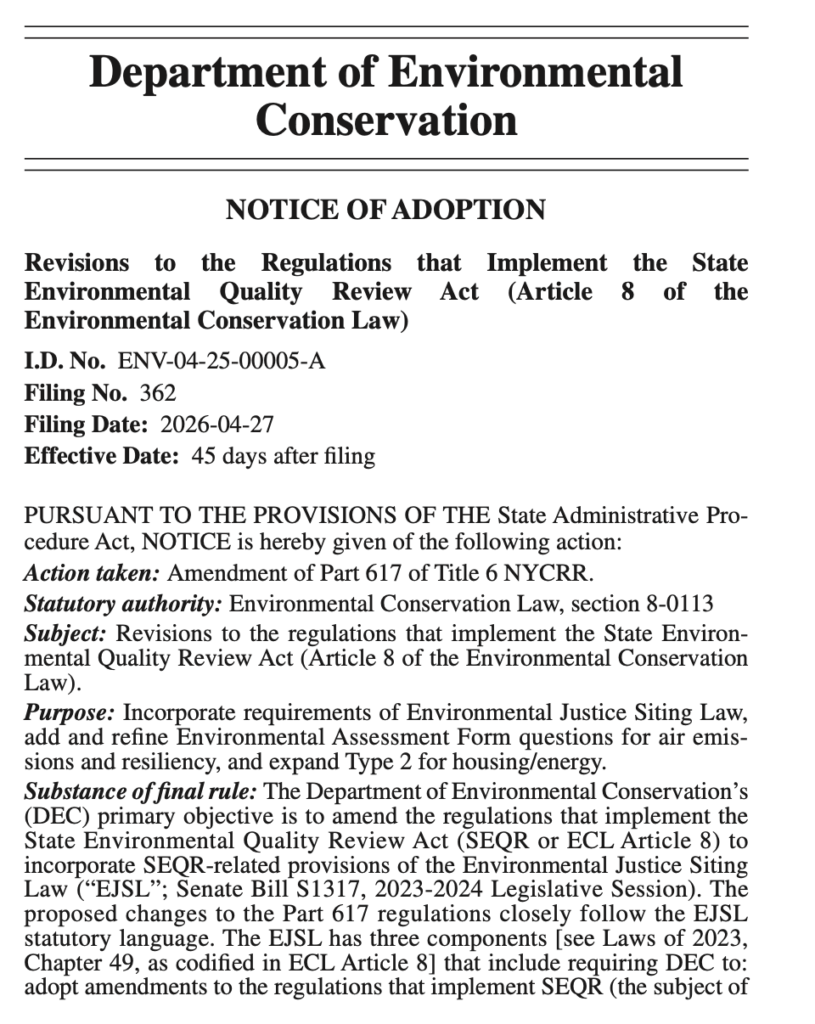
The New York State Department of Environmental Conservation (DEC) has finalized long-awaited updates to the State Environmental Quality Review Act (SEQRA) regulations to implement the Environmental Justice Siting Law. The agency adopted the final regulations on April 24, just ahead of the April 30, 2026 deadline (and posted on May 13). The regulations are scheduled to take effect on June 12.

These changes come at the same time Governor Hochul is proposing sweeping amendments to SEQRA through the state budget process, an expedited legislative mechanism that allows major policy changes to be enacted with limited public hearings and compressed review, reducing transparency and public scrutiny. In my view, using the budget process in this way goes beyond tilting the scales and concentrates too much power in a process not designed for this level of substantive policy change. It is more than a thumb on the scale—the governor is effectively sitting on it.

What SEQRA Is and Why It Matters

SEQRA is New York’s environmental review law. Since becoming effective in 1976, it has helped protect communities, public health, water, infrastructure, and natural resources by requiring government agencies to evaluate the potential impacts of major development projects before approvals are granted.

SEQRA is unique to New York State, and not every state has an equivalent environmental review process. It is one of the state’s primary tools for identifying environmental and community impacts, including traffic, air and water quality, noise, infrastructure strain, and cumulative effects. It also requires agencies and applicants to consider mitigation measures to avoid or reduce significant impacts before projects move forward.

This distinction becomes clear when looking at cases outside New York. During our fight against Niagara Bottling over a decade ago, after a five-month effort that helped push the company out of our area, KingstonCitizens.org followed their proposal to Bloomfield, Connecticut, where the community was at a significant disadvantage compared to New York communities. In Connecticut, the local water system was controlled at the state level, and there was no comparable environmental review framework like SEQRA to require the same level of public process and impact analysis.

As a result, despite local opposition, the small community ultimately lost its fight against a 432,000-square-foot Niagara Bottling facility that had originally been proposed for Ulster County. Experiences like this illustrate how important SEQRA is in New York—it is a safeguard that should be valued and improved through careful, transparent change, not dismantled or treated as an obstacle.

What the Environmental Justice Siting Law Requires

The Environmental Justice Siting Law requires decision-makers to consider whether proposed projects could have disproportionate impacts on disadvantaged communities. Until now, there has not been clear guidance explaining exactly how local governments were supposed to make those determinations during environmental review.

The updated regulations will revise the Environmental Assessment Form used during SEQRA review and add questions designed to better identify potential impacts on disadvantaged communities. DEC is also expected to update its SEQRA Handbook and related guidance so municipalities and applicants can apply the new requirements more consistently across the state.

Small Housing Projects and SEQRA Exemptions

The final regulations also expand certain SEQRA categories known as “Type II actions” for small multifamily housing projects. Type II actions are categories of development that are excluded from SEQRA environmental review because they are considered unlikely to result in significant adverse environmental impacts.

Under the DEC’s final rule, some multifamily projects with four or more housing units may qualify for this exemption if they are under 10,000 square feet, located on an approved lot, connected to existing public water and sewer service, allowed under local zoning either as-of-right or by special permit, and still subject to local site plan review.

These conditions limit the exemption to relatively small projects that DEC considers to have already been sufficiently evaluated through past environmental review experience, making additional SEQRA review unnecessary.

The Governor’s Proposal

At the same time, Governor Hochul has proposed separate changes to SEQRA through the state budget that would go significantly further than DEC’s rulemaking. Her proposal would exempt housing developments of up to 300 units in cities and 100 units outside cities from environmental review entirely, meaning it would allow much larger housing projects to bypass review than those covered under current DEC rules.  If enacted, those changes could override portions of DEC’s newly finalized framework, including its Type II exemption for small multifamily housing, meaning that although DEC’s rules may take effect on June 12, parts of them could later be superseded by broader exemptions adopted through the budget process.

Unlike DEC’s rulemaking, which was grounded in prior environmental review experience with smaller developments and included a public rulemaking process, the Governor’s proposal has not been accompanied by any publicly explained analysis or supporting data for the chosen unit thresholds, including review of past environmental review outcomes, Environmental Notice Bulletin filings, community input, or environmental justice impacts. The proposal has instead been advanced through the state budget process, where policy changes are negotiated and enacted as part of executive-led budget negotiations rather than through separate, standalone legislative hearings.

In a recent social media post defending her changes, Governor Hochul stated: “For too long, NIMBY culture has blocked the housing New Yorkers need. Not anymore.”  Her statement is a broad dismissal of her constituents, framing opposition as the problem rather than part of the democratic process.  This reflects a familiar political dynamic in which crises are used as justification to advance sweeping changes that would otherwise face greater scrutiny, including the rollback of environmental review protections.

What Happens Next

The difference between DEC’s rulemaking and the Governor’s proposal is substantial. DEC’s exemption applies only to relatively small projects and still operates within a broader environmental justice review framework. The Governor’s proposal, by contrast, would exempt far larger developments from SEQRA review entirely, including environmental justice considerations.

For now, DEC’s rulemaking is complete and the new regulations are scheduled to take effect on June 12. The focus will shift to how municipalities apply the updated requirements in practice and whether the Governor’s broader SEQRA proposal is ultimately adopted through the state budget process.

To help municipalities come up to speed once the budget process concludes,  local leadership should consider training for its boards, councils, trustees and committees who are most likely to serve as lead agencies for projects in their communities.

Communities in NYS without a zoning code may also want to prioritize adopting a comprehensive plan and zoning regulations. Doing so can provide clearer long-term direction for development decisions and help ensure that growth occurs in a way that reflects community priorities rather than leaving those decisions entirely to individual project proposals.


ADDITIONAL READING

70+ Local Leaders Rally Against Gov. Hochul’s Changes to NY’s Environmental Review Law (5/1/26)
Read the City of Kingston Planning Board’s letter (4/20/26)
Read the City of Kingston Common Council’s letter (3/27/26)
Read the City of Kingston Mayor’s letter (3/16/26)
Read the Kingston Conservation Advisory Council letter (3/5/26)

Guest Editorial: “Moving at the Speed of Need” – Revising New York’s Environmental Laws for Housing and Environmental Justice

By Jennifer O’Donnell, Hone Strategic LLC

New York is currently at a high-stakes crossroads in urban and environmental policy. Whether we are discussing the Expedited Land Use Review Procedure (ELURP) in New York City or the proposed State Environmental Quality Review Act (SEQRA) revisions in Albany, the mandate is clear: we must ‘build at the speed of need’ to solve our housing crisis. I see a recurring structural risk in these ‘fast-track’ models. Speed is a necessary objective, but it cannot be achieved by dismantling the very review processes that ensure development is compatible with our physical, historical, and climate limits. True efficiency in land use isn’t about bypassing scrutiny; it’s about refining it to incentivize growth where it is most sustainable. My analysis suggests a deeper structural risk.

Moving at the Speed of Need

Last week, NYC’s new Expedited Land Use Review Procedure (ELURP) underwent its first real-world tests (see Shelterforce story). With the Mamdani Administration and the Department of City Planning aiming to reduce review times from seven months to just 90 days, the “Manhattan Plan” is officially in motion.

I view this as a fascinating yet precarious crossroads, similar to the one we face with SEQRA in New York State.

There is consensus that the status quo is broken. We need at least 100,000 new homes in New York City and have a shortage of more than 800,000 in New York State, according to figures being used in Albany. However, the “Fast Track” approach requires more than just speed—it requires adaptation, resilience, and agency.

The new measures emphasize the 12 community districts with the lowest affordable housing production. While increasing density is a mechanical solution to the supply crisis, we must be cautious not to lose the character that defines our 19th-century commercial streetscapes.

I believe this new era calls for three key pillars:

  • Adaptive Integrity: Speed should facilitate the adaptive reuse of historic structures. “The greenest building is the one already built” (i.e., embodied energy is more environmentally sound than new construction) is a longstanding motto of the National Trust for Historic Preservation.
  • Climate-Resilient Infrastructure: The ELURP includes “climate-resilient infrastructure.” This must be a priority, ensuring regenerative land management is integral to every new urban site plan.
  • Community Agency: Streamlining should not equate to silencing. 

True success in expediting occurs when developers engage early and authentically, rather than waiting for a 90-day clock to start.

The objective is not merely to construct “units,” but to develop neighborhoods. To my fellow planners and developers: How are you preparing for the January 2027 rollout of the full “City of Yes” framework? Are we ready to build at the speed of need while preserving the quality our unique city demands?

Let’s Go Further: Focusing Reforms on Sustainable, Environmentally Just Housing

As Albany nears a final budget agreement, a critical debate is unfolding over SEQRA. While the goal is to accelerate housing, the current legislative language contains technical gaps that could undermine local planning.

“….focusing growth precisely where it is most sustainable: in areas already served by robust infrastructure, transit access, and walkable neighborhood centers. Rather than allowing sprawl to hide behind vague definitions, these changes ensure that ‘fast-tracked’ housing is built in the locations best equipped to support it”

In my work as an environmental strategist and urban planner, I’ve raised these issues with state leadership. Here’s what matters most:

  1. The “Disturbed” Definition: Current proposals broadly define “disturbed land” to include maintained lawns. This risks bypassing reviews for subsurface archaeological resources and critical pervious landscapes.
  2. The Sprawl Loophole: We must ensure that a minor existing road or structure isn’t used to classify a massive greenfield site as “previously disturbed,” allowing large-scale sprawl to skip traditional environmental scrutiny.
  3. Infrastructure Reality: Fast-tracking cannot ignore physical limits. Without mandatory water and sewer capacity analysis, we risk overwhelming local systems and degrading environmental health.

Critically, adopting these technical refinements will not hinder the delivery of new housing. On the contrary, by narrowing the ‘previously disturbed’ and ‘mixed-use’ definitions, the State provides a clearer, more predictable roadmap for the development community. These revisions act as a strategic incentive, focusing growth precisely where it is most sustainable: in areas already served by robust infrastructure, transit access, and walkable neighborhood centers. Rather than allowing sprawl to hide behind vague definitions, these changes ensure that ‘fast-tracked’ housing is built in the locations best equipped to support it, thereby reducing the likelihood of the very infrastructure failures and legal challenges that currently stall production.

While many advocates, including Ulster County Executive Jen Metzger, suggest that “tweaking” the bill to include affordability and sustainability standards is enough, my analysis suggests a deeper structural risk. While I support those goals, adding “criteria” to an exemption is an honor-system approach. The review process itself is the only way to verify infrastructure capacity and prevent industrial-scale energy users from hiding behind residential facades and honor the intent of CLCPA’s climate and environmental justice goals.

SEQRA is not a substitute for local planning and zoning, but it is the essential “hard look” that ensures development is compatible with a community’s physical limits. Efficiency must not come at the cost of evidence-based decision-making.

Ultimately, the goal of these recommendations—whether tightening the definition of ‘previously disturbed land’ upstate or ensuring community agency within the ‘City of Yes’ framework —is to move from a culture of delay to one of strategic acceleration. 

By ensuring our environmental reviews are precise rather than permissive, we provide a clearer, more predictable roadmap for developers while protecting our aging infrastructure and the character of our neighborhoods. We do not have to choose between housing production and environmental integrity; in fact, the most resilient housing is that which respects the ‘hard look’ required by our state and city laws. As we move toward full implementation of these new frameworks, let’s ensure we are not just constructing ‘units,’ but developing the sustainable, equitable neighborhoods that the next generation of New Yorkers deserves.

Jennifer O’Donnell is the founder of Hone Strategic.  She has lived in the Hudson Valley since 2004, where she has worked with numerous communities and organizations to plan and implement projects in historic sites and neighborhoods. Prior to this, she was a cultural heritage specialist and planner at the World Bank, where she was involved with World Heritage sites and cities in over 30 places abroad. Jennifer was also a design and construction project manager for many historic buildings and cultural institutions in her native New York City.  She has Masters’ degrees from Columbia University in Urban Planning and Real Estate Development, a BA in Art History from SUNY Stony Brook, and studied conservation at UNESCO’s ICCROM program in Rome, Italy.

Kingston Hotel Faces Violations After Inspection

By Rebecca Martin

At last evening’s Town of Ulster Board meeting, Warren Tutt, the building inspector for the Town of Ulster, provided an overview of his inspection of the Kingston Hotel. On September 18, 2025, he conducted a four-hour inspection, gaining access to 61 of the hotel’s 66 rooms. Every room inspected was found to have violations.

WATCH the recorded meeting on Facebook. Starts at 1:31:31

He reported issues ranging from mold to bed bugs and cockroach infestations. Even the six vacant rooms had violations, and he stated those rooms should not be offered until they are fully brought up to code.

The Kingston Hotel was originally approved by the Town to operate as a transient hotel, but it is now being used as long-term housing—without any of the infrastructure required to safely support that use. There are no proper kitchen facilities, no legal multi-family approvals, and none of the protections expected in regulated residential housing.

When asked why the inspection didn’t happen earlier, Supervisor James Quigley responded, “BOCES.” He noted that the building department had been tied up with other projects and only initiated the inspection about five weeks ago, after a report by Kingston Wire brought public attention to the issue.  But people have been talking about the poor conditions at the Kingston Hotel for much longer than that. 

As for how the inspection was carried out, the building inspector explained that there are three legal ways to gain access: permission from the owner, permission from a registered tenant over 18, or a court order. In this case, the owner provided him a key.

The Town issued a Notice of Violation, giving the property owner 30 days to fix the problems, with a deadline of October 31st. 

Supervisor Quigley confirmed that the Ulster County Executive’s office has been briefed on the findings. According to Quigley, County officials were “shocked” by the report.

Policing of the property has also increased. Quigley said that the Ulster Police Department has been monitoring the hotel for nearly two years. In September, the Town entered into a formal agreement with the property owner to provide additional patrols, with the owner billed monthly for the added presence.

“There’s a concern for the safety of the people living there, and for the surrounding community.” Supervisor Quigley said. 

According to the Ulster County Comptroller’s report released in April 2025, emergency housing costs are substantial and growing. By 2024, the cost per room for emergency housing is $102.86.  For the Kingston Hotel, if all 66 rooms were occupied year round, the total would be $6,788.76 per day, or $2,477,897 per year. That’s a significant amount of money for the Kingston Hotel.  So why is maintenance being deferred?

“This is a commercial relationship between the County and the owner,” Quigley said. “They have the responsibility to apply pressure to bring the building into compliance.”

The Town has not yet determined what enforcement action it will take if the property is not brought up to code by October 31st, though options include issuing further violations or pursuing legal action.

When hotels and motels end up being used for long-term housing, shouldn’t they be required to meet at least the bare minimum standards of a studio apartment? This stopgap solution that costs taxpayers millions each year and yet families are left to live in unsafe and unhealthy conditions. If property owners are making a profit by effectively operating these rooms as unintended long-term housing, where is the accountability? Are there any requirements in place to enforce safe, livable conditions? There should be. The ongoing neglect is inhumane. 


ADDITIONAL READING

Lessons from Kingston, NY  (Tenants PAC)

Families stuck for years in Hudson Valley motels, ‘just trying to survive’ (TIMES UNION)

Upcoming Public Hearing on Kingston Forward Citywide Form-Based Code DGEIS on March 23

By Rebecca Martin

On Thursday, March 23 at 6:30pm, a public hearing on the Forward Citywide Form-Based Code draft Generic Environmental Impact Statement. (“DGEIS”) will occur at Kingston City Hall. Currently, the hearing is scheduled to occur in the Common Council’s conference Room 1 indicating that the city is not anticipating many residents to attend.  

UPDATE: The meeting will be moved to council chambers

KingstonCitizens.org has requested that it be moved to council chambers in order to accommodate more members of the public. Community members can make the same request by calling or writing Bartek Starodaj, Director of Housing Initiatives at (845) 334-3928 or bs*******@*********ny.gov 

Resolution 50 of 2023, that passed on March 7, 2023 when the Common Council, the lead agency for the Form-Based Code State Environmental Quality Review (“SEQR”), voted to accept the draft Generic Environmental Impact Statement (“DGEIS”) as complete in scope and content. The Common Council also voted to schedule a public hearing on Thursday, March 23th with an open public comment period that will continue through April 10th. ” 

An important moment for the public and housing in the City of Kingston

Although we are nearing the end of the citywide Form-Based Code process, the Kingston Common Council as Lead Agency of the State Environmental Quality Review (“SEQR”) as a type 1 action has an obligation to hear from and respond to the public in its determination of whether or not the DGEIS is either adequate or deficient.  

We continue to fully support a Form-Based Code for Kingston as well as the city and the council in its work to create a unique code for the Kingston community.  To do that, we have identified some questions and concerns out ahead of Thursday’s public hearing. It’s important that the public is confident that the council is guided by Kingston-centric data that takes into account pandemic conditions so that the code, once passed, is inclusive to make housing affordable for all.

Affordable Housing vs. Low Income Housing

In the City of Kingston, we have often heard people speak about Affordable Housing and Low Income housing interchangeably when they are not the same.

Affordable housing defines properties that take up less than 30% of a renter’s income. Low Income housing describes residences designed to support renters struggling to keep up with rising rental costs. These distinctions are important for our new code so that Low Income families are not left behind.

According to HUD’s Median Family Income Calculation Methodology and Income limit definitions, Low Income ranges from 51% – 80% Annual Median Income (“AMI”). If the city sets Affordable Housing at 80% AMI, then according to these figures, we are at the high end of AMI for Low Income housing and may not be attainable in this climate for our Low Income families in Kingston. Furthermore, if the city plans to privatize its public housing authority units as it is currently doing, what will happen to the Very Low Income (31-50% AMI) and Extremely Low Income (0-30% AMI) families living here now?  We need more definitions, requirements and incentives for other categories in order to address the housing crisis in the City of Kingston.

Ulster County vs. City of Kingston Median Income 

In the DGEIS, Ulster County rather than City of Kingston median incomes are guiding affordable.  At a glance, according to the US Census (2021), the City of Kingston median income is $58,840 while in Ulster County for the same period is $71,010. That sample alone proves that there are tangible differences between the two.

So why is the code using Ulster County rather than City of Kingston data for the city’s unique zoning code?  In the public comments of the Kingston Community Review (Draft 2.0, line 105), staff wrote that the Ulster County Area Median Income figure is referenced “because HUD does not publish AMI levels specific to Kingston,” and that, “the current draft is simplified to reference the applicable HUD definition.”  

Is the council confident that HUD does not publish AMI levels for Kingston, and is it in our community’s best interest to “simplify” during a housing crisis to turn Ulster County’s AMI into law?  What is the Ulster County AMI doing or not doing to provide opportunities and access for more people who live in the City of Kingston now?

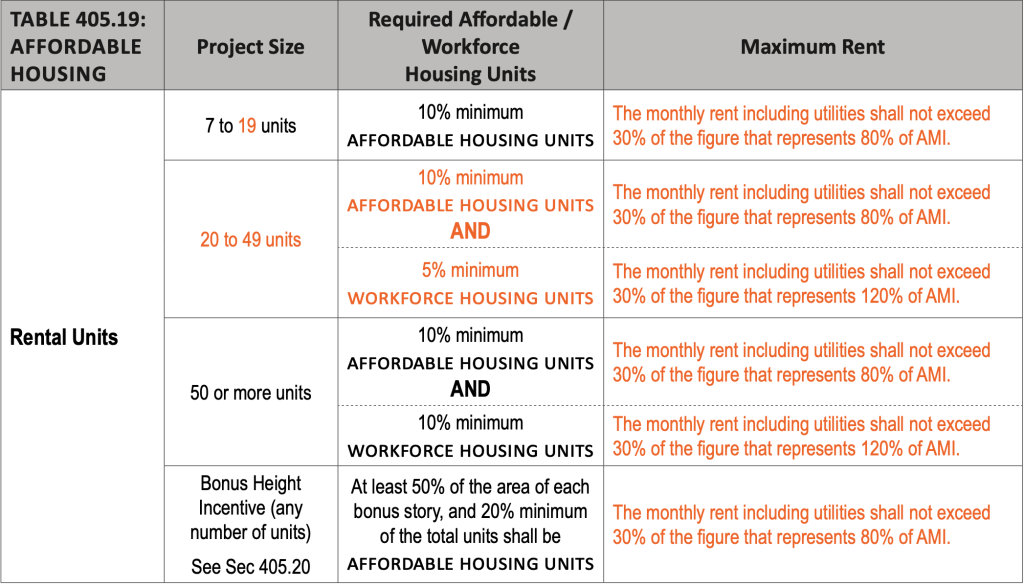
Developers may be able to opt-out of 10% Affordable Units with Payment-in-Lieu-of Affordable Housing

A Payment-in-Lieu-of Affordable Housing (“PILOAH”) is included in the Kingston Form Based Code 3.0, page 114 , where the criteria is not clearly defined, as criteria would be set and adopted by the Kingston Common Council at some later date.  Here, the developer is provided an option to make a Payment-in-Lieu of Affordable Housing instead of providing on-site affordable or workforce housing units into an Affordable Housing Fund.

On March 16, Bartok Starodaj provided the council with a presentation on the housing changes to the Form-Based-Code and at that time, was not able to go into any detail about the municipalities where a PILOAH is successfully implemented or provide examples of policy of how an Affordable Housing Fund is used. 

Since an Executive Order was issued in December 2020, all applicants requesting site plan approval with the City of Kingston’s Planning board building more than 5 units of housing anywhere in the City are required to have at least 10% of its units affordable without any loopholes.

Where did the PILOAH come from and is it wise for the council turn it into law in the code before policies are clearly defined? What should be considered is continuing to require 10% affordable units for all housing projects as well as to include more income ranges than is currently required now as affordable.

Council sets a special meeting to approve the Stony Run Apartments deal ahead of the Form Based Code public hearing as well as the code for housing criteria becoming law.  

As the City of Kingston works on defining housing for development in its code, the council has set-up a special meeting on March 22nd to consider approving a deal with Aker Cos that would allow the developer to raise rents in vacant units unilaterally to the maximum amount allowed by the agreement or 120% AMI. An approval for 120% AMI in any capacity would preempt both the public hearing on March 23 and the Form-Based-Code process before it concludes.

Next steps

1. Attend the upcoming public hearing on the Forward Citywide Form-Based Code draft Generic Environmental Impact Statement (DGEIS) on Thursday, March 23 at 6:30pm at Kingston City Hall. If you cannot attend in person, written comments may be emailed to Bartek Starodaj, Director of Housing Initiatives, via bs*******@*********ny.gov or dropped off at the City Clerk’s Office. Consider the following items on housing:

  • Affordable housing and low income housing are not interchangeable. The code should include more definitions, requirements and incentives for all categories of housing in order to accommodate the housing crisis in the City of Kingston;
  • Kingston’s code should be informed by the most up-to-date data for the City of Kingston median income and not Ulster County; 
  • A Payment-in-Lieu of Affordable Housing and Affordable Housing Fund needs policies before being included in the code as law. Otherwise it should be removed.

2. Attend the Special Common Council meeting on March 22nd at 7:30pm at Kingston City Hall.

  • Request that the council table the Aker deal until it has had the opportunity to respond to all additional questions during the Form-Based-Code SEQR process and adopts Kingston’s new code into law.

The road paved by a $30.6 million dollar Kingstonian PILOT (in exchange for a parking garage): A timeline and next steps in October 2020

By Rebecca Martin

Community members who have been following the Kingstonian project’s payment-in-lieu-of-taxes (PILOT) request have asked for more detailed financial information to understand the potential impacts (including developer’s “trade secrets” which are fair game for a public/private partnership). Others are up in arms that a wealthy developer who wants to create high-end housing and a luxury boutique hotel in Uptown Kingston would have the audacity to request a 25-year, 100% tax exempt PILOT agreement worth $30.6 million dollars. Nearly seven months after the SEQR process concluded (where the full value of public subsidies were not and should have been revealed), the developers publically revealed their PILOT request to the Ulster County Industrial Development Agency (UCIDA) threatening the board that without their approval of the PILOT, they would not secure the financing that they need and that the City of Kingston was at risk for the project (and the Downtown Revitalization Initiative (DRI) grant) to go away.

According to Rose Woodworth, the CEO of the UCIDA, the ground rules for a deviated PILOT (meaning that it’s not a standard PILOT under the unified tax exemption policy) include the consent of the involved local jurisdictions and in this case, the Kingston Common Council, Ulster County Legislature, and the Kingston City School District’s Board of Education.  She also noted that the UCIDA “…could, if it so determined, to move forward without the consents of the local jurisdictions.”  The process that Woodworth nonchalantly describes reminds us of the worst part of top down culture. It is not meant to be fair or inclusive, but only to provide the illusion of participation. Those “in charge” may override a decision if it runs counter to their desired and in many cases predetermined outcome. 

There are still steps remaining in the process for the Kingstonian PILOT, one of which is an independent, third party cost benefit analysis of the Kingstonians’ financials requested and paid for by Ulster County.  The National Development Council (NDC) was hired only last week as an unbiased third party. The report, that the City of Kingston should have requested last year, should be available any day now. If released to the public (and it should as a taxpayer funded study for a public/private partnership) we will be able to learn its legitimacy based on the materials the NDC has solicited from the developer.

Earlier in October, when Ulster County Executive Pat Ryan announced plans for this study, the Board of Education tabled its discussion on the Kingstonian PILOT until they could review the report. The Ulster County Legislature’s (UCL) Economic Development, Tourism, Housing, Planning & Transit Committee chaired by Legislator Brian Cahill on the other hand went on to pass the Kingstonian PILOT resolution to “…be fair to the developers.” The PILOT resolution appeared next at the Legislature’s Ways and Means Committee chaired by Legislator Lynn Archer, where they wisely chose to table the discussion for the same reasons as the Board of Education.

The next bit may move very fast, with the Ways and Means committee meeting for a second time this month on Tuesday October 20 at 5:00pm. If the Kingstonian PILOT is on their agenda and it is passed out of committee, it goes to the Democratic caucus at 5:45pm and most likely to the floor for a full legislative vote at 7:00pm.

We’ve laid out a timeline of all of the events that have led us to this moment that you can review below. We conclude with “what’s next” for the remaining meetings regarding the Kingstonian PILOT in October.  

PROMISES WITH NO DATA: The Mayor of Kingston Comments on the Kingstonian PILOT

Photo credit: Paul Kirby, The Daily Freeman

By Editorial Board

The Mayor of Kingston sent out a press release today, one day before the Kingston Common Council’s Finance and Audit Committee is set to review the Kingstonian PILOT request of 25 years at 100% tax exempt in exchange for an air conditioned / heated parking garage that will primarily serve luxury housing tenants and boutique hotel guests.  This is certainly not the first attempt by the Mayor to try to influence the legislative branch in their decision-making at a time when they should have autonomy.  

Below is a breakdown of the Mayor’s communication, paragraph by paragraph, that includes some of what was omitted, misleading or missing from his statement.  

“The Kingstonian project is of great importance to our City – not only will it bring desperately needed housing stock to our community, along with much-needed parking, the hotel and retail spaces will bring visitors and tax revenue. The developers have committed to paying a living wage for all new jobs created to operate the apartments, hotel and garage complex, and the public plaza will be a welcomed addition to Uptown. A PILOT for this project will have no negative tax implications, only positive!”
–  Mayor Noble

The Kingstonian luxury housing project offers apartments where the rents would be market rate (+) and unattainable to most of the Kingston community.  In the PILOT application, the Kingstonian applicant is only asked to provide a living wage for a single adult. They state that 84% of their jobs would pay $20.73 per hour, which is not nearly enough for that single person if they were raising a child in the community.   Such a worker will not earn enough to live in the Kingstonian luxury apartments and will most certainly have a hard time finding an apartment at an affordable monthly rent with a $20.73 per hour wage. It may end up being a second job for that single person who might end up living outside of the Kingston community due to the lack of affordable rentals in a county that has nearly a 0% vacancy rate.  

Read more…

VIDEO: “Kingstonian” Application Appears Before Kingston Planning Board.

By Rebecca Martin

At the recent City of Kingston’s Planning Board meeting, the proposed Kingstonian project gave its formal presentation and presented its application for the first time, starting what will be a very long process.

All of the documents and the presentation will be made available at the planning office.  Citizens are encouraged to schedule a time to review the materials by calling: (845) 334-3955. We’re asking that they be placed online, too, under the Planning Departments “Planning Project” page.  

Following the presentation, the board voted unanimously on the following;

  • The Kingstonian Project is a Type 1 Action in SEQR and a coordinated review must be taken. A full Environmental Assessment Form (EAF) will be required to determine any environmental impacts.
  • The City of Kingston Planning Board requests that it be Lead Agency of the project.  Their request will be circulated to all Involved agencies who will have 30 days to respond to either approve or deny their request.   (List of Involved agencies forthcoming).
  • In 30 days, the the Planning Board will ‘entertain’ the project at a regular board meeting and schedule a public hearing (more on this in the coming weeks). 

Please review video from last night’s planning board meeting. Brought to you by KingstonCitizens.org and filmed by The Kingston News.


Leo Schupp
Special Permit 106 W. Chestnut Street
4:20 – 6:15

Bernie Redman
Special Permit 106 W. Chestnut Street
6:26 – 6:52

Alex Panagiotopoulos
Kingstonian Application
6:54 – 8:14

Abigail Frank
Special Permit 106 W. Chestnut Street
8:20 – 10:25

David Gordan
Special Permit 106 W. Chestnut Street
10:36 – 16:30

Rashida Tyler
Kingstonian Application
16:52 – 18:15

Callie Jayne
Kingstonian Application
18:22 – 19:30

Linda Seekamp
Special Permit 106 W. Chestnut Street
19:36 – 20:44

Barbara Stedge
Special Permit 106 W. Chestnut Street
19:45 – 21:05

Owen Harvey
ICC Application
21:06 – 22:10

Juanita Velazquez-Amador
Kingstonian Application
22:20 – 24:26

Betsy Krat
Kingstonian Application
24:30 – 25:01

Tanya Garment
Comp Plan Zoning Task Force and Kingstonian application
25:08 – 28:55

Public Hearing (Tabled)

Item #3: #270 Fair Street SPECIAL PERMIT RENEWAL for a 12 room hotel with 978 business rental space. SBL# 48.331-4-20. SEQR Determination. Zone O-2, Stockade Overlay, HAC, MUOD. Ward 2. Hudson Valley Kingston Development/applicant; Charles Blaichman/owner.

Old Business – Kingstonian Project 

Item #4: #9-17 & 21 North Front Street and 51 Schwenk Drive and a portion of Fair Street Extension LOT LINE DELETION of the Lands of Herzog’s Supply Company and the City of Kingston. SBL 48.80-1-25, 26 & 24.120. SEQR Determination. Zone C-2, Mixed Use Overlay District, Stockade Historic District. Kingstonian Development, LLC/ applicant; Herzog’s Supply Co. Inc. & City of Kingston/owner.

Item #5: #9-17 & 21 North Front Street and 51 Schwenk Drive and a portion of Fair Street Extension SITE PLAN/SPECIAL PERMIT to construct a Mixed Use building with a 420 car garage, 129 apartments, 32 hotel rooms, and 8000sf of retail space. SBL 48.80-1-25, 26 & 24.120. SEQR Determination. Zone C-2, Mixed Use Overlay District, Stockade Historic District. Kingstonian Development, LLC/ applicant; Herzog’s Supply Co. Inc. & City of Kingston/owner.

Item #6: #106 West Chestnut Street SPECIAL PERMIT to operate a Boarding House. SBL 56.34-11-22. SEQR Determination. Zone R-1. Ward 9. Chestnut Hill NY Inc.; applicant/owner.


Brooklyn Real Estate Management Company Negatively Impacts Quality of Life in Ulster County.


Last evening, we attended the Sunset Gardens Tenant Association meeting at the Town of Ulster’s Senior Center.  One after another, tenants of apartment complexes in the Towns of Ulster and Esopus spoke of the shocking disrepair, unsafe conditions and treatment of those living at Sunset Gardens (ToU), Lakeshore Villas (ToE) and Black Creek Road (ToE).  Special thanks to Laura Hartmann and all of the citizens from Sunset Gardens who had the courage to organize.

The culprit – E & M Management – the real estate investment and management company based in Brooklyn, NY is mostly new to the area, gobbling up apartment complexes that include “68 apartments across from the Rondout Creek” in downtown Kingston and a vacant parcel near the Maritime Museum to build the “Kingston Waterfront Plaza”, a mixed-use project.  There is speculation that they are looking at Dutch Village, too – in uptown Kingston.

Although the planning process in Kingston is complete for their new build downtown – with a negative declaration in SEQR which is absolutely unbelievable – we are continuing our efforts to advocate for an improved development process for our planning department and planning board. We will keep a close eye on this company and work with our neighbors to assure that if E & M and all of their LLC partners want to come to our community, it is not on their terms.

Thanks to Clark Richters of The Kingston News for filming the event, brought to you by KingstonCitizens.org.