
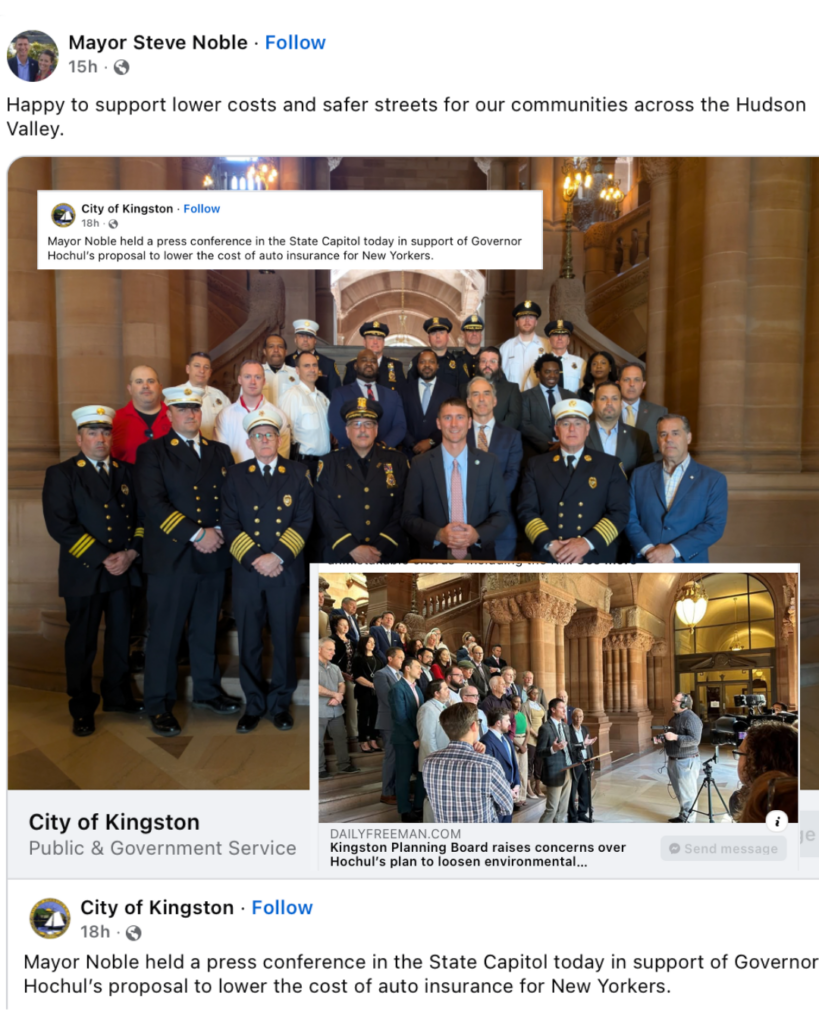
Most residents don’t see what happens behind the scenes when City Hall turns its attention to state-level politics. But lately, there’s been a noticeable pattern: repeated “lobby days” in Albany organized by our mayor and involving City staff—not just attending, but organizing them from the ground up.
That raises a basic oversight question: when does routine intergovernmental coordination become a structured lobbying operation funded by City staff time?
Cities do advocate in Albany. But what is less clear here is the scale and structure of the effort. When staff are involved not just in supporting a mayoral trip, but in planning, coordinating, and executing multiple statewide advocacy days within a short period, it stops looking like occasional intergovernmental work and starts looking like an organized program.
And that leads directly to a budget question that has not yet been answered publicly: what specific authority or budget line supports this use of staff time?
TAKE THE POLL (Now Closed): “Do you believe City staff time should be allocated to organizing statewide lobbying days in Albany initiated by the Mayor without a clearly defined budget line or formal Council approval?”
City staff are funded to run municipal operations—everything from permitting and infrastructure to public services and administration. When significant staff capacity is redirected toward repeated statewide lobbying trips, the public is entitled to ask how much staff time is being used? What work is not being done locally while this is happening? And who approved this as a priority?
There is also a transparency question for the Common Council. If this is now part of the Mayor’s operating approach, was the Council formally informed that City personnel would be engaged in recurring Albany lobbying efforts at this level?
The Kingston City Charter gives the Council oversight authority over City departments and employees, including access to records and the ability to examine official conduct and use of public resources. That authority exists for moments like this—when the line between normal intergovernmental coordination and sustained advocacy operations becomes blurred.
None of this is about whether Kingston should advocate in Albany. It should. The question is whether this is still “advocacy as part of government,” or whether it has become something closer to a standing lobbying function carried out using City staff time—with limited visibility into cost, scope, or authorization.
At minimum, it deserves a clear public accounting: who is doing the work, and what it is replacing? Because once public staff time becomes part of a recurring political program, it is no longer just a policy choice—it is a budget and oversight issue.
When publicly funded staff time is used for sustained, high-visibility statewide advocacy, it raises a fair question: is this about advancing Kingston’s priorities, or advancing a political profile? That distinction matters—and it requires transparency.
TAKE THE POLL (Now Closed) “Do you believe City staff time should be allocated to organizing statewide lobbying days in Albany initiated by the Mayor without a clearly defined budget line or formal Council approval?”