What NYS Counties are doing about Kratom: Public Hearing on Kratom legislation in Ulster County on November 17

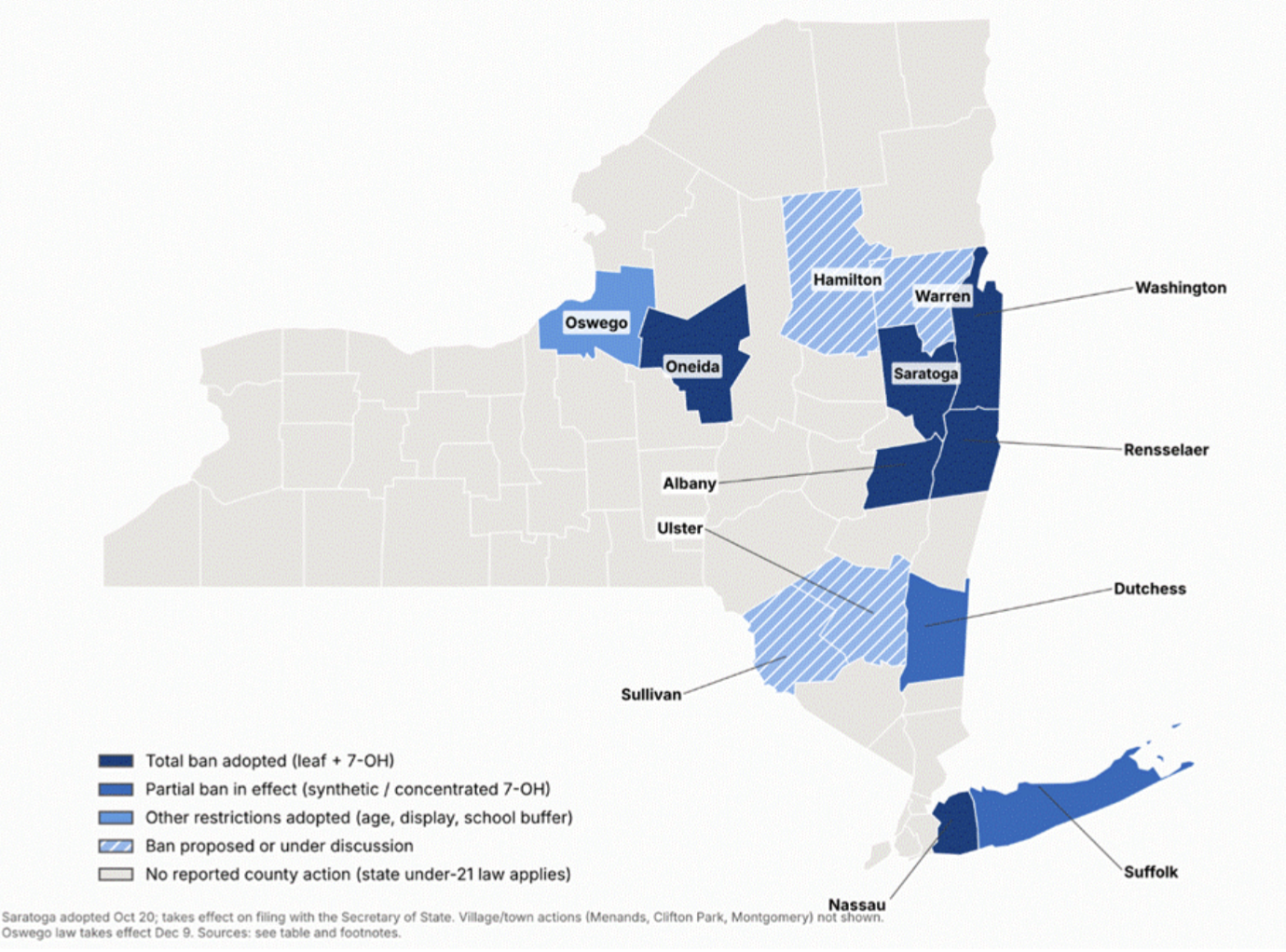
Figure 1. County action on kratom in New York State, as of November 6, 2026. Darker shades indicate stronger enacted restrictions; hatching marks proposals not yet adopted.


TAKE ACTION IN ULSTER COUNTY 
READ the FAQ
SHARE the Facebook Event

  1. Show up and speak. Attend the public hearing on Tuesday, November 17 at 7:05pm and urge the Legislature to pass Proposed Local Law No. 16 of 2026. You are also encouraged to share your views on any additional protections Ulster County should consider. The full text of the proposed local law is available here. Members of the public are encouraged to attend the meeting and provide comments or submit written comments to the Clerk of the Legislature at vf**@************ny.gov.
  2. Address the broader retail market. Weigh in on whether the County should go beyond concentrated and synthetic 7-OH products and prohibit the sale of all unregulated kratom products, while retaining the prescription and FDA-approved product exemptions identified in the proposed law.
  3. Put money behind enforcement. Ask the County to dedicate funding for staff, inspections, product testing, and investigations needed to implement and enforce the law. Direct the $25,000 allocated by County Executive Jen Metzger for public education toward these efforts, and explore whether additional opioid settlement funds can support kratom education, prevention, and enforcement.
  4. Make public education a part of the response.  Ask Ulster County to incorporate kratom and concentrated 7-OH education into its existing substance-use prevention programs. That means reaching young people, parents, educators, health professionals and the broader community.


By Kathleen (kt) Tobin and Rebecca Martin

Kratom (Mitragyna speciosa) is a tropical tree native to Southeast Asia. Its leaves contain alkaloids, chiefly mitragynine and 7-hydroxymitragynine (7-OH), that act on the brain’s opioid receptors.  [1]  The FDA describes kratom products as potent opioid products that have not been proven safe or effective for any use. Kratom products are sold both in their natural form and with added synthetic 7-OH. With or without added 7-OH, kratom can lead people with addictive tendencies to kratom addiction, illegal opioid use, or jumpstart a recovering addict’s opioid relapse because kratom contains active chemical compounds that interact with the exact same brain pathways as prescription opioids and heroin.

In the great majority of New York State counties, kratom is legal to sell in retail locations like gas stations, smoke shops, and convenience stores. A short list of New York State counties have passed greater kratom restrictions, but the majority are only subject to statewide age and labeling rules. We have previously written here that we support a full kratom ban.

State and federal regulations to date have focused on age restrictions and on concentrated and synthetic 7-OH products. In December 2025, Governor Hochul signed legislation barring the sale of any type of kratom to people under 21, along with requirements for warning labels and full ingredient lists. [2] In June 2026, the State Legislature unanimously passed S.8925-A, the Senate bill that replaced its Assembly counterpart, A.9156-B. The bill would prohibit the sale of products containing 7-OH above 2 percent of total alkaloids or more than 1 milligram per serving, with civil fines of up to $500 for a first violation and $1,000 for later ones. [3] As of November 6, the bill still had not been delivered to the Governor; bills from this session are typically acted on by the end of the year, and this one would take effect 90 days after signing.
Read more…

What Does an Affordable Waste Management System Look Like for Ulster County?

In response to “UCRRA Becoming More Affordable” in the Kingston Wire on November, 1, 2026

Ulster County is in an enviable position when it comes to food waste management. We have an established network of public and private composting facilities, strategically located throughout the County, with the capacity to process substantially more food waste than we currently collect.

That is an important foundation for building a more sustainable, resilient and affordable waste management system. We should be strengthening it, not putting it at risk.

On October 22, the Ulster County Resource Recovery Agency (UCRRA) Board voted to eliminate its tipping fee for food waste, moving the effective date up to November 2, rather than the originally anticipated start of the new year. The decision has been presented as a way to make waste management more affordable and encourage greater food waste diversion.

Making food waste diversion more affordable is a worthwhile goal. But we need to look at the broader implications of this decision and ask whether eliminating one facility’s tipping fee is actually the best way to accomplish it.

This is not about protecting private businesses from public competition. It is about recognizing that public and private facilities are part of the same waste management infrastructure. They provide different outlets and collectively create the capacity and redundancy necessary for a successful countywide system. Undermining one part of that system ultimately weakens the whole.

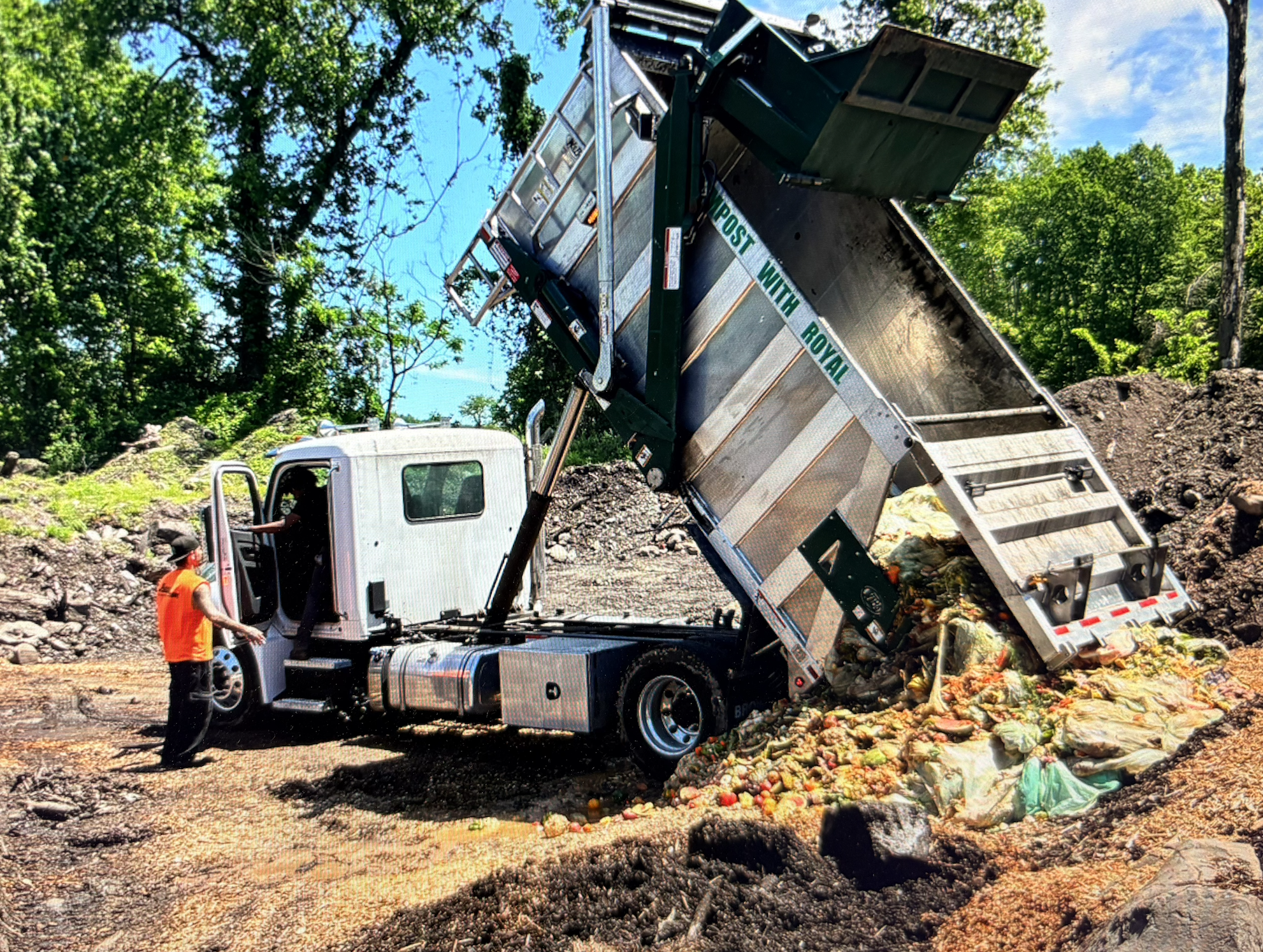
Consider what happened when UCRRA reached its permitted annual capacity for food waste. Haulers were able to redirect their material to Greenway’s and Community Compost’s facilities without interrupting the flow of food waste. When UCRRA resumed accepting material in January, its customers returned. That is how a resilient system should work. When one facility reaches capacity or experiences operational challenges, other facilities can help keep material moving.

Ulster County currently has approximately 15,000 tons of annual food waste processing capacity among UCRRA, the Town of New Paltz, Community Compost and Greenway. Yet only about 6,500–7,000 tons are collected annually. We have more than twice the processing capacity we currently use.

The challenge isn’t a lack of places to process food waste. It is getting food waste from generators to those facilities.

That is where investment is needed. Rather than eliminating its tipping fee and potentially putting private processing capacity at risk, UCRRA could use revenue from its fuel surcharge to fund grants that help haulers expand food waste collection. Haulers need to invest in vehicles and equipment before they can add food waste collection to the routes they already serve, reaching more businesses, institutions and residents. Supporting that investment would make better use of existing processing infrastructure, increase food waste diversion and benefit the entire County.

There is also a much larger affordability question that deserves attention.

The Kingston Wire framed UCRRA’s recent fee changes as a response to the economic crisis. But when we talk about the cost of waste management in Ulster County, we should be looking at the tipping fees associated with municipal solid waste, too.

Much of that waste contains organic material that could be separated and composted locally. Instead, we pay to haul it more than 250 miles to Seneca Meadows, where we are subject to tipping fees and transportation costs largely outside our local control.

Every ton of organic material we can divert locally is a ton that doesn’t need to be transported and disposed of there. Expanding local food waste collection and processing is an opportunity to reduce those costs while keeping more of our waste management infrastructure and investment close to home.

There is something contradictory about trying to make waste management more affordable by eliminating fees at a local composting facility while failing to make the investments needed to remove organics from the much larger municipal solid waste stream.

We should be asking how to build a system that works for everyone: municipalities, residents, haulers, public agencies and private composting businesses. That means making food waste diversion accessible, investing in collection capacity, maintaining multiple processing outlets and reducing our dependence on long-distance disposal.

UCRRA has an important role to play in making that happen. But it cannot be accomplished by looking at the agency’s individual tipping fee on organics in isolation from the broader system.

We have the beginnings of something valuable in Ulster County. Let’s build on it rather than put it at risk. Tell UCRRA to pause the elimination of its food waste tipping fees until the potential impacts on Ulster County’s existing public and private composting infrastructure, local businesses, haulers and the broader community can be discussed.