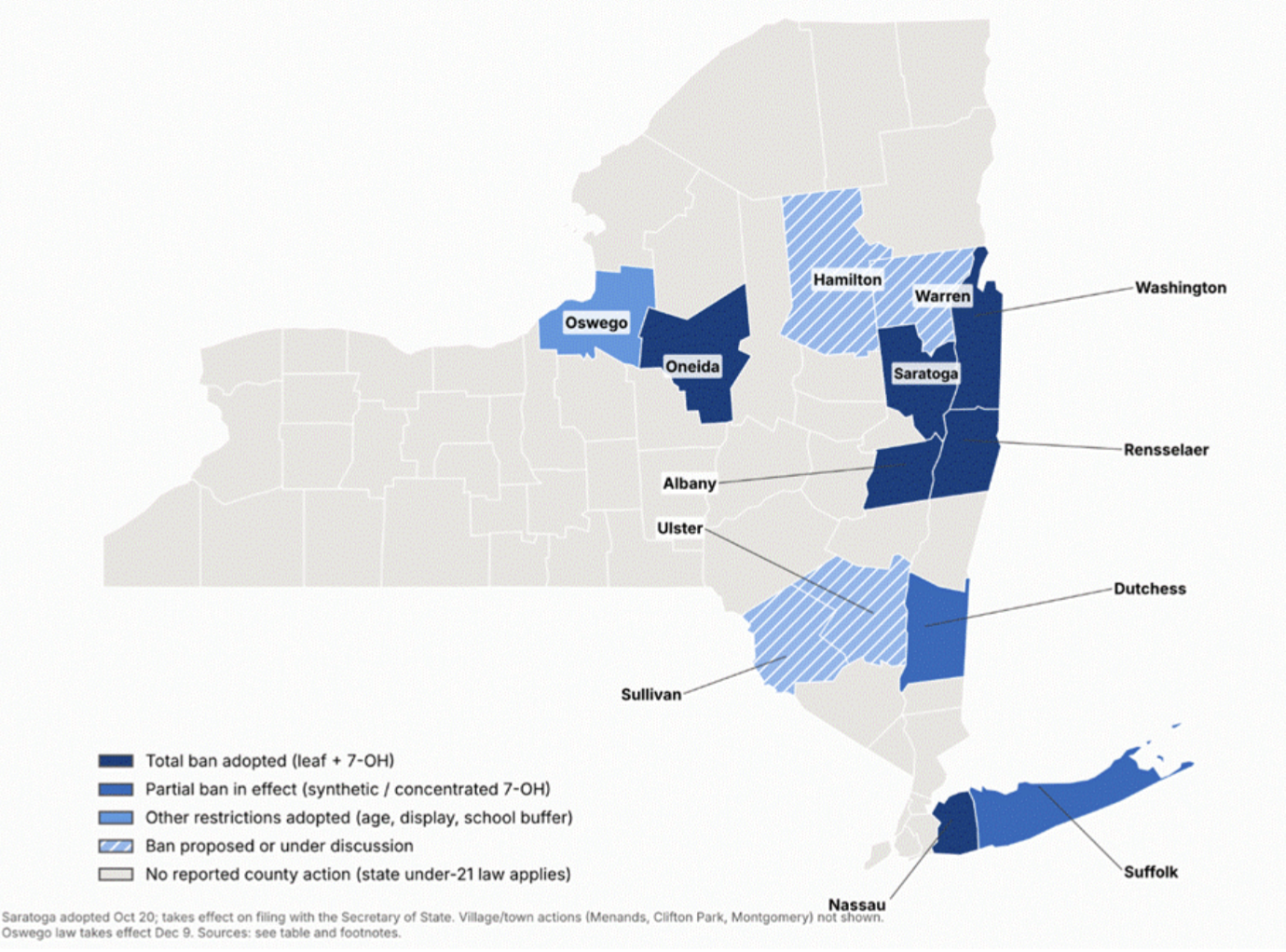
Figure 1. County action on kratom in New York State, as of November 6, 2026. Darker shades indicate stronger enacted restrictions; hatching marks proposals not yet adopted.
TAKE ACTION IN ULSTER COUNTY
READ the FAQ
SHARE the Facebook Event
- Show up and speak. Attend the public hearing on Tuesday, November 17 at 7:05pm and urge the Legislature to pass Proposed Local Law No. 16 of 2026. You are also encouraged to share your views on any additional protections Ulster County should consider. The full text of the proposed local law is available here. Members of the public are encouraged to attend the meeting and provide comments or submit written comments to the Clerk of the Legislature at vf**@************ny.gov.
- Address the broader retail market. Weigh in on whether the County should go beyond concentrated and synthetic 7-OH products and prohibit the sale of all unregulated kratom products, while retaining the prescription and FDA-approved product exemptions identified in the proposed law.
- Put money behind enforcement. Ask the County to dedicate funding for staff, inspections, product testing, and investigations needed to implement and enforce the law. Direct the $25,000 allocated by County Executive Jen Metzger for public education toward these efforts, and explore whether additional opioid settlement funds can support kratom education, prevention, and enforcement.
- Make public education a part of the response. Ask Ulster County to incorporate kratom and concentrated 7-OH education into its existing substance-use prevention programs. That means reaching young people, parents, educators, health professionals and the broader community.
By Kathleen (kt) Tobin and Rebecca Martin
Kratom (Mitragyna speciosa) is a tropical tree native to Southeast Asia. Its leaves contain alkaloids, chiefly mitragynine and 7-hydroxymitragynine (7-OH), that act on the brain’s opioid receptors. [1] The FDA describes kratom products as potent opioid products that have not been proven safe or effective for any use. Kratom products are sold both in their natural form and with added synthetic 7-OH. With or without added 7-OH, kratom can lead people with addictive tendencies to kratom addiction, illegal opioid use, or jumpstart a recovering addict’s opioid relapse because kratom contains active chemical compounds that interact with the exact same brain pathways as prescription opioids and heroin.
In the great majority of New York State counties, kratom is legal to sell in retail locations like gas stations, smoke shops, and convenience stores. A short list of New York State counties have passed greater kratom restrictions, but the majority are only subject to statewide age and labeling rules. We have previously written here that we support a full kratom ban.
State and federal regulations to date have focused on age restrictions and on concentrated and synthetic 7-OH products. In December 2025, Governor Hochul signed legislation barring the sale of any type of kratom to people under 21, along with requirements for warning labels and full ingredient lists. [2] In June 2026, the State Legislature unanimously passed S.8925-A, the Senate bill that replaced its Assembly counterpart, A.9156-B. The bill would prohibit the sale of products containing 7-OH above 2 percent of total alkaloids or more than 1 milligram per serving, with civil fines of up to $500 for a first violation and $1,000 for later ones. [3] As of November 6, the bill still had not been delivered to the Governor; bills from this session are typically acted on by the end of the year, and this one would take effect 90 days after signing.
At their Fall Seminar in Syracuse (September 28-30), the New York State Association of Counties (NYSAC) passed a resolution urging the State to prohibit synthetic, adulterated, and high-potency kratom-derived products and for Governor Hochul to sign S.8925-A/A.9156-B. [4]
At the federal level, attempts to restrict kratom began a decade ago in 2016, when the DEA announced plans to temporarily add both of kratom’s main alkaloids, mitragynine and 7-OH, to Schedule I of the Controlled Substances Act, the most restrictive category. After public opposition, the DEA withdrew that notice in October 2016. [5]
On July 1, 2026, the DEA again announced its intent to temporarily place 7-OH above a specified threshold and three related synthetic compounds (mitragynine pseudoindoxyl, MGM-15 and MGM-16) in Schedule I. [6]
On August 26, 2026, the DEA, part of the US Department of Justice, issued a temporary order adding the three synthetic compounds to Schedule I, citing that this change was “necessary to avoid an imminent hazard to public safety.” The order expires on August 26, 2028, and can be extended for one year.[7] The 7-OH order itself has still not been issued. The comment period on the July notice closed September 10.[8]
On October 9, the Department of Justice announced that the DEA would restart the 7-OH discussion using a new threshold recommended by the U.S. Department of Health and Human Services (HHS), and that it would reissue its notice for MGM-15 and MGM-16, which stay in Schedule I in the meantime.[44]
On October 14, the DEA withdrew its July notice and published a new notice of intent to temporarily place both 7-OH and mitragynine pseudoindoxyl in Schedule I when a product contains more than 1 milligram per gram (or per milliliter of liquid), or when its mitragynine content is less than 100 times its 7-OH content. The DEA acknowledged that the new threshold “would permit certain products to remain in the marketplace,” while saying neither agency had found the substances safe below it.
The order can be issued on or after November 13, 2026, and would take effect on publication.[45]
What are NYS counties doing?
Eight New York State counties already ban some form of kratom (six ban all kratom sales, while two ban only synthetic or concentrated 7-OH products), and four more are currently considering partial or full bans of kratom retail sales. County-level kratom regulations have been clustered in the Capital Region, Long Island, and the Hudson Valley. Approaches to regulation and enforcement have varied across the state.
In the Capital Region
Albany, Washington, Rensselaer, and Saratoga counties have already banned both natural leaf kratom and 7-OH kratom product sales.
In May 2026, Washington County was the first to act upstate. After revisions that removed county Health Department enforcement, the Board of Supervisors passed Local law (LL 5 of 2026, the Washington County Kratom Consumer Protection Act), enacting a ban on any type of kratom sales in the county.[9]
Albany County has a temporary ban on all kratom sales by means of a public health order from the County Department of Health, announced by County Executive Dan McCoy. The ban went into effect September 1, 2026, covers both natural leaf and 7-OH products, and carries fines of $1,000 to $2,000 per violation for each day a violation continues.[10][11] Albany has not passed a local law, and the order stays in effect until it is lifted or other local, state, or federal actions override it; McCoy has called it a temporary measure while the County Legislature considers more permanent regulations.[12]
The Village of Menands, in Albany County, discussed a narrower local ban on 7-OH, but in September its board decided a separate village law was unnecessary and instead wrote to the county in support of the countywide ban.[13]
On September 8, the Rensselaer County Legislature voted 15-2 to pass a total ban in the form of Local law (T-4 of 2026), after rejecting proposals to exempt natural leaf kratom and to add a sunset tied to the pending state 7-OH ban.[14] After a September 24 public hearing, County Executive Steve McLaughlin signed it into law in early October.[15]
In Saratoga County, after an October 14 public hearing,[16] the Board of Supervisors voted on October 20 to adopt a total ban (Introductory No. 6 of 2026) covering natural leaf as well as synthetic products.[46] The law gives retailers 30 days to clear their inventory. A first violation carries a fine of up to $1,000, and a repeat violation within five years is a misdemeanor punishable by a fine of up to $1,500 and up to a year in jail. Unlike Rensselaer, which rejected a sunset clause, Saratoga’s law becomes void if substantially similar state or federal legislation takes effect.[47]
On October 6, the Clifton Park Town Board, a municipality in Saratoga County, held a public hearing on a ban on both natural and 7-OH kratom and adopted Local Law No. 13 of 2026.[17] The town law prohibits the sale, distribution, and public display of kratom products.[48]
In October, the Warren County Board of Supervisors voted 6-1 to advance a local law banning kratom sales, alongside a separate law restricting nitrous oxide sales. Public hearings on both are set for November 20. [18][49] Neighboring Hamilton County has introduced Proposed Local Law No. 2 of 2026, “Prohibiting the Sale and/or Distribution of Kratom in all Forms,” and has noticed a public hearing on it.[50]
In the Mohawk Valley and Central NY
On September 10, Oswego County adopted Local Law 7. Their law, which will go into effect on December 9, restricts kratom sales to those age 21+, requires behind-the-counter storage, and institutes a 500-foot school buffer.
In early June, via a temporary Health Department public health order, Oneida County’s total kratom ban went into effect on June 5. County Executive Anthony J. Picente Jr. subsequently proposed a local law in late June, and the county Board of Legislators unanimously approved it on August 12; Picente signed it on August 19, thereby making the ban permanent.[19][20] A first violation carries a $500 civil penalty, and later violations up to $1,000 per item confiscated.
There are exemptions for FDA-approved kratom, and for kratom dispensed by a pharmacist on a physician’s prescription, in the Nassau, Oneida, Rensselaer and Saratoga regulations.[21][22][23][47] These are forward-looking, as the FDA has not approved any kratom product for medical use.[24]
On Long Island
In March 2026, Nassau County enacted a total ban on natural and 7-OH kratom sales. The Legislature passed it unanimously on March 9, with all 19 legislators as cosponsors,[51] and the County Executive approved it March 24. Violations are misdemeanors punishable by fines of up to $1,000 and up to one year in jail, enforced by the county Health Department, Department of Consumer Affairs and Police Department.[25][26]
Suffolk County has barred kratom sales to people under 21 since 2016.[27] After a proposed total ban stalled in April,[28] Suffolk County passed a narrower law in July 2026 that bans synthetic, adulterated, and smokable or vaped kratom products, limits 7-OH in kratom foods and drinks, and requires third-party lab testing of every batch. County Executive Ed Romaine signed it in late July.[29][30]
In the Hudson Valley
Similar to Suffolk County, Dutchess County’s initial proposal, from County Executive Serino, was for a full ban,[31] but the county legislature instead unanimously passed a narrower ban on concentrated and synthetic 7-OH products (Local Law No. 6 of 2026) on August 10, which County Executive Serino signed into effect in September while saying it “does not go far enough.”[32][33]
A similar partial ban, Proposed Local Law No. 16 of 2026, has been proposed in Ulster County.[34] On September 3, a legislative committee voted 5-2 to postpone scheduling its public hearing, and the hearing has since been set for November 17 at 7:05 p.m., during the Legislature’s regular session.[35][52].In her budget address last month, Ulster County Executive Jen Metzger announced an allocation of $25,000 towards a kratom public education campaign to “ensur[ing] residents understand what it is, the risks associated with its use, and where to get help.” [53]
In 2025, Orange County initiated efforts to age-restrict kratom sales to people age 21 or older, but in December 2025 the Governor signed statewide legislation doing the same and the county measure did not advance.[36] There have been no further reported discussions of county-level kratom bans in Orange County since that time. A public hearing on a total ban was held in the Village of Montgomery (in Orange County) on October 6, and the law was discussed at their October 20 meeting where they instructed their attorney to make revisions; no official action has yet been taken.[37]
The Sullivan County Legislature has begun preliminary discussions of kratom retail sale bans; in September, Legislature Chair Nadia Rajsz said lawmakers would take up a sales ban “in the coming months.”[38]
Elsewhere, Columbia County’s Health and Human Services Committee heard a September 15 presentation urging local action on synthetic kratom products sold in stores, though no law has been proposed there.[43] Processes and approaches to enforcement have varied.
The process
Most counties with kratom regulations have passed a local law, almost always with unanimous votes; Rensselaer’s 15-2 vote and Saratoga’s 17-4 vote were the exceptions. A local law requires a public hearing, a legislative vote, the county executive’s signature where there is one, and filing with the New York Secretary of State; Nassau, Washington, Rensselaer, Saratoga, Suffolk and Dutchess all took this route.
Two counties moved faster with a public health order from the county health department. In Albany that order is the ban itself, while Oneida used one to bridge the months until its local law was filed. Debate has also narrowed proposals: Suffolk and Dutchess both started with full bans and passed laws limited to synthetic, adulterated or concentrated 7-OH products. Some towns and villages, such as Clifton Park and Montgomery, have acted on their own while county measures were pending, while Menands chose to rely on Albany County’s order.
Enforcement
Responsibility for enforcement of any kratom regulations has been debated across locales. Capital region counties are approaching enforcement in varied ways.
Washington County eliminated initial county Health Department involvement. In contrast, the Oneida Health Department is responsible for enforcement there, alongside law enforcement, through routine inspections, complaints and criminal investigations. [39] In Rensselaer County, enforcement responsibility will be shared by the county health department and law enforcement. [40] In Albany County, kratom checks have been added to regular business inspections that are already in place for tobacco sales. [41] In Saratoga County, the Department of Health and the Sheriff’s Office share enforcement. [47] On Long Island, Nassau assigns enforcement to its health, consumer affairs and police departments, and Suffolk to its Department of Health Services, with police and peace officers. In Ulster County, the Department of Health has said it lacks enforcement authority over drugs and the capacity to police possession or online sales, a concern raised before the hearing was postponed. [42]
Conclusion
In less than a year, New York’s county map on kratom has changed quickly. Eight counties now ban some form of kratom, six of them completely, and the strongest local actions have been Capital Region and Long Island counties acting without waiting for state or federal action. Those efforts have not been uniform. Counties have split on whether to ban natural leaf kratom as well as concentrated 7-OH, on whether to act by local law or health order, and on who enforces.
State and federal action could narrow these differences but will not end them. If Governor Hochul signs S.8925-A/A.9156-B, high-potency 7-OH products will be illegal statewide, and if the DEA issues its 7-OH order, which it can do as soon as November 13, products above its threshold will be in Schedule I nationally. Neither measure would establish a statewide ban on natural leaf kratom products that fall below the specified thresholds. Outside of local jurisdictions with additional restrictions, kratom remains legal for adults 21 and older in New York State law. For counties that want a full ban, including Ulster, local action remains the only path for now, and Albany, Oneida, Rensselaer, Saratoga, Washington and Nassau counties offer working models for both the law itself and how to enforce it.
TAKE ACTION IN ULSTER COUNTY
READ the FAQ
SHARE the Facebook Event
- Show up and speak. Attend the public hearing on Tuesday, November 17 at 7:05pm and urge the Legislature to pass Proposed Local Law No. 16 of 2026. You are also encouraged to share your views on any additional protections Ulster County should consider. The full text of the proposed local law is available here. Members of the public are encouraged to attend the meeting and provide comments or submit written comments to the Clerk of the Legislature at vf**@************ny.gov.
- Address the broader retail market. Weigh in on whether the County should go beyond concentrated and synthetic 7-OH products and prohibit the sale of all unregulated kratom products, while retaining the prescription and FDA-approved product exemptions identified in the proposed law.
- Put money behind enforcement. Ask the County to dedicate funding for staff, inspections, product testing, and investigations needed to implement and enforce the law. Direct the $25,000 allocated by County Executive Jen Metzger for public education toward these efforts, and explore whether additional opioid settlement funds can support kratom education, prevention, and enforcement.
- Make public education a part of the response. Ask Ulster County to incorporate kratom and concentrated 7-OH education into its existing substance-use prevention programs. That means reaching young people, parents, educators, health professionals and the broader community.
Table 1. County activity related to kratom regulation in New York State (as of November 6, 2026)
| County | Process | Status (as of Nov 6, 2026) | Enforcement | Penalties | Type |
| Albany | Public health order from County Dept. of Health (no local law) | Enacted
In effect Sept 1; temporary until lifted or superseded |
Health Dept. inspections, added to existing tobacco checks | $1000-2000 per violation, daily | Total ban (leaf + synthetic) |
| Columbia | Committee presentation (Sept 15) | No law proposed | Discussion only | ||
| Dutchess | Local Law No. 6 of 2026. Unanimous (Aug 10). County Executive signed it in Sept. despite wanting a full ban. | Enacted
|
Bans concentrated/synthetic 7-OH; natural leaf still legal | ||
| Hamilton | Proposed Local Law No. 2 of 2026[50] | Public hearing noticed (Oct 15) | Total ban (“kratom in all forms”) | ||
| Nassau | Local law; Unanimous; all 19 cosponsored[51] | Enacted
March 9 (approved by County Executive March 24) |
Health Dept., Consumer Affairs, Police | Misdemeanor, up to $1k or 1 year; 1,500 for sales to minors) | Total ban (leaf + synthetic) |
| Oneida | Health order (June 5), then local law (passed Aug 12, signed Aug 19), Unanimous | In effect | Health Dept. + law enforcement | $500, then up to $1,000 per item | Total ban (leaf + synthetic) |
| Orange | Under-21 measure (2025) did not advance; Village of Montgomery held hearing on village ban Oct 6 | County: shelved; state law superseded it | Age limit (county); total ban proposed (village) | ||
| Oswego | Local Law 7 of 2026, adopted Sept 10[C2] | Takes effect Dec 9 | Age 21+, behind- the-counter storage, 500-ft school buffer | ||
| Rensselaer | Local law (T-4 of 2026); 15–2 vote Sept 8; hearing Sept 24 | Signed by County Executive McLaughlin (reported Oct 2) | Health Dept. + law enforcement | $500 / $1,000 per item; willful violations may be prosecuted | Total ban (leaf + synthetic) |
| Saratoga | Local law (Introductory No. 6 of 2026) adopted 17-4 on Oct 20[46] | Hearing held Oct 14; adopted Oct 20; takes effect on filing with Secretary of State | Health Dept. + Sheriff | Up to $1,000; repeat violation within 5 years a misdemeanor, up to $1,500 and/or 1 year[47] | Total ban (leaf + synthetic) |
| Suffolk | Signed July 28 (ceremony July 30). Started as a full ban proposal, then narrowed; passed unanimously. | Enacted | Dept. of Health Services; police and peace officers | Misdemeanor, up to $1,000 and/or 1 year | Bans synthetic, adulterated, smokable/vaped kratom; caps 7-OH in foods/drinks; requires lab testing; under-21 limit since 2016 |
| Sullivan | Proposed ban | Legislature to take up “in coming months” (Sept 10) | Unclear | ||
| Warren | Local law advanced 6–1 (Oct)[49] | Public hearings Nov 20, 10 a.m. | Kratom + nitrous oxide | ||
| Washington | Local law (Intro. E; LL 5 of 2026[C3] ); Tabling motion failed 9–4 | Enacted, adopted May 15 | Health Dept. removed from enforcement | Not confirmed | Total ban (leaf + synthetic) |
| Ulster | Proposed LL 16 of 2026 (Legislator Murray) | Committee postponed hearing 5–2 on Sept 3; public hearing set for Nov 17, 7:05 p.m.[52] | County Health Dept. says it lacks enforcement capacity | Concentrated/synthetic 7-OH only |
Footnotes
[1] U.S. Food and Drug Administration, “FDA and Kratom.“
[11] Spectrum News 1, “Albany County kratom ban,” September 1, 2026.
[12] WAMC, “Albany County temporary kratom ban goes into effect,” September 1, 2026.
[13] Village of Menands, Board Meeting Minutes, September 8, 2026.
[14] WAMC, “Rensselaer Co. bans sale of kratom after last minute debate,” September 9, 2026.
[15] WNYT NewsChannel 13, “Kratom ban in Rensselaer Co. signed into law,” October 2, 2026.
[18] The Post-Star, “Warren County weighs kratom, nitrous oxide sales ban.“
[19] Oneida County, “Picente Introduces Local Law Banning Kratom in Oneida County,” June 30, 2026.
[20] Oneida County, “Picente Signs Local Law Prohibiting Sale of Kratom,” August 19, 2026.
[22] Oneida County, “Picente Signs Local Law Prohibiting Sale of Kratom,” August 19, 2026.
[23] CBS6 Albany, “Rensselaer County kratom ban now awaits county executive’s decision,” September 2026.
[24] U.S. Food and Drug Administration, “FDA and Kratom.“
[27] Suffolk County Code, Chapter 423, Article VIII, “Sale of Kratom,” adopted by Local Law No. 37-2016.
[28] News 12 Long Island, “Suffolk lawmakers reschedule vote to potentially ban kratom,” April 22, 2026.
[30] Suffolk County Legislature, news release on kratom and tianeptine laws signed July 30, 2026.
[31] Mid-Hudson News, “Serino proposes countywide ban on Kratom,” August 3, 2026.
[32] Mid-Hudson News, “Dutchess lawmakers vote to ban synthetic kratom,” August 11, 2026.
[33] News 12, “Dutchess County Executive Sue Serino signs partial kratom ban,” September 12, 2026.
[35] Kingston Citizens, “TAKE ACTION: Ban Kratom in Ulster County,” September 30, 2026.
[36] Orange County Legislature, agenda, January 6, 2026.
[37] Village of Montgomery, “October 6, 2026 Public Hearing” notice.
[38] Mid-Hudson News, “Sullivan County to ban sale of kratom,” September 10, 2026.
[39] Oneida County, “Picente Signs Local Law Prohibiting Sale of Kratom,” August 19, 2026.
[40] CBS6 Albany, “Rensselaer County kratom ban now awaits county executive’s decision,” September 2026.
[41] Spectrum News 1, “Albany County kratom ban,” September 1, 2026.
[46] Aidan Cahill, “Saratoga County Bans Sale of Kratom,” Saratoga TODAY, October 22, 2026.
[48] Citizen Portal, “Clifton Park adopts ban on kratom sales and public display,” October 7, 2026.
[49] Cathy DeDe, “Warren County aims at Kratom & Nitrous bans,” Glens Falls Chronicle, October 29, 2026.
[50] Hamilton County, “Public Hearing Proposed Local Law No. 2 of 2026,” October 15, 2026.
[51] PoliticsNY, “County legislature passes bill to ban kratom sales” (Nassau County), March 16, 2026.
[52] Mid-Hudson News, “Ulster County to hold hearing on proposed kratom sales ban,” October 24, 2026.
[53] Ulster County Newsletter | The 2027 Executive Budget