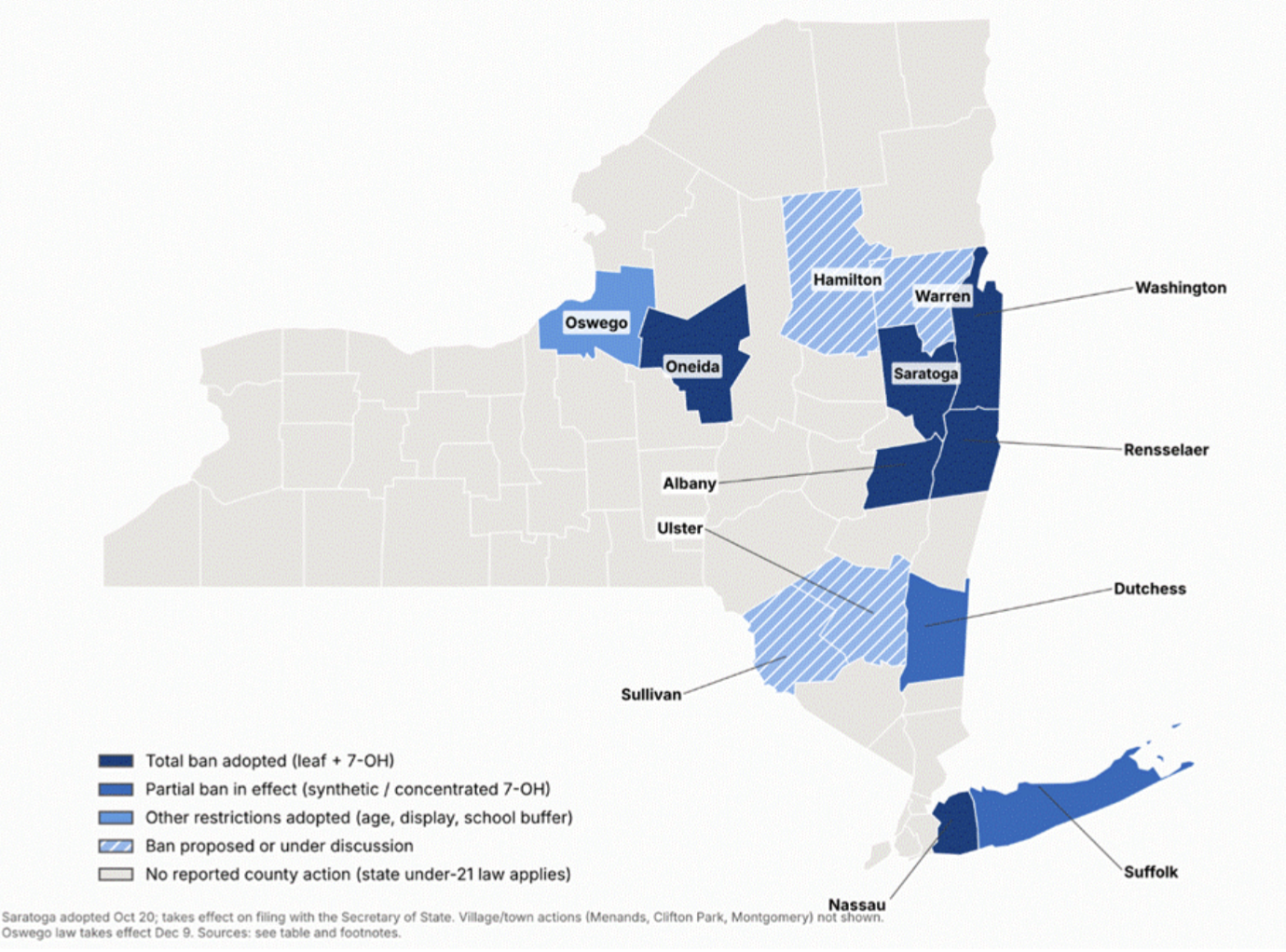
Figure 1. County action on kratom in New York State, as of November 6, 2026. Darker shades indicate stronger enacted restrictions; hatching marks proposals not yet adopted.
TAKE ACTION IN ULSTER COUNTY
READ the FAQ
SHARE the Facebook Event
- Show up and speak. Attend the public hearing on Tuesday, November 17 at 7:05pm and urge the Legislature to pass Proposed Local Law No. 16 of 2026. You are also encouraged to share your views on any additional protections Ulster County should consider. The full text of the proposed local law is available here. Members of the public are encouraged to attend the meeting and provide comments or submit written comments to the Clerk of the Legislature at vf**@************ny.gov.
- Address the broader retail market. Weigh in on whether the County should go beyond concentrated and synthetic 7-OH products and prohibit the sale of all unregulated kratom products, while retaining the prescription and FDA-approved product exemptions identified in the proposed law.
- Put money behind enforcement. Ask the County to dedicate funding for staff, inspections, product testing, and investigations needed to implement and enforce the law. Direct the $25,000 allocated by County Executive Jen Metzger for public education toward these efforts, and explore whether additional opioid settlement funds can support kratom education, prevention, and enforcement.
- Make public education a part of the response. Ask Ulster County to incorporate kratom and concentrated 7-OH education into its existing substance-use prevention programs. That means reaching young people, parents, educators, health professionals and the broader community.
By Kathleen (kt) Tobin and Rebecca Martin
Kratom (Mitragyna speciosa) is a tropical tree native to Southeast Asia. Its leaves contain alkaloids, chiefly mitragynine and 7-hydroxymitragynine (7-OH), that act on the brain’s opioid receptors. [1] The FDA describes kratom products as potent opioid products that have not been proven safe or effective for any use. Kratom products are sold both in their natural form and with added synthetic 7-OH. With or without added 7-OH, kratom can lead people with addictive tendencies to kratom addiction, illegal opioid use, or jumpstart a recovering addict’s opioid relapse because kratom contains active chemical compounds that interact with the exact same brain pathways as prescription opioids and heroin.
In the great majority of New York State counties, kratom is legal to sell in retail locations like gas stations, smoke shops, and convenience stores. A short list of New York State counties have passed greater kratom restrictions, but the majority are only subject to statewide age and labeling rules. We have previously written here that we support a full kratom ban.
State and federal regulations to date have focused on age restrictions and on concentrated and synthetic 7-OH products. In December 2025, Governor Hochul signed legislation barring the sale of any type of kratom to people under 21, along with requirements for warning labels and full ingredient lists. [2] In June 2026, the State Legislature unanimously passed S.8925-A, the Senate bill that replaced its Assembly counterpart, A.9156-B. The bill would prohibit the sale of products containing 7-OH above 2 percent of total alkaloids or more than 1 milligram per serving, with civil fines of up to $500 for a first violation and $1,000 for later ones. [3] As of November 6, the bill still had not been delivered to the Governor; bills from this session are typically acted on by the end of the year, and this one would take effect 90 days after signing.