Canopies and the Loss of Main Streets

By Jennifer O’Donnell

Note: This paper is based on research originally conducted for the Ulster County Planning Department 2010, in my capacity as deputy director, to provide technical assistance to a group of approximately 40 property owners in Uptown Kingston who signed a petition and letters in support of removing the canopies at that time.*

Canopies and the Loss of Main Streets

For over a decade, the city of Kingston, New York, has been the site of a passionate and often polarized debate regarding the future of the “Pike Plan” canopies in its historic Stockade District. As crews prepare to begin the long-awaited removal of these structures in the coming week, the local conversation mirrors a much larger national movement toward reclaiming the transparency and architectural integrity of the American Main Street. While the research overwhelmingly supports the removal of mid-century “modernizations” to foster economic revitalization and a more authentic pedestrian experience, it is important to pause on the logistics of the current plan: it should be noted that this piece does not endorse the commencement of this work during the winter months. Executing masonry-sensitive demolition in freezing conditions poses significant risks to the underlying historic facades—ranging from moisture-trap damage to the cracking of fragile brickwork—and requires urgent discussion to mitigate long-term structural harm.

Understanding the national precedent for canopy removal can provide a roadmap for Kingston’s future, provided the physical execution respects the very history it aims to reveal.

The National Shift Toward Canopy Removal

The move away from these structures represents a rejection of the “suburban mall” aesthetic in favor of the authentic “Main Street Experience.” Research from the National Trust for Historic Preservation indicates that these canopies actually accelerated downtown decline by obscuring historic architecture and reducing retail visibility.The revitalization of American downtowns through the removal of 1960s and 1970s street canopies (often called “modernizing” or “slipcovering”) is a well-documented shift in  urban planning.

During the peak of urban renewal, property owners often “modernized” their 19th-century brick buildings by covering them with aluminum panels or modern canopies. The dramatic process of stripping away these 1970s additions across the country revealed the original masonry and intricate cornice work underneath. By removing these covers and canopies, the buildings regained their “transparency,” making the storefronts feel open and inviting to modern shoppers.

Research from the National Trust for Historic Preservation and various municipal case studies indicates that these canopies—once intended to save downtowns—actually accelerated their decline by obscuring historic architecture and reducing retail visibility.

  • Key Visual Elements of Success:
    • Daylighting: Restoring the upper glass sections (transoms) of storefronts.
    • Rhythm and Scale: Replacing a continuous, monolithic canopy with individual building identities, which makes a walk down Main Street feel more varied and engaging.
    • Wayfinding: Without the canopy, pedestrians can see landmarks and cross-streets more easily, improving the “navigability” of the CBD.

The Era of the “Modernized” Main Street (1950s–1970s)

During the peak of urban renewal, downtown property owners and city planners attempted to compete with enclosed suburban malls by “modernizing” historic facades.

  • Slipcovering” and Canopies: Owners often covered 19th-century brickwork with metal “slipcovers” (prefabricated aluminum panels) and installed continuous sidewalk canopies.
  • The Intent: These structures were designed to provide a uniform, mall-like appearance and protect shoppers from the elements.
  • The Result: Instead of drawing customers, these additions effectively “erased” the unique character of the street, making downtowns look like “unsuccessful, roofless versions of the malls they were trying to imitate.” [1]

Why Canopies Became Obsolete

By the 1980s and 90s, research began to show that these physical barriers were detrimental to the central business district (CBD) for several key reasons:

  • Loss of Merchandise Visibility: The National Association of City Transportation Officials (NACTO) found that “lack of storefront visibility by motorists” and pedestrians made retailers less likely to lease space. When people cannot see the goods or the “life” inside a shop from the street, they are less likely to enter. [2]
  • The “Shadow” Effect: High-profile canopies often created dark, cavernous sidewalks that felt unsafe or neglected. In many cities, these shadowed areas became magnets for loitering, further discouraging shoppers.
  • Maintenance and Deterioration: Many of the 1970s materials (aluminum, plastic, and low-grade steel) did not age well. As they became rust-streaked or dented, they signaled a “declining” district rather than a modern one. [3]

The National Trust’s “Main Street” Philosophy

The National Trust for Historic Preservation launched the Main Street America program in 1980 specifically to counter the “urban renewal” damage of the previous decades.[3]

  • Preservation Brief 11: This seminal document argues that the storefront is the most important architectural feature of a commercial building.4 The Trust advocates for removing 1960s-era “modernizations” to reveal the original “transom lights” and “cornice lines” that give a building its identity. [4]
  • The Merchandising Argument: The Trust notes that “sensitive rehabilitation of storefronts can result not only in increased business… but also provides evidence of the owner’s stake in the community.” [5]

Financial Evidence: The Impact of Removal

Cities that removed these canopies and pedestrian malls have seen significant measurable improvements in their property values and tax bases.


    City

The Intervention

Economic / Financial Impact

Buffalo, NY Removing the 1987 Pedestrian Mall (reopening Main St) Private property value along the corridor had decreased by 48% during the mall era (1987-2001). Reopening the street and removing barriers led to a massive resurgence in retail occupancy and property investment. [2]
Rogers, AR Facade restoration & canopy removal Rental rates jumped from $0.40 per sq. ft. to $8.00–$12.00 per sq. ft. after the city removed “modernized” covers and restored historic storefronts. [6]
Raleigh, NC Removing Fayetteville St Mall (2006) After reopening the “dead” pedestrian mall to traffic and visibility, downtown Raleigh saw its development pipeline explode to over $7.4 billion in new investment. [7]
Jacksonville, IL Pilot Canopy Removal Project A single canopy removal project in the downtown square inspired over 20 additional private facade restoration projects, significantly increasing local property tax assessments. [8]
Kalamazoo, MI Reopening the “First Mall” (1998) After removing blocks of the mall to allow traffic and better visibility, the city reported that the shift helped reverse a 40-year decline in downtown retail sales. [9]


Research Conclusions

Modern consumers prioritize the “Main Street Experience”—defined by authenticity, walkable historic character, and high-quality “window shopping.”

  • The “Transparency” Factor: According to the Texas Historical Commission, “increased visibility and enhanced property appeal resulting in greater income potential for tenants” is the primary financial driver for removing 1970s canopies. [3]
  • The Return of the Street: Research from Smart Growth America and Main Street America confirms that “people-centric” design, which emphasizes seeing and being seen, is the most effective way to compete with e-commerce, as it offers a tactile, social experience that a “mall-style” canopy cannot replicate. [10]


Endnotes & Citations

  Kingston Citizens, “Pike Plan: Nearly 90% of the Special Tax Stakeholders are in Favor of Permanent Removal” (as of 12/31/2010)” 

  1. National Trust for Historic Preservation, The Main Street Approach to Revitalization
  2. NACTO, Pedestrian and Transit Mall Case Studies Summary (Buffalo and Chicago data)
  3. Texas Historical Commission, Main Street Before and After: Economic Benefit of Facade Restoration
  4. National Park Service, Preservation Brief 11: Rehabilitating Historic Storefronts
  5. [Jandl, Ward, National Trust for Historic Preservation/NPS Research on Storefront Merchandising]
  6. Arkansas Heritage, The Economic Impacts of the Arkansas Main Street Program
  7. Downtown Raleigh Alliance, State of Downtown Raleigh Report 2024
  8. Jacksonville Main Street, Impact Report on Canopy Removal and Downtown Rebranding
  9. Project MUSE, The Kalamazoo Mall and the Legacy of Pedestrian Malls
  10. Smart Growth America, Main Streets as Places of Economic Resilience


Illustrated Success Stories

These stories and images below provide a visual timeline of the “before” images, which often feature overhangs that block light and obscure facades and storefronts of buildings, while the “after” images highlight the restoration of transparency, natural light, and historic architectural detail.

These examples show the dramatic change in street-level visibility once 1960s-era structures are removed, allowing the original “transom” windows (the small windows above the main storefront) to once again bring light into the buildings.

The Great Unveiling: Reclaiming the American Main Street

In the 1960s, cities across the U.S. sought to mimic the climate-controlled convenience of suburban malls by installing massive metal and concrete canopies. This image showcases the “before and after” of a typical restoration, where the removal of these heavy overhangs allowed natural light to flood the sidewalks once more. This restoration instantly improved the visibility of retail window displays and highlighted the unique architectural character that malls simply cannot replicate.

During the peak of urban renewal, property owners often “modernized” their 19th-century brick buildings by covering them with aluminum panels or modern “slipcovers.” This image illustrates the dramatic process of stripping away these 1970s additions to reveal the original masonry and intricate cornice work underneath. By removing these covers and their associated canopies, the building regained its “transparency,” making the storefront feel open and inviting to modern shoppers.

Jacksonville, Illinois, serves as a premier case study for canopy removal. The city’s downtown square was once dominated by heavy concrete overhangs that created a dark, tunnel-like atmosphere. Their pilot project in the downtown square demonstrated that removing the heavy concrete and metal canopies made the square feel like an outdoor “living room” again rather than a dated transit hub. By removing these structures, the city transformed its Central Business District from a dated, decaying corridor into a vibrant open-air “living room.” This visual comparison demonstrates how removing physical barriers can spark a ripple effect of private investment and facade improvements across an entire district.

The Square Transformation


Rogers, Arkansas: Economic Revitalization through Facades

Rogers serves as a primary financial example of how restoring visibility leads to higher lease rates. Note how the “after” storefronts prioritize large display windows that make merchandise visible from both the sidewalk and the street.


About Jennifer O’Donnell, Hone Street Strategic   Jennifer has lived in the Hudson Valley since 2004, where she has worked with numerous communities and organizations to plan and implement projects in historic sites and neighborhoods. Prior to this, she was a cultural heritage specialist and planner at the World Bank, where she was involved with World Heritage sites and cities in over 30 places abroad. Jennifer was also a design and construction project manager for many historic buildings and cultural institutions in her native New York City.  She has Masters’ degrees from Columbia University in Urban Planning and Real Estate Development, a BA in Art History from SUNY Stony Brook, and studied conservation at UNESCO’s ICCROM program in Rome, Italy.  She is fluent in French, Italian and Spanish. In addition to her work as a planner and historic preservationist, Jennifer has an active civic life as a leader, volunteer and board member leader in numerous sustainable development organizations. 
Kingston’s Zoning Board of Appeals reverses its June DAR House decision, siding with the HLPC—and why this case matters to every Kingston resident 

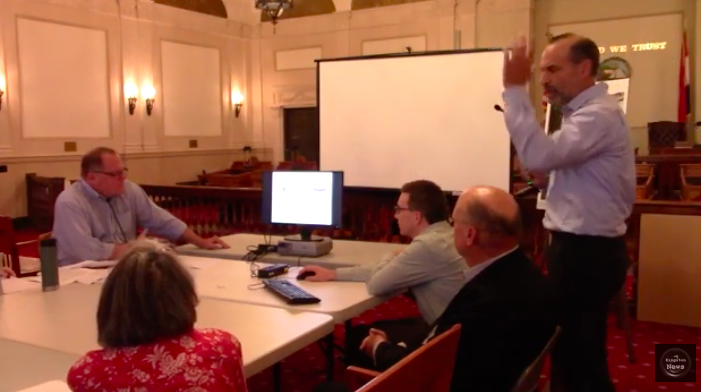
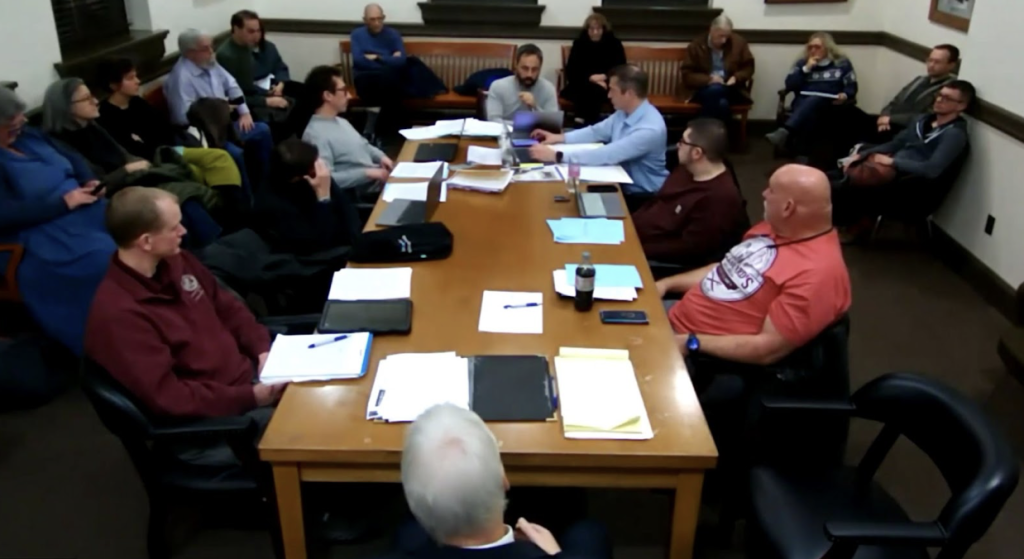
Screenshot of Zoom recording from Dec. 11 ZBA meeting

By Marissa Marvelli

On Thursday, December 11, nearly six months after its last deliberation, the five-member Zoning Board of Appeals (ZBA) unanimously reversed its June 12 decision regarding the historic Sleight-Tappen/DAR House windows. Over three hours, the board, led by chair Anthony Tampone Jr., carefully applied the preservation review criteria that guide the Historic Landmarks Preservation Commission (HLPC) in evaluating changes to landmark-designated buildings and districts. Members repeatedly cited the extensive record compiled since 2021, when the Wiltwyck Chapter of the Daughters of the American Revolution (DAR) was first notified that exterior work on the building required review. Assistant Corporation Counsel Matt Jankowski aided the board in drafting a detailed decision typical of the HLPC.

During deliberations, Tampone and other members acknowledged that the board had been misled back in June about the proposed replacement windows. Contrary to the DAR’s prior assertions, the windows are not “exact replicas” of the existing historic windows; they are generic replacements. Tampone explained that he personally confirmed  this by contacting a Marvin window representative, who said that the measurements that were taken were only of the overall openings, and not any of the other window details. The board engaged in a lengthy discussion about the special qualities of historic windows, how they differ from modern replacements, and how the cumulative effect of 32 rigidly square contemporary windows would diminish the architectural integrity of one of the Stockade’s significant historic buildings. Members also noted that, in a 2023 affidavit, the DAR itself admitted that restoring the historic windows would have been more cost-effective. Board members struggled to understand why they did not go that route. The costs associated with replacements have undoubtedly increased since the chapter engaged in a protracted legal dispute.

The DAR’s attorney, James Bacon, a sitting judge in New Paltz, was the sole representative of the applicant present. The board permitted him to testify before their deliberation began. Much of his case consisted of recycled arguments already refuted or dismissed by both the ZBA and HLPC. Most notably, Bacon again asserted—incorrectly—that only federal recognition of a building’s individual significance permits regulatory control over exterior features. The City of Kingston, a certified local government with a historic preservation ordinance, has the authority to carry out municipal responsibilities for its historic preservation program. It is largely carried out by its trained and qualified commission, the HLPC, which reviews and approves exterior changes to its locally designated landmarks and in local historic districts. The DAR House is both an individually designated landmark (since 1969) and a contributing building in the Stockade Historic District. The building’s—or district’s—listing on the National Register of Historic Places is irrelevant to the City’s authority in this matter.

Generously interpreting an old brochure of preservation guidelines, Bacon repeated the DAR’s justification for failing to seek HLPC approval before expending $65,000 on Marvin replacement windows in March 2022, the same month Kingston Planning Director Suzanne Cahill contacted the chapter for a second time to confirm that exterior work required review. The DAR has previously admitted that it did not consult the City of Kingston’s administrative code before proceeding.

The credibility of the DAR’s case was further undermined when Chair Tampone questioned Bacon’s submission of what was plainly an AI-generated query summary as an exhibit for the record. Under questioning, Bacon explained that he was unaware the document was AI-generated and that it had come from Kaaren Davis, the chapter’s treasurer, and originated with her son, Harley Davis, whom Bacon stated is also the contractor for the window replacement project. Bacon agreed it should be removed from the record, adding that he would not have accepted such a submission in his own court.

What was made abundantly obvious last night is the urgent need to address the ambiguity in Kingston’s administrative code. A questionable interpretation by the Corporation Counsel forced the ZBA to serve as a de facto landmarks commission without the requisite training, expertise, or experience. While the ZBA members should be applauded for their thoughtful deliberation last night, they should never have been put in the position of re-deciding the HLPC’s certificate of appropriateness decision rather than its subsequent hardship denial. A code amendment is now being prepared for Common Council adoption in the new year.

What’s Next?

The unanimous ZBA decision is not the end of this advocacy effort. The DAR will likely return to court for judicial relief, where a single judge, Honorable Sharon Graff, could overrule the hundreds of hours expended by city staff, volunteers on the HLPC and ZBA, and advocates to review, uphold, and defend Kingston’s preservation law. Graff is more likely to side with the DAR—and possibly award them financial compensation—in the absence of a response from City of Kingston’s Corporation Counsel Barbara Graves-Poller, who, to date, has not publicly acknowledged the DAR’s article 78 petition filed in State Supreme Court on July 25, despite the frivolous nature of the suit.

Civic engagement is not episodic; it’s a daily practice. Meaningful change, whether in historic preservation, zoning reform, affordable housing, or charter reform, is a long game that depends on sustained public participation. Almost without exception, high-stakes conflicts like the DAR House case expose the weaknesses in our democracy. Here, that weakness is Kingston’s strong-mayor form of government, codified in our three-decades-old “city manager” charter. Just weeks after receiving a controversial $30,000 salary increase, Graves-Poller continues to operate within a system in which her office serves at the mayor’s pleasure. With Mayor Steve Noble up for re-election in 2027, this structure inherently discourages independent representation of the Common Council when disagreements between the two branches arise. The DAR House case is simply the latest instance in which this flaw has been exposed.


Call to Action: 

  1. Demand a strong legal defense. Write to Mayor Steve Noble and urge him to direct the Corporation Counsel’s office to defend the hard work of the HLPC, ZBA, and city staff on the DAR matter in court. These volunteer boards and public servants followed the law and deserve the city’s full backing in court. Letters can be emailed to SN****@*********ny.gov or mailed to Office of the Mayor, 420 Broadway, Kingston, NY 12401.
  2. Show up and speak out. Use the public comment period at monthly Common Council meetings to urge the Council to have its own staff, specifically, an independent counsel and independent clerk. This independence is essential for good governance and for the Council to effectively carry out its responsibilities, especially as it prepares to oversee the city charter review process in 2026-2027, a process the Mayor recently declined to support. The next council meeting is on Wednesday, December 17. The following hearing will be Tuesday, January 6, when four new council members, including myself, will be sworn in.


Background Reading

Preserving Our History and the Laws That Protect It  KingstonCitizens.org, Aug. 20, 2025

Local Chapter of the Daughters of the American Revolution Battling Against Kingston’s Historic Preservation Law”   KingstonCitizens.org, July 3, 2025

Kingston slaps stone house with stop-work order over window renovations  by Brian Hubert, Daily Freeman, July 25, 2025.


Correction (December 15, 2025): This post previously misstated the year of the Mayoral election. It is in 2027 and has been corrected here.

CALL TO ACTION: Defend Kingston’s Preservation Law – ZBA to Rehear Sleight-Tappen/DAR House Window Appeal November 13

By Marissa Marvelli

After a summer of intense actions and counteractions, followed by a two-month lull, the appeal by the Daughters of the American Revolution Wiltwyck Chapter (DAR) will finally be reheard by the Kingston Zoning Board of Appeals (ZBA) on Thursday, November 13, at 6:00 p.m. This hearing has already been postponed twice at the DAR’s request, as their attorney was unavailable in September and October. The ZBA has stated that it will not delay the hearing any longer.

At this hearing, the ZBA will consider new testimony and review the full record of the April 2025 decision by the Historic Landmarks Preservation Commission (HLPC), which denied the DAR a Certificate of Appropriateness to replace all 32 historic windows with Marvin insert units. At the July ZBA meeting, when the board considered whether to rehear the appeal, Chair Anthony “Junior” Tampone acknowledged procedural flaws in its June 12 hearing, during which his board initially overturned the HLPC’s decision. The flaws included the rushed decision-making process, the withholding of important documents, the absence of key stakeholders, and the inadequate public notice.

This case has always been about more than windows. It is about respecting and upholding the well-founded decision of a trained and qualified commission. The HLPC carefully reviewed the DAR’s window replacement application over multiple meetings, developing thorough findings to support its two denials of a Certificate of Appropriateness in 2023 and 2025, as well as its subsequent denial of a hardship claim.

There are striking parallels between the Wiltwyck DAR’s actions and the recent destruction of the East Wing of the White House: a disregard for the embodied history of an important building, an ignorance of the past, and a blatant failure to follow proper procedures. If local laws are to retain their purpose, they must be vigorously defended in situations like this. Fairness, accountability, and public trust are the bedrock of democracy—principles that a patriotic organization like the DAR should honor.

CALL TO ACTION

  • ATTEND the Nov. 13 meeting at City Hall. Bring a friend. The ZBA needs to see that the public is invested in getting this right.
  • TESTIFY at the hearing about the importance of upholding our preservation law and honoring the hard work of Kingston’s volunteer boards and commissions.
  • WRITE a letter emphasizing that our local laws must be upheld and that the ZBA should not overturn well-founded HLPC decisions.
    • All written comments must be received by 2:00 p.m. on Monday November 10. Comments may be emailed to Amee Peterson at apeterson [at] kingston-ny.gov, hand-delivered or placed in the drop box outside of City Hall. Use the subject line: “ZBA Meeting Comment November 13, 2025 – DAR House Rehearing.


BACKGROUND INFORMATION

  1. Top 10 Things to Know About the D.A.R. House Review, Google Doc with links
  2. Timeline of DAR House window replacement effort, Google Doc with links
  3. Preserving Our History and the Laws That Protect It” KingstonCitizens.org, Aug. 20, 2025
  4. Local Chapter of the Daughters of the American Revolution Battling Against Kingston’s Historic Preservation Law”  KingstonCitizens.org, July 3, 2025
  5. Kingston slaps stone house with stop-work order over window renovations” by Brian Hubert, Daily Freeman, July 25, 2025.


DAR Requests ZBA Hearing Be Delayed; Community-Funded Video Released

Group Editorial

Just seven days before the Zoning Board of Appeals (ZBA) is scheduled to re-hear the appeal of the Historic Landmarks Preservation Commission’s (HLPC) decision regarding the Sleight-Tappen House at 106-122 Green Street, the attorney for the Wiltwyck Chapter of the Daughters of the American Revolution (DAR) has requested a postponement, citing that neither he nor his clients are available to attend. He has also stated that he will be unavailable the following month as well.  

The September 11th hearing date has been on the calendar since July 10th, when the ZBA determined that a re-hearing was justified. It has been referenced repeatedly in court filings related to the DAR’s ongoing attempt to overturn the city’s stop-work order—a matter we covered in our August 20th post

Given the DAR’s past legal actions, this last-minute postponement request has prompted concern within the community. Many are questioning whether this could contribute to further delays in the process, and whether it risks undermining public accountability and trust in the system. 

We urge the City of Kingston to reschedule the hearing for the earliest possible date that accommodates all parties, and to hold a special meeting if the DAR cannot attend the October 9th date as well. 

We also urge the City to keep its stop-work order in full effect until the review process is complete and a building permit has been issued, or until the matter is resolved in the courts. As of now, nine first-floor windows on the front and rear elevations remain covered with black plastic. Hon. Sharon Graff, who is presiding over the DAR’s petition, recently clarified, “Pending further order of this Court, the Stop Work Order remains in effect and any work currently underway should be ceased pending determination of the pending proceeding and/or further order of this court.” 

However, with the windows obscured and no clear visibility into the site, it is difficult, if not impossible, to verify whether the stop-work order is actually being observed. This lack of transparency has heightened concerns, especially in light of the past disagreements over the interpretation of rules and court directives by the parties involved. 

In Defense of Kingston’s Historic Preservation Law

This week, ahead of the now-postponed September 11th ZBA re-hearing, a community-funded five-minute film was released to educate the ZBA and the public on the importance of upholding Kingston’s historic preservation law. The video—available HEREfeatures six experts in local history, preservation, and policy, including City Historian Taylor Bruck and West Chestnut Street author Lowell Thing. 

100% of the donations raised supported the work of professional videographers and an editor to produce a film that speaks to not only this preservation effort, but to the larger importance of protecting our shared history and resources. It’s a story about what’s at stake when preservation is overlooked, and what’s possible when the community comes together to defend the places they love.  

This project was led by Kingston-based preservation professional Marissa Marvelli, who contributed significant time and personal funds to bring this story to life. Thanks, Marissa!

GUEST EDITORIAL: Local Chapter of the Daughters of the American Revolution Battling Against Kingston’s Historic Preservation Law

Sleight-Tappen House in 1880 (Friends of Historic Kingston Collection)

By Marissa Marvelli

Yes, this is a loaded headline, especially on the eve of our nation’s birthday. In an era when many democratic norms and institutions are being forsaken, why should we care about a local issue involving a longtime civic club comprising women who cherish their ancestral connections to our country’s founding? 

This is about standing up for good government, and good government must begin at home. What began as a run-of-the-mill debate about historic windows in 2022 has today morphed into an existential threat to the legitimacy of the city’s Historic Landmarks Preservation Commission (HLPC). What’s the worth of any local law if it’s not upheld? 

Some Background

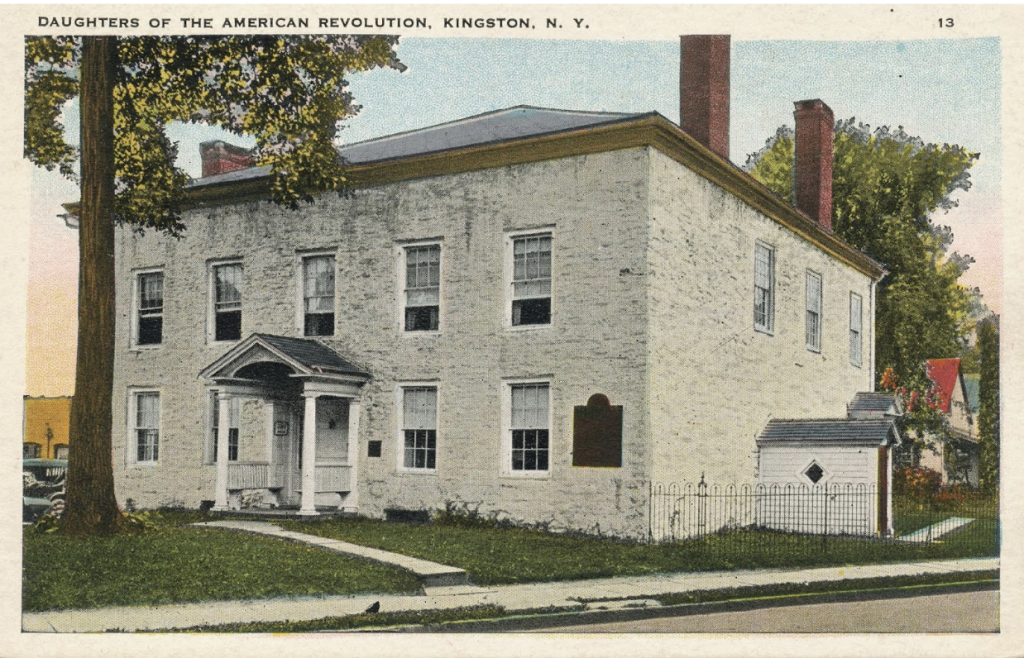
Kingston’s Wiltwyck Chapter of the National Society of the Daughters of the American Revolution (DAR) was formed in 1892. Its first regent was Mary Isabella Forsyth, whose family donated Forsyth Park. In 1907, the group purchased the 18th-century Sleight-Tappen House, located at the intersection of Green and Crown streets in the heart of the Stockade district, to serve as its new chapter house. They hired local architect Myron Teller to rejuvenate the downtrodden building. It was one of his earliest “restoration” commissions for which he would become renowned and inspire Kingston’s preservation culture. In 1969, the house was designated a local landmark by the nascent Landmarks Commission. Five years later, it was deemed a contributing resource in the new local and National Register-listed Stockade Historic District. A local landmark medallion was later mounted to the building’s facade.

Over the subsequent 118 years, the chapter has used the house for meetings and events. Wiltwyck DAR is a 501(c)(3) charity. On publicly available 990 filings required of tax-exempt entities, the chapter summarizes its mission as “historical preservation to educate community on a historical home and events.” They open the house to the public on rare occasions, such as during the biennial reenactments of the 1777 Burning of Kingston. This historic house museum is otherwise inaccessible to the public.

Sleight-Tappen/DAR House at 106-122 Green St, June 2025.

Willful Ignorance

In 2021, a question over the fate of the house’s window shutters triggered outreach by the city’s planning director, Suzanne Cahill, to the chapter’s leadership, explaining that “any work which is proposed for the exterior…must be reviewed and approved by” the HLPC. The chapter had been before the commission before, most recently for the approval of a perimeter fence in 2008. Despite this proactive outreach, in March 2022, the chapter ordered 32 Marvin Ultimate replacement windows without applying for a permit from the HLPC. This oversight was reported by a whistleblower, and the DAR was instructed to apply for approval from the commission. 

In April 2022, during the first of what would be four hearings and meetings for the application (there was a second round in 2024-2025), the commission probed the chapter’s regent, Selina Guendel, about the necessity to replace historic fabric on what is a “very significant, high-profile building.” In a later hearing, another commissioner described the building as “so standalone, almost like a fishbowl,” noting how all four of its elevations are visible from the street, and how the windows are character-defining. They requested evidence that the windows were beyond repair and whether their restoration had been explored as an option. Commissioners also asked to see the proposed replacement window to compare it with an existing historic sash. 

Guendel outlined the chapter’s reasoning for replacing the windows:

  1. She claimed all 32 windows were replaced in 1910 by Myron Teller, so they are not historic. Preservationist note: A feature need not be original to be historic. Regardless, these windows appear in historic photos taken before the 1907 renovation.
  2. The windows were “extended beyond their life use.” Preservationist note: The lifespan of a historic wood window can be extended indefinitely if it is properly maintained or restored. 
  3. Marvin units have better energy performance. Preservationist note: This frequently cited argument warrants more explanation than can be provided here. For now, historic windows paired with storm windows have comparable energy performance at a much lower cost. Additionally, this is a historic house museum that is often unoccupied; therefore, energy performance should not be a primary factor in this decision.
  4. The new windows will be “exactly the same” as the historic sash and “you won’t notice a difference.” Preservationist note: It is extraordinarily challenging for a manufactured window to match a historic one. Marvins and the like are merely imitations, like the buildings at Disney World. They can be customized only to the extent that they roughly fit the window opening, match the number of lights (panes), and paint color. The fast-growth wood used in windows today isn’t comparable to old-growth.  

What was not revealed in the first meeting was that the chapter had already ordered the windows. 


Comparison of a contemporary replacement window with a historical photo of the same house with its old sash. Note how the replacement window doesn’t fill the full opening like the historic units and must be padded. The muntins (dividers) are fatter to accommodate the thickness of the insulated glass. Also, the house’s settling is made more obvious with the perfect squareness of the insert.

The HLPC worked in good faith to gather the facts before rendering a decision, including requesting an evaluation of the existing windows by a qualified expert and seeking an advisory opinion from the New York State Historic Preservation Office (SHPO), which oversees the Certified Local Government program. SHPO quickly submitted a formal opinion stating, “The application materials do not make a convincing argument for replacement of the historic wood windows. We support the HLPC’s request for a conditions/assessment survey, prepared by a qualified historic preservation consultant.” The applicants reluctantly complied with some of the information requests, providing a window assessment from a general contractor, Harley Davis, who is the contractor for the replacement project (and who also happens to be the son of the chapter’s treasurer, Kaaren Davis). Not surprisingly, he recommended replacement. In the absence of a qualified assessment, the HLPC lacked sufficient findings to support approval according to its review criteria. The application was therefore unanimously denied by the HLPC in August 2023.

Throughout the review process, the DAR maintained that they are preservationists and that they did not know they needed approval because they did not think their building was on a “historic registry.” They also contend that the unofficial guidelines published by the Friends of Historic Kingston, an advocacy group rather than a regulatory agency, provided all the guidance they thought they needed. “It says in-kind replacement does not need approval!” What they did not do was call the City of Kingston’s Planning Office. 

The Present Crisis

After a failed attempt to appeal the decision in the State Supreme Court due to the petition being filed past the statute of limitations, the DAR returned to the HLPC to restart the process with the intent of appealing again. The HLPC heard the new application at its February and April meetings this year. The commission funded an independent assessment of the windows by a qualified restoration contractor, Stacy Caputo of Bridge Lane Restoration. Her shop had been responsible for the recent restoration of the historic wood windows of the Ulster County Courthouse on Wall Street. The DAR refused her access to inspect the windows from the interior. Based on an exterior survey, she found that the historic windows were in “sound condition and can be fully restored.” 

Without new evidence to support window replacement, the HLPC issued its second unanimous denial of a preservation permit, called a Certificate of Appropriateness. The DAR’s lawyer, James Bacon, who is also a judge in New Paltz, immediately filed a hardship appeal with the HLPC, a procedure that has rarely been pursued. That too was unanimously denied because the “alleged hardship was self-inflicted.” The decision also lists the multiple grant programs available to a non-profit like the DAR for window preservation, which would alleviate some of the financial loss.

This time around, instead of filing an Article 78 proceeding in the State Supreme Court, the city’s Zoning Board of Appeals (ZBA) served as the appellate body after a hardship appeal was heard by the HLPC. (These procedural changes merit a separate explanation.) Like the HLPC, the ZBA is a volunteer body appointed by the mayor. It typically hears appeals about use and area variances. It does not have experience or expertise with HLPC review procedures or criteria. Yet, on June 12, it considered the appeal of the HLPC decisions brought by Judge Bacon. During a torturous nearly three-hour-long hearing, involving extended executive sessions with the assistant corporation counsel, the members of the ZBA struggled to understand which decision to base its appeal upon, the Certificate of Appropriateness denial or the hardship denial. They eventually decided upon the former. 

Even though it is specified in the ZBA’s procedures that the HLPC must be notified of an appeal in advance of the hearing, the HLPC and its staff learned of the hearing after the fact. The ZBA’s public agenda was not posted to the city website beforehand either. As a result, no representatives of the HLPC or members of the public were present to testify or rebut the many misstatements and falsehoods made by the DAR and Judge Bacon during this hearing. The HLPC record presented to the ZBA was limited and curated in such a way to favor the DAR. Regardless, it appears that the oral testimony of the DAR and their lawyer served as the primary evidence for the ZBA. When one member asked his colleagues if they should table the decision to allow more time to review the record, they agreed it was not necessary and continued. No examination of the existing or proposed windows is apparent in the video recording. The five-member board’s deliberation on the preservation review criteria (2:07:45) is challenging to watch, as their discussion lacks clarity and seems to rely more on assumptions than on a thorough understanding of the facts.

So What? It’s Just Windows

The issue extends beyond the windows. By unanimously voting to overturn the HLPLC’s thoroughly documented and well-reasoned Certificate of Appropriateness, the ZBA seemed unaware of the gravity of their decision, effectively dismissing the HLPC’s meticulous work, which was supported by specialized training and expertise. This action undermines the HLPC’s authority to protect the city’s architectural heritage. Why invest substantial time and effort in following procedure and compiling a clear record if another review body can so easily disregard it? What is the purpose of a preservation law if violations will be permitted by the ZBA? This case has demanded countless hours from the HLPC’s commissioners and staff, advocates, and consultants, largely because the applicant—a tax-exempt charity whose primary reason for existence is to be the stewards of a historic house museum—has persistently refused to accept the HLPC’s decisions. This sets a concerning precedent for future rulings.

What’s Next

In a special meeting held June 24, the HLPC agreed to submit a letter to the ZBA requesting a “re-hearing” of the appeal. This consideration has been placed on the ZBA agenda for its Thursday July 10 meeting (6:00pm, Kingston City Hall located at 420 Broadway, Conference Room 1) According to ZBA’s procedure, there must be unanimous agreement to schedule a re-hearing. The public is encouraged to testify in person or to submit written comments. Anyone who cares about preservation or about good government is urged to speak up. Written comments may be emailed to ZBA’s administrative clerk, Amee Peterson: ap*******@*********ny.gov. The sooner the ZBA receives it, the better.

It is not yet clear what will happen if the ZBA does not agree to a re-hearing. The HLPC is already at work on seeking to amend the appeal procedure in the administrative code, but that will not serve this specific case. The HLPC’s staff and volunteer members should be commended for their professionalism, diligence, and patience in this matter. Mayor Steve Noble, too, should be commended for his appointments and hires to this commission. Preservation is only as strong as the people who support and defend it. Buildings can’t preserve themselves.

And why does preservation matter? As the late architect Nathan Silver once wrote, buildings are vessels of human history. Their details give depth to our daily existence. They remind us that we have been here before. There is still so much to learn from them if only we listen.

Marissa Marvelli is a professional historic preservationist. She served on the HLPC from 2016 to 2019.

The house in 1906 before the Myron Teller updates. (LOC)

The house today with ivy engulfing the west elevation, June 29, 2025.
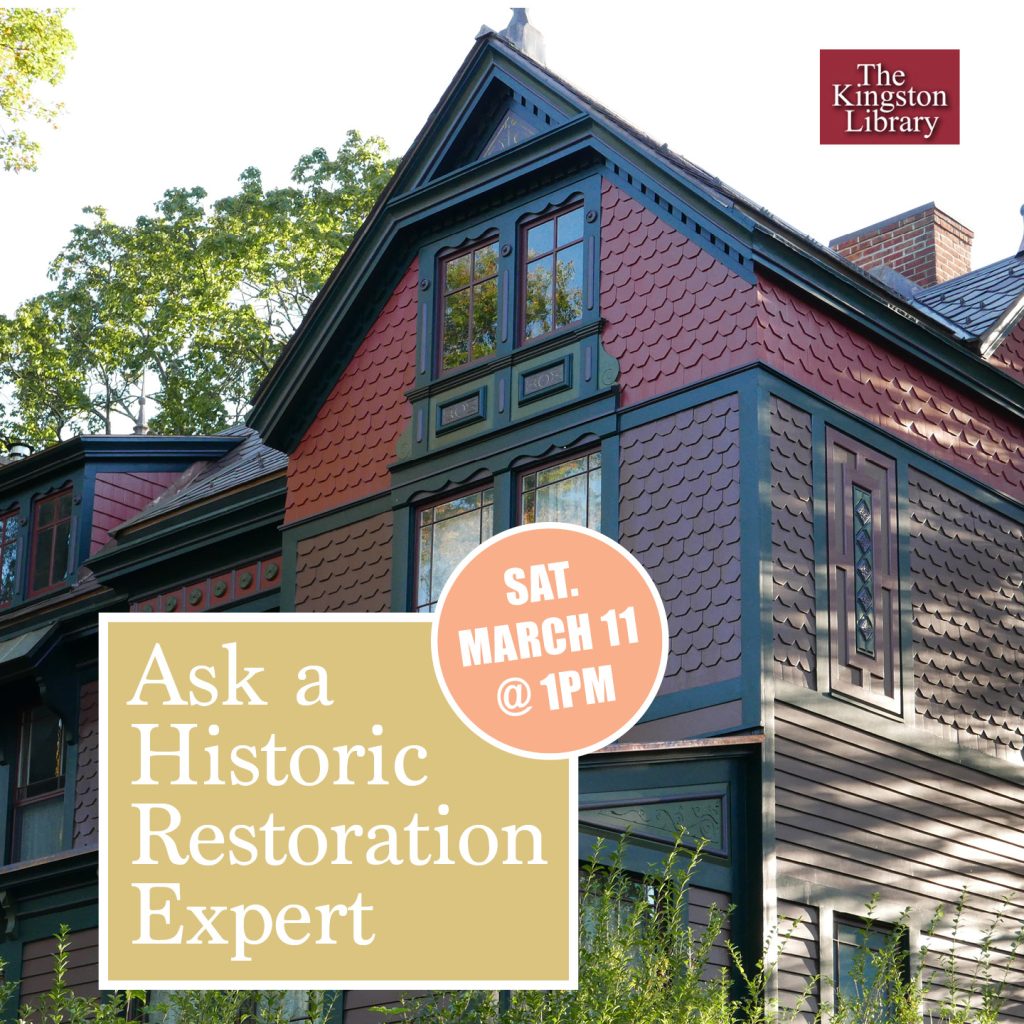
Two upcoming historic preservation talks at the Kingston Public Library

Attention historic preservation enthusiasts and newbies: Kingstoncitizens.org contributor Marissa Marvelli is hosting two free presentations at the Kingston Library that you should know about. The first one, Saturday February 18, is an introduction to researching buildings in Ulster County. She’ll also talk about historic rehabilitation tax credits. The second one, Saturday March 11, will feature Derrick McNab, one of Kingston’s greatest fonts of knowledge when it comes to restoring historic buildings. 

Saturday February 18, 1pm: Research Your Historic House with Marissa Marvelli – Got an old house? Curious about who lived there or when it was built? Bring your questions to Marissa Marvelli, a Kingston local and an award-winning historic preservation professional. She’ll show you the available resources to help you become an expert on your home. Historic maps, deeds, census records, newspaper archives, city directories and other materials contain a treasure trove of information waiting to be mined. 

Saturday March 11, 1pm: Ask a Historic Restoration Expert: Discussion with Derrick McNab – Wondering what to do with your old windows? Got roof repair issues? Thinking about installing new insulation? Want to avoid a bad masonry job? Wondering if your contractor is right for the job? In March, program organizer Marissa Marvelli will hand the mic over to Kingston-based Derrick McNab, an expert in all things pertaining to historic building restoration. His many skills include decorative paint work, plastering, woodworking and finishing, masonry restoration, and slate roofing and repair. He will discuss common restoration and maintenance issues and practical approaches to addressing them.

A (Working) Preservation Guide for Historic Property Owners and Enthusiasts in Ulster Co., NY. Last month, Marissa Marvelli shared a working GOOGLE DOCUMENT with the public and a goal of it becoming a comprehensive preservation guide for Ulster County.  Marissa is a real treasure and we give her thanks for all that she does for Kingston and Ulster County. 

The Kingstonian to be Jointly Reviewed Tonight; State Preservation Office Finds ‘Adverse Effects’ in its Evaluation of the Project; Confusion about Historic District Boundaries

By Rebecca Martin and Marissa Marvelli

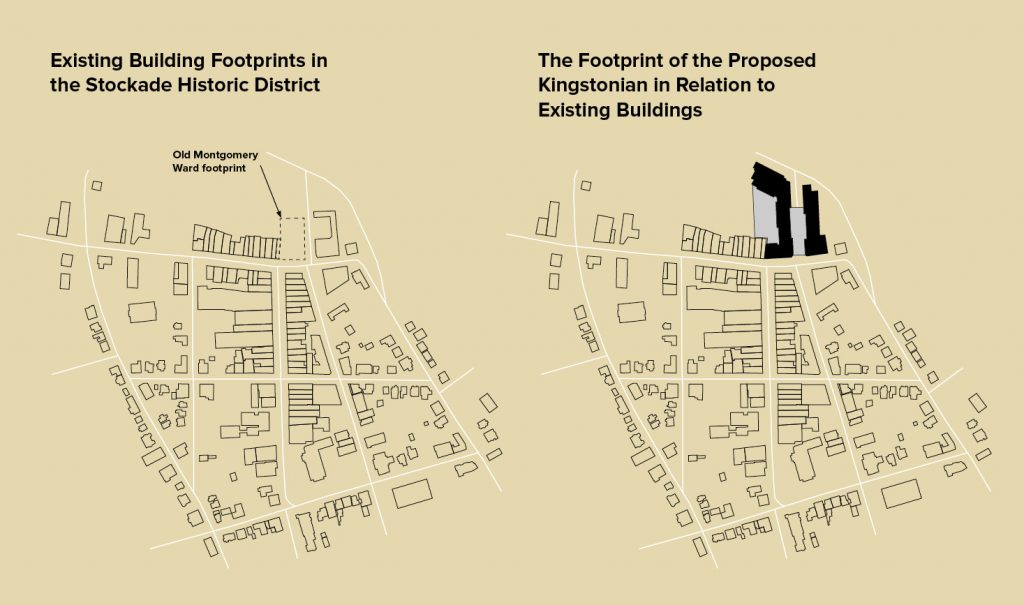
Stockade Historic District Building Footprints Comparison
This comparison comes from Marissa Marvelli’s illustrated guide for understanding architectural appropriateness in the Stockade Historic District.


This evening members of the City of Kingston Planning Board, Historic Landmarks Preservation Commission (HLPC), and the Heritage Area Commission (HAC) will convene for a joint meeting to discuss the visual impact analysis and other architectural drawings that were prepared for the proposed Kingstonian development by the applicant’s architect. It is one of nine consultant reports submitted in July as part of the project’s State Environmental Quality Review (SEQR). These reports are meant to help inform the Planning Board, the lead agency, as it completes Parts 2 and 3 of the Environmental Assessment Form (EAF), which assesses a project’s potential impacts, including those on historic, archaeological, architectural, or aesthetic resources. Although the applicant’s attorney volunteered to fill out the forms during the last Planning Board meeting on September 11th, completing these forms is the responsibility of the lead agency; the applicant cannot be its own critic.

Marissa Marvelli, a historic preservation consultant and a former member of the HLPC, has prepared an illustrated guide for evaluating new construction in the Stockade Historic District. It is meant to complement the questions asked in the EAF Part 2. While her guide does not attempt to prescribe design solutions as that is the responsibility of the project’s architect, it does call attention to the special qualities, features, and significance of the district. The guide is viewable at the bottom of this post.


Understanding Impacts on Historic, Archaeological, Architectural, and Aesthetic Resources

The following questions come directly from the NYS Department of Environmental Conservation’s SEQR Workbook, which is meant to assist the lead agency in completing a Part 2 EAF. They pertain specifically to impacts on historic, archaeological, architectural, and/or aesthetic resources:

  • Does the proposed project contain, or does it adjoin a structure listed on the national or state register of historic places, or a structure that has been determined by the Commissioner of OPRHP to be eligible for listing on the State Register of Historic Places? (The Kingstonian project site does not contain such a structure.)
  • Is the proposed project located in a national, state, or local historic district, or one that has been determined by the Commissioner of OPRHP to be eligible for listing on the State Register of Historic Places? (The Stockade Historic District is a designated local district. It is also listed on the National and State Registers.)
  • Does the community have a local survey, inventory, or list of important historic, architectural, or aesthetic resources, and are there any resources recorded on or near the project site? (Yes, the Senate House & Grounds to name one important one.)
  • Is the proposed project located in an archaeologically sensitive area? (Yes.)
  • If the project site is located in such an area, additional information may need to be collected to see if there are any resources in or near the specific location that may be impacted.
  • Are there historic or archaeological resources on the property or nearby?
  • Has an archeological survey been done to confirm if the project site has any such resources? (Only a Phase 1a survey has been completed so far. Consulting archaeologist Joseph Diamond has recommended a Phase 1b.)
  • Will the proposed project directly or indirectly affect them? How? (A Phase 1b survey would reveal potential impacts.)
  • Is the proposed project located in a scenic overlay district, scenic byway, or scenic area of state significance? (No.)
  • Is there a specific architectural style that identifies the community or neighborhood?  For example, most buildings may be predominantly of colonial architecture, or perhaps all the buildings in the neighborhood are constructed of red brick. (Yes, the immediate blocks are predominantly 19th-century brick commercial buildings. The district boasts the largest assemblage of 18th and early 19th century stone buildings in New York.)
  • Will the project block important scenic views, or change the aesthetic character of an area? (Yes, the project’s scale and massing break drastically with the pattern of the district and the development would close a historic street to create an open plaza, which has no precedent in the district. It also proposes to drastically alter the topography, which is important to the district’s history and significance.)
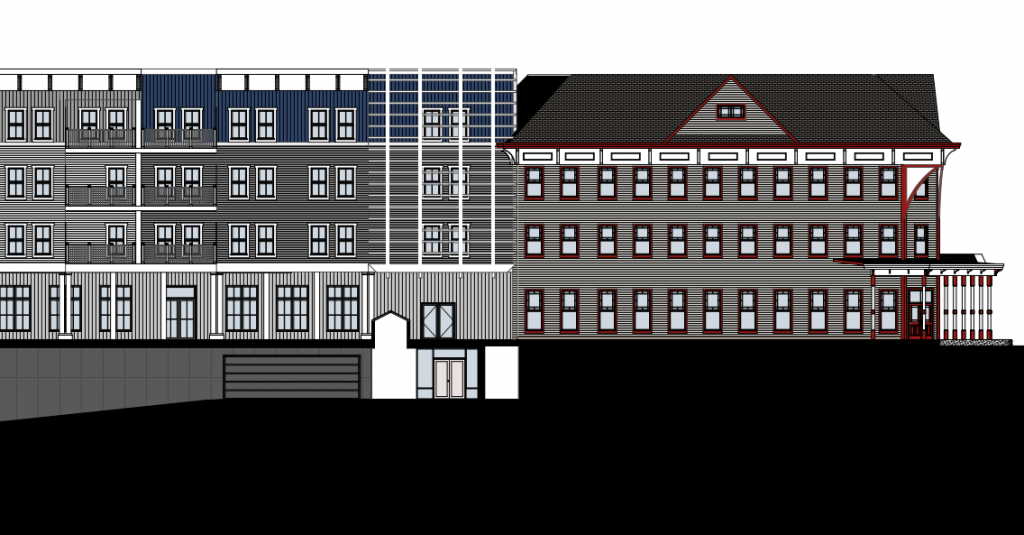
West elevation
West elevation from Fair Street of the proposed Kingstonian. Drawing by Mackenzie Architects.


Measuring Impacts

According to the EAF Part 2 Workbook, in considering impacts, the agency must decide if that impact will be small or moderate to large. This decision should be based on the magnitude of the potential impact. Magnitude is not just the physical size of the project in feet or acres. Magnitude also considers the scale and context of a proposed project, and severity of that project’s impact. The Workbook gives guidance on assessing impact according to each environmental topic, including historic and archaeological resources.

A small impact could occur if:

  • There is no historic or archaeological resource on the site, but there may be a small impact to community character because of concerns over consistency with existing architectural and aesthetic resources.
  • There are historic or archaeological resources on the site, but the project design is such that no disturbances or major changes to historic structures will occur. For example, the location where archaeological resources exist will be avoided, or the historic structure on the property will be maintained and restored.
  • Minor disturbances to the resources will occur or minor changes to the aesthetic or scenic quality of the area but these do not destroy the historic resource or drastically change the character of the area.
  • Work at a location that is locally designated and historic preservation permits are issued that indicate identified work as being in compliance with relevant local historic preservation code.

Moderate to large impacts may occur if:

  • Historic structures are planned to be demolished or relocated as part of the development plan.
  • Historic structures are to be remodeled in a way that destroys or damages its historic value.
  • The project introduces an architectural design that is not consistent with a designated historic district, or a district that has been determined eligible for listing on the State Register, and that is not consistent with the long-term vision the community has for its aesthetic character as identified in an adopted comprehensive plan.
  • The project changes the character or view of important aesthetic resources.


SHPO Believes Project Will Have ‘Adverse Effects’ on the Historic District

In a September 19th letter to the Kingstonian applicant, the State Historic Preservation Office (SHPO) provided its comments on the project after its review of the materials. The comments are part of a consultation mandated by Section 14.09 of the New York Parks, Recreation and Historic Preservation Law. It is required for projects that are funded, licensed or approved by state or federal agencies. 

The letter describes the agency’s concerns:

  • North Front Street is the traditional district boundary marked by a distinct natural drop-off down toward the Esopus Creek. This natural contour clearly marks the northern boundary of the historic 1658 stockade. The lower portion to the north of the district now contains modern buildings and the shopping plaza further to the north, but the historic boundary remains readily apparent and continues to characterize the district. The new construction would significantly alter the northern district boundary and would be clearly visible from within the historic district. The Montgomery Ward building, now demolished, was the only structure that extended significantly beyond that traditional northern border. The proposed new development is much larger and would extend well beyond the old Montgomery Ward footprint.
  • By the mid-19th century, when the commercial street front was developed, the section of Fair Street extending north from North Front Street was established to access railroad facilities and the lumber yards. This historic street, which allows pedestrian and vehicular access to the district, would be virtually eliminated as part of the proposed development.
  • The historic commercial and residential buildings of the Kingston Stockade are characterized by a variety of materials, styles, and colors. The new construction is monolithic compared with the surrounding district. Though the currently proposed design attempts to reference the historic setting and surrounding architecture, we believe that a much greater effort is warranted for a construction of this scale.

SHPO’s comments provided under Section 14.09 are not advisory. The applicant must consult with agency staff to find acceptable solutions for avoiding, mitigating, or minimizing any adverse effects identified.


Confusion About the Boundaries of the Stockade Historic District

According to citizens who were present, during a presentation of the Kingstonian to the HLPC at its September 5th meeting, questions were raised about the location of the northern boundary of the Stockade Historic District as it pertains to their project site. The Kingstonian project team has apparently been operating under the assumption that the boundary bisects the northern part of the City-owned parcel because that is what is shown on SHPO’s Cultural Resource Information System, which maps of State and National Register properties and districts throughout the state. Because the HLPC’s review of a project ends at the boundary line, it would be to the applicant’s advantage to have the boundaries more constricted.

The boundaries of the State and National Register historic district are not relevant to the HLPC because the HLPC reviews only locally-designated districts and landmarks. The boundaries of local districts are approved by the Common Council and are included in the zoning chapter of the City’s Administrative Code. It is clear that the local historic district boundaries avoid bisecting any parcels. Curiously, the applicant is not questioning the boundaries of the Stockade Mixed-Use Overlay District, which mirror those of the local historic district and is of great worth to this project.


Kingstonian Architect Presents Visual Impact Analysis at Heritage Area Commission.

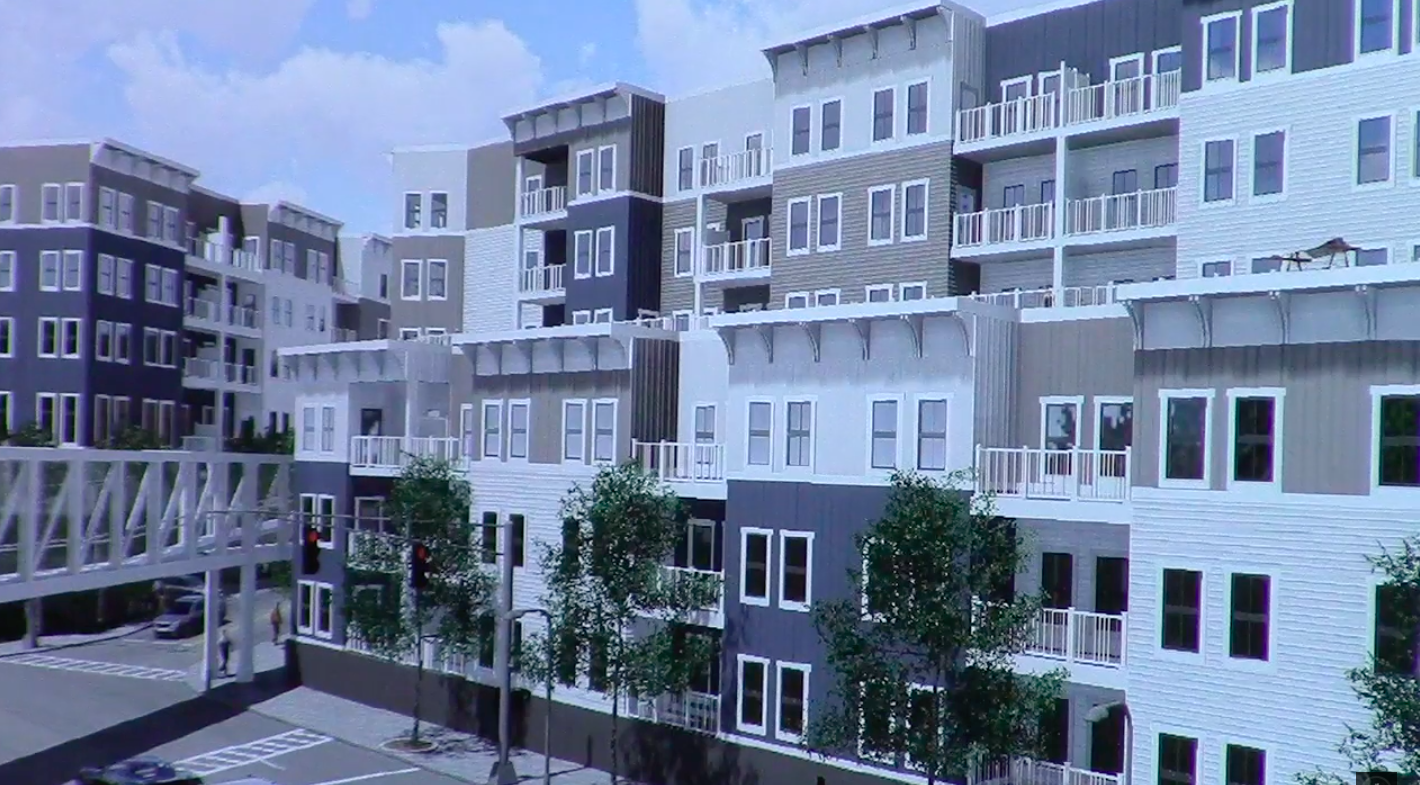
At last evening’s Heritage Area Commission (HAC) meeting, Steve MacKenzie of Mackenzie Architects P.C. presented his firm’s visual impact analysis for the Kingstonian project. It is the first time the architect has personally presented his design proposal to the community. Included in his presentation were new renderings not before seen by the public.

Although the HAC will play only an advisory role in this case, two of its members also serve on the Historic Landmarks Commission (HLPC), a decision-making body in the review process for the Kingstonian project. At last night’s meeting, HAC Chair Hayes Clement confirmed that no deliberations would be occurring before the project’s SEQR process has been completed.

MacKenzie noted that he will be making the same presentation to the HLPC at its meeting on Thursday September 5th.

Click on image watch the Visual Analysis Study review of the Kingstonian Project.

Kingstonian Visual Impact Analysis by MacKenzie Architects P.C.

Giovanna Righini, a Kingston resident and former longtime member of the HAC, spoke during the public comment portion of last night’s meeting. Righini was one of four volunteers who stepped down this spring in the wake of the City of Kingston executive branch’s efforts to merge the HLPC and HAC commissions against the will of council members, preservationists, civic advocates, and residents. Righini’s comments addressed the general role and responsibilities of the HAC:

I know that the Commissioners are all familiar with the Kingston Urban Cultural Park Draft Management Plan, which serves as the original basis for the Heritage Area Commission’s advisory work. Tonight I am here to put a reminder of it on the public record. As you review tonight’s materials, the HAC should have a clear understanding of the responsibility of its advisory role in structuring comments for the HLPC.

Per the Preservation Plan Approach in Part V, page 28, the Review Board is clearly laid out as follows:

“One of the most potent tools in promoting preservation is architectural and design review. The areas identified above [which include the Stockade District and West Strand] will be placed under the jurisdiction of the HLPC, the City’s existing preservation-oriented board. Standards and procedures set forth in the local laws establishing this Commission and creating the Stockade Historic and Architectural Design District will be applied to these areas as will applicable provisions in the recently adopted City zoning law and preservation standards established by the Secretary of the Interior…”

Continued under Preservation Standards and Guidelines in Part V, page 35, the Zoning Ordinance is noted as establishing preservation standards, guidelines and procedures within the City’s historic districts.

“Applicable portions of the Revised Zoning Ordinance require Landmark Commission review and approval of all applications for any changes made within these districts including construction, reconstruction, alteration, restoration, removal, demolition or painting. These requirements apply to all buildings, structures, out-buildings, walls, fences, steps, topographical fixtures, earthworks, landscaping, paving and signs.”

It goes on to describe requirements imposed by the ordinance pertaining to all aspects of compatibility with existing and adjacent architecture and character. “In short, every conceivable element of significance and compatibility.”

And so, also in short, if it is in a historic district, design review decisions are the purview of the HLPC. While the HAC can and should make comments, it should also make sure to clearly defer final decisions to the HLPC.

Planning Board to Accept Public Comments on Kingstonian Studies at August 19 Hearing

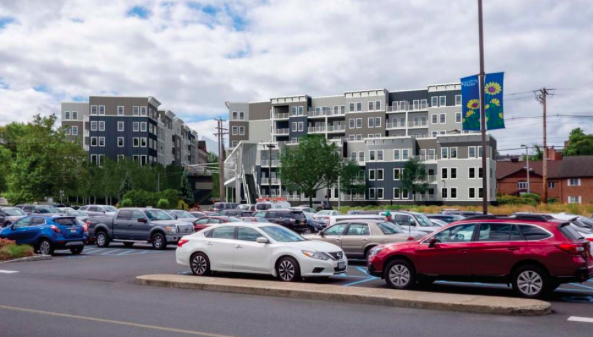
From the Visual Impact Analysis report by MACKENZIE ARCHITECTS, P.C.. Vantage point of the proposed Kingstonian project from the Kingston Plaza Parking Lot at MAC Fitness Entrance.

Group Editorial

At the end of July, the City of Kingston’s Planning Office posted nine consultant reports pertaining to the proposed Kingstonian project to the City’s website. They were produced on behalf of the applicant, Kingstonian Development LLC, at the request of the Planning Board which they made in their June 4 meeting (see video of that meeting here). The Planning Board as lead agency in the State Environmental Quality Review (SEQR) of this project will weigh this information as it determines its environmental impact.

In that same meeting, in response to a question about the estimated timeline for review, Kingston Planning Director Suzanne Cahill stated that there would be no hearings on the project in the month of August. But on August 2 the Mayor issued a notice announcing two separate hearings for the Kingstonian that month, including one on Monday August 19 in which the Planning Board will hear public testimony on the consultant reports. The August 19 hearing will probably be the only opportunity for the public to raise questions directly to the Planning Board before it makes its determination.

Kingston Planning Board: Public Hearing on Kingstonian Premlinary Studies  Monday, August 19 at 6:00pm.  Kingston City Hall, 420 Broadway.

This means that the community was given just 19 days to digest nine reports worth of information about archaeological resources, visual impacts, geotechnical aspects, stormwater capacity, building demolition, traffic, water supply, sewage, and more—subjects few of us are experts in. Feeling overwhelmed? So are we. 

TAKE ACTION: Submit a request in writing to the Planning Board that they allow the public more time to review the reports.  pl******@*********ny.gov

Kingstonian Consultant Reports

Herzog’s Warehouse Building Asbestos Survey Report (pdf)

Green Features of the Kingstonian Development (pdf)

Geotechnical Report (pdf)

Threatened and Endangered Species Habitat Suitability Assessment Report (pdf)

Preliminary Storm Water Report (pdf)

Traffic Impact Study (pdf)

Water Supply and Wastewater Capacity Preliminary Report (pdf)

Phase 1A Cultural Resource Investigation (pdf)

Visual Impact Analysis (pdf)


SEQR and Cultural Resources

There is a prevalent misconception that the “environment” in a State Environmental Quality Review pertains only to natural resources when in fact, according to the SEQR Handbook, “The terms ‘archeological’ and ‘historic’ are specifically included in the definition of the ‘environment’ at Part 617.2(l) as physical conditions potentially affected by a project.” The Handbook explains that such resources are:

“… also often referred to as cultural resources. These resources may be located above ground, underground or underwater, and have significance in the history, pre-history, architecture or culture of the nation, the state, or local or tribal communities. Examples include: 

  • Buildings (houses, barns, factories, churches, hotels, etc.), 
  • Structures (dams, bridges, canals, aqueducts, lighthouses, etc.), 
  • Districts (group of buildings or structures that have a common basis in history or architecture), 
  • Sites (battlefields, historic forts, prehistoric encampments, shipwrecks, etc.), 
  • Objects (ships, etc.), and 
  • Areas (gorges, parks, etc.).” 

The Kingstonian project site features more than one of these resource examples. The site is in an archaeologically-sensitive area; it contains a historic building—the late 19th century hotel building today the Herzog’s Warehouse; and most of the site lies within the National Register Stockade Historic District. It is also in close proximity to the Senate House State Historic Site. 

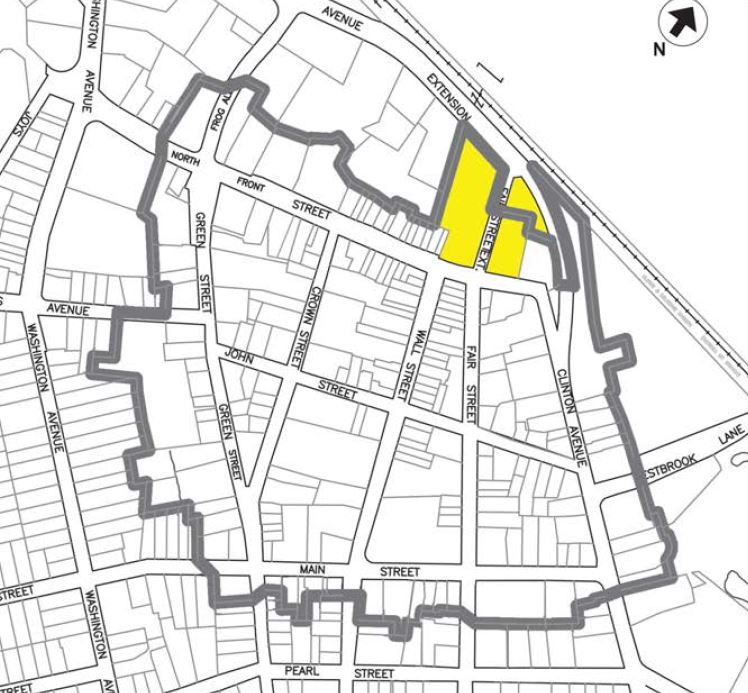
The boundaries of the Stockade Historic District. The project site is highlighted yellow.


Archaeological Resources

At the behest of the applicant, Joseph Diamond, a well regarded local archaeologist and professor at SUNY New Paltz, conducted a Phase 1A archaeological survey of the project site. A Phase 1A is an initial survey carried out to evaluate the overall sensitivity of the project area for the presence of cultural resources, as well as to guide the field investigation that follows. No subsurface probing is involved. (More information about archaeological surveys can be found here.) In his summary report, Diamond notes that: 

“The project area borders a National Register Historic District in a location where subsurface testing has never been undertaken. Potential archaeological deposits include, but are not limited to 1) the 1658 Stockade along the northern edge of North Front Street, 2) the moat constructed by Stuyvesant in June of 1658 which surrounds 3 sides of the stockade area, 3) deposits associated with the 17th-century Dutch and British Colonial Periods, and 4) deposits of Native American origin which may be mixed with or underlie the deposits from the 17th-century Dutch and British.”

Because of the site’s potential to yield significant pre-historic and historic archaeological information, Diamond recommends a Phase 1B field investigation, which would involve subsurface testing at select locations with the use of a backhoe.


Historic Resources

In a letter to the Planning Board dated March 11, 2019, the Kingston Historic Landmarks Preservation Commission (HLPC) outlined its concerns about the Kingstonian project. In submitting this letter—which was unanimously approved by the Commission at its March 7 meeting—the HLPC was fulfilling its role as an involved agency in SEQR. However, for reasons that remain dubious, Planning Director Suzanne Cahill advised the Planning Board to disregard that letter as they were reviewing responses from various agencies about the project at its June 4 meeting, confirming that it was still being “deliberated.” 

A relevant side note: Shortly after the HLPC’s letter was submitted to the Planning Board, two highly qualified members—a historic preservation specialist and an architect—were dismissed from the HLPC by Mayor Steve Noble. Two other members resigned in protest of his action. Since April, he has appointed four new individuals to the Commission. (See “CoK’s Executive Branch Move to Streamline Commissions May Impair Historic Preservation Efforts,” KingstonCitizens.org, April 4, 2019)

The concerns outlined in the HLPC’s March letter closely follow the SEQR criteria for determining significance, focusing on criterion “(v) the impairment of the character or quality of important historical, archeological, architectural, or aesthetic resources or of existing community or neighborhood character.” Specific concerns identified by the Commission include the potential to uncover archaeological resources; the demolition of the old hotel building and the potential to create a false sense of history by replicating it; the potential for negative impacts on nearby buildings from excavation and pile-driving; the degree of change to the visual context of the historic district and the Senate House caused by the new construction; and the altering of a major geographic feature, the bluff, which is a key element of the district’s significance (this bluff is discussed in a recent editorial in the Kingston Times, “Building on the past: the Stockade District’s tipping point,” July 28, 2019). 

While the reports prepared by the applicant’s consultants touch on some of the HLPC’s concerns, many remain open questions. 

Suggested requests that members of the public can make to the Planning Board as they review the applicant’s consultant reports:

  • When will the Phase 1B archaeological investigation be conducted? If significant archaeological resources are discovered, such as evidence of the original stockade, what contingencies will there be to mitigate adverse impacts to them during construction? When will those contingencies be established?
  • The geotechnical engineer should provide a summary assessment of the risks posed to nearby buildings by excavation and pile-driving for the project and how such risks can be mitigated. This assessment should be comprehensible to the general public. 
  • The applicant must demonstrate in photos and engineering reports the necessity of demolishing the old hotel building. The historic building should be documented in detailed drawings, including floor plans, elevations, and sections.
  • The applicant must illustrate the measures that will be taken to avoid creating a false sense of history with the replica hotel building. The Secretary of the Interior’s Standards for Reconstruction state that “Reconstruction will be based on the accurate duplication of historic features and elements substantiated by documentary or physical evidence rather than on conjectural designs or the availability of different features from other historic properties. A reconstructed property will re-create the appearance of the non-surviving historic property in materials, design, color and texture.”
  • Of the ten vantage points illustrated in the visual impact analysis, none show the proposed plaza in any detail, either of it or from it. This is an important experience to understand as it will be wholly new to the Stockade. Another vantage point that needs to be studied is from the intersection of Fair and North Front Street. Oddly, one of the vantage points included in the analysis is a view south along Wall Street with the Kingstonian out of frame. The purpose of showing this is lost on us.
  • The visual impact analysis does not include a vantage point of the Kingstonian from farther south along Wall Street. The usefulness of the perspective is to demonstrate whether or not the Schwenk Drive side of the Kingstonian development is visible from within the historic district. Other simulations suggest that the north side rises to a greater height than the development’s North Front Street building. 
  • The rendered perspectives show that the North Front Street garage entrance will be on axis Wall Street making this utilitarian building feature visible from a great distance.
  • Recognizing that the bluff is significant not only to the story of the historic district but to the history of the settlement of New York state and the nation and that the proposed changes to this feature would be irreversible, what options are there to mitigate this negative impact? The applicant and their architect should study this question carefully.

These questions address only the historic and  archaeological aspects of the project. Not touched upon here are concerns about traffic, storm water management, water supply, sewage, sustainability, and the lack of affordable housing. Each merit careful scrutiny by the community. With just four days left before the Planning Board’s public hearing, it is not likely that will happen.

WHAT TO EXPECT. Public Hearing on Proposed Kingstonian Project on April 10

WHAT
City of Kingston Planning Board
Public Hearing on the Kingstonian

WHEN
Wednesday, April 10, 2019
6:00pm

WHERE
City of Kingston City Hall
Council Chambers (Top Floor)
420 Broadway
Kingston, NY

“LISTEN TO THE COMMUNITY” Rally
Before the public hearing
5:00pm
Front Lawn
Kingston City Hall

Co-sponsors include:  Kingston Tenants Union, Midtown Rising, Rise Up Kingston, Citizen Action of New York Mid-Hudson Valley Chapter, Nobody Leaves Mid Hudson and KingstonCitizens.org

MORE
It is not expected that the planning board will make any decisions on the 10th.

A regular planning board meeting will occur on Monday, 4/15 where the planning board may decide on the items listed in the 4/10 AGENDA  (lot line deletion, site plan / special permit and SEQR determination (pos or neg dec))

Read more…

Kingston’s Historic Landmarks Preservation Commission and the Importance of Procedure


***

This post was updated December 21, 2018, to clarify two details. Firstly, the assistant corporation counsel, who provides legal counsel to the city’s commissions and boards, insisted to the Commission that the transcript of the final hearing would be sufficient for explaining the rationale of the Commission’s decision in lieu of a thorough written decision. Secondly, frequent intrusions in the commission’s final deliberations were made by the applicant and their lawyer and not other members of the public.

***


“The purpose...is to provide for the promotion of the educational, cultural, economic and general welfare of the public through the protection, enhancement, perpetuation and preservation of landmarks and Landmark Districts. The legislative body declares that it is in the public interest to ensure that the distinctive landmarks and Landmark District shall not be injuriously affected, that the value to the community of those buildings having architectural and historical worth shall not be impaired and that said districts be maintained and preserved to promote their use of the education, pleasure and welfare of the citizens of the City of Kingston and others.” 

Legislative Intent of the Historic Landmarks Preservation Commission, City of Kingston Administrative Code §405-63

By Marissa Marvelli

Following established procedures is key to any review by a quasi-judicial commission or board. Any misstep, big or small, can result in a judge rejecting its decision on appeal. This is precisely what has happened with the decision of Kingston’s Historic Landmarks Preservation Commission (HLPC) to deny the Irish Cultural Center (ICC) a “preservation notice of action” for their proposed new building in the Rondout Historic District. In her ruling, the Honorable Lisa Fisher of the State Supreme Court correctly notes how the members of the HLPC failed to render a clear written decision that contains specific references to the zoning code. Without that in hand, she, like Kingston’s Zoning Board of Appeals (ZBA), was left to parse the transcript of the hearing, which she accurately describes as “erratic.”

The HLPC failed in its review of the ICC—not on principle but on procedure. The final written decision of the HLPC is inadequate in describing the Commission’s reasons for its denying approval for the ICC.  No member of the Commission was directly involved in the composition of the written decision, a concern that was raised by members in the weeks following the final hearing.  In response, the assistant corporation counsel for the City of Kingston, who provides legal counsel to the city’s boards and commissions, insisted that the transcript would be sufficient for conveying the commission’s rationale. That transcript, which by default became the primary record of the hearing, documents a circuitous deliberation by Commissioners with frequent intrusions by the applicant and their lawyer.  The record further reveals the difficulty that Commissioners had in interpreting the criteria for review as outlined in the code, because the language is too vague and weighted towards the consideration of changes to individual buildings rather than new construction in historic districts. In this light, it is not difficult to see why the ZBA and this judge concluded that the HLPC’s decision was “arbitrary and capricious.”

One of the fundamental duties of the HLPC when reviewing proposed changes in a historic district is to ensure that the character of the historic district is maintained, and “prevent construction, reconstruction, alteration or demolition out of harmony with existing buildings insofar as character, material, color, line and detail are concerned, and thus to prevent degeneration of property, to safeguard public health, promote safety and preserve the beauty of the character of the landmark or Landmark District.”    (City of Kingston Administrative Code §405-64 D)

No single detail defines a historic district’s character. It is the multitude of details taken together that creates a distinctive environment and sense of place. Such character-defining qualities include the relationships of buildings to each other and to the street. Do the buildings form a continuous streetwall or are they spaced apart? Are they situated directly at the street or are they set back from it? What was the historical development trend that led to their existence? Is there a discernible rhythm or pattern of details, be it building sizes, roof massing, cornices, or windows? Many districts have multiple rhythms. Character is also defined by the type of buildings, their construction, and scale—the architecture of a single-family dwelling is different than that of a store-and-loft building in terms of massing, façade proportion, materiality, fenestration, and building features like porches and storefronts.

The qualities described above are aesthetic ones. It is incumbent on members of the HLPC to consider all of them when considering the appropriateness of new construction in a historic district, be it an addition to an existing structure or a wholly new building on a vacant site.

Read more…

A Correct Path for a Complete and Proper Reset of Historic Preservation in Kingston (and just in time).   

By Rebecca Martin

At last evening’s Kingston’s Historic Preservation Landmarks Commission (HLPC), the group introduced a draft of an updated preservation ordinance, modeled after the 2014 preservation ordinance, in accordance with the Certified Local Government guidelines (SHPO) and with preservation ordinances from Saratoga Springs, Syracuse, Buffalo, and Rochester.

Kingston having the rich history that it does, and seemingly everyone’s support to preserve it, requires clear guidelines, policies and laws which we simply haven’t had in place for a long time. Additionally, and for decades, the City of Kingston’s HLPC has been siloed from everything else. Today, we are on a clear path for a complete and proper reset of what is old and fragmented preservation guidelines. We encourage everyone to view this 50-minute discussion.  It’s illuminating and exciting to see a process like this being handled so professionally.

You can follow along with the video (starting at 2:00) and the powerpoint presentation (click on image below for the entire PowerPoint) created by HLPC’s Vice Chair Marissa Marvelli.

Read more…

GUEST EDITORIAL: Beyond ‘Streamlining’ – Improving Kingston’s Preservation and Heritage Programs

Click on Imagine to review educational panel “Historic Preservation in the City of Kingston: Re-thinking the Review Process”

By Marissa Marvelli

On September 19th, the Kingston Common Council’s Laws & Rules Committee may discuss whether or not to throw out or to table the Corporation Counsel office’s draft legislation to merge the Heritage Area and Historic Landmarks Preservation Commissions. It will be nearly the fourth consecutive meeting for which this matter has been a topic, and it’s our opinion that the Council should not hesitate to throw out the legislation and instead, continue on the promising path that they are on now.

The council members who serve on the committee deserve praise for their careful study of the Corporation Counsel’s draft legislation and the reasons why it is being proposed. After a lot of information-gathering—particularly at their meeting in July where they heard directly from program administrators—it appears the broad consensus of the committee is that merging the commissions will not meaningfully address issues concerning the regulatory review process, and in fact, may create new problems.  

And what are the issues exactly? What problems is “streamlining” meant to solve? Were other solutions considered before the legislation was put forward? No one could say for sure. The reasons repeated by city administration is that merging the commissions is a recommendation of the now disbanded Comp Plan Re-zoning Subcommittee without sharing any notes that show how that conclusion was reached. At face value, the idea to eliminate one step in the public review process by combining two related volunteer commissions would seem like a rational change. Why make an applicant appear before two separate commissions for a new business sign? No one is arguing in favor of such redundancy, but is there another way to solve this?

Read more…

VIDEO: Kingston Laws and Rules Committee Host Roundtable to Clarify Kingston Development Processes.


CITIZEN REQUEST.  Please request that the Kingston Common Council Laws and Rules Committee throw out streamlining legislation and continue to collaborate with all relevant Kingston departments, boards and commissions to clarify the development process scenarios comprehensively in the City of Kingston. 

Contact:  Laws and Rules Committee Liaison to Streamlining Commissions:  Ward 9 Alderwoman Andrea Shaut at:  wa***@*********ny.gov

By Rebecca Martin

In April of this year, draft legislation to “streamline” the Historic Landmarks Preservation and Heritage Area Commissions was introduced by the City of Kingston’s executive branch to the common council with support from both the Planning and Building Departments.  Streamlining Historic Commissions, they argued, would eliminate any redundancies and create a more efficient process for project sponsors who came forward with development concepts for the city.

It’s been a rocky road since, with Kingston’s assistant Corporation Council misleading the council and the public by providing false time requirements and pending litigation that was never understood as reasons to get the streamlining legislation as a local law passed by September.

To help to better understand the process, we jumped in to provide an important educational forum so that we had good information for debate. With more questions than answers, the majority of the council (7-2) with the public’s support, brought the proposed ‘streamlining’ legislation back to committee from the floor for further review.

How did the City of Kingston’s Planning and Building Department come to the conclusion that streamlining commissions was the best way forward?  Was there a flowchart of all development processes? Had all parties involved been gathered to discuss the process to collectively agree that streamlining was the solution?

We got our answer during July’s Common Council Laws and Rules Committee meeting.  Led by Ward 9 Alderwoman Andrea Shaut, who serves as the liaison to the Laws and Rules Committee on the streamlining matter, a roundtable discussion was called that included invitations to all decision makers – whether regulatory or advisory.  Turns out that this was the first time that everyone had been brought together to discuss. The planning department didn’t have flowcharts and Kingston’s Planning Director Suzanne Cahill insisted that the development process was not ‘one size fits all’ so it wasn’t possible to create them.

Really? Even SEQR has a flowchart. When you are talking about processes that if not available, up-to-date or followed correctly will impact the public in profound ways, you better get that information out of your head and onto the page.

Read more…

VIDEO: Kingston Common Council Sends Streamlining Historic Commissions and Legislation Back to Committee.

Click on image to review the legislation packet from last night’s Council meeting. Scroll down to see Resolution #107 and accompanying legislation.

By Rebecca Martin

In what might might very well be in my top 10 most perplexing processes I’ve witnessed in 12 years at KingstonCitizens.org,  good sense prevailed and Resolution #107 of 2018 “Common Council of the City of Kingston Establishing a Public Hearing Regarding the Possible Merger of the Historic Landmarks Preservation Commission and the Heritage Area Commission” (with accompanying legislation from 5/16/18 to be sent out to Involved Agencies)   was referred back to the Laws and Rules Committee for proper vetting with a  7 / 2 vote.

In favor: Morrell, Worthington, Carey, Davis, O’Reilly, Schabot, Shaut
Against: Scott-Childress, Koop

The good news is that I think Kingston is venturing into a new kind of conversation to better understand Historic Preservation in Kingston with a secondary goal to identify best practices so to make the review process for development more efficient.

Thanks to council members for a thoughtful and robust debate.

It’s also a moment for the executive branch to contemplate better boundaries for its corporation counsel.  I hope that the Kingston Common Council will also consider advocating for a budget line to provide its own council on retainer for second opinions. With a new budget cycle coming up, it’s the perfect time to be putting that forward. I think the public might readily support that this year given this flub. The council should have staff, too. What happened to the council clerk position that began last summer and ended in the fall?

A refreshed value may be placed on the Historic Landmarks Preservation Commission (HLPC), with the council allocating a council liaison and/or, assigning the HLPC to a council committee (perhaps Laws and Rules) for an ongoing dialogue to allow relationships to be built and for council members to have the opportunity to get to know Historic Preservation items and issues in real time, as well as to come to a new appreciation of the work that our commission is doing on Kingston’s behalf. That seems entirely possible to me now.

Below is video from the recent council caucus and meeting with excerpts. Thanks to my partner Clark Richters of the Kingston News for his great work in recording video for this, and all of the meetings that we cover. I couldn’t do it without him.

Read more…