Ulster County has an opportunity right now to turn its Zero Waste commitments into action. UCRRA, the County Legislature, and the County Executive can work together on a funded Zero Waste Implementation Plan (ZWIP), led by UCRRA, that reduces waste, expands reuse and organics diversion, supports local businesses, and determines what infrastructure we actually need for the future.
Solid waste needs to be a priority, alongside clean water, clean air, and healthy land. How we produce, manage, and divert waste affects all three and is at the root of much of the pollution that ails us.
Ulster County already has many of the pieces it needs to move toward Zero Waste that includes local composters, food-scrap haulers, municipal transfer stations, and a County Executive who has made organics diversion a priority. What’s missing is a countywide plan to bring these efforts together, set measurable goals, and provide the funding and support to make them happen.
UCRRA brings the facilities and waste-management experience. The County Legislature makes policy and provides funding. The County Executive provides leadership and coordinates county departments. They need to work together so municipalities and local businesses aren’t left to figure it out on their own.
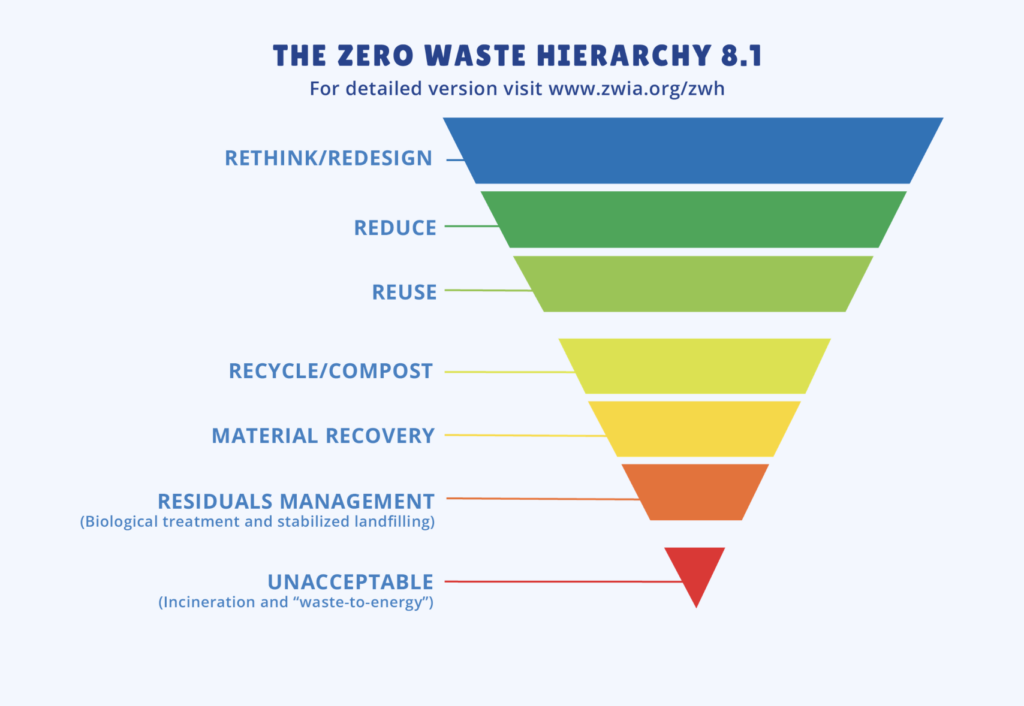
The Zero Waste Hierarchy provides the roadmap: rethink and redesign, reduce, reuse and repair, then recycle and compost what remains. A ZWIP puts that into practice through local policies, infrastructure, funding, public education, and measurable goals. Disposal comes last. The point is to throw less away.
Start with organics. Get every transfer station moving
In February 2023, County Executive Jen Metzger issued Executive Order 1, setting a goal of diverting 100% of the County’s organic waste from landfills and incinerators by 2030, starting with County government operations. That commitment needs to become a countywide priority.
UCRRA’s 2023 Annual Waste and Recycling Report documents 21,386 tons of organic materials managed through composting, animal feeding, rendering, anaerobic digestion, and food donation, including 7,333 tons of source-separated food scraps. Organics diversion is already happening, but we need to do much more.
And we need more than processing capacity. We need collection and hauling, convenient drop-off locations, and participation from community members, businesses, schools, institutions, and local governments.
Every municipal transfer station should be part of the effort. A countywide ZWIP would identify what each municipality needs to participate, from equipment and space to staffing, funding, and collection systems. It would also give UCRRA and the County a clear basis for working with municipalities and help the Legislature make informed budget decisions.
UCRRA’s $0 tipping fee for food waste needs to be reversed
UCRRA eliminated food-waste tipping fees effective November 2, 2026, as announced in its October 26 press release. UCRRA may argue that eliminating the fee will encourage more food scraps to be diverted from the waste stream. But what happens to the local businesses already doing this work? A policy intended to increase organics diversion should not undermine the local businesses that make it possible.
Let’s be honest about where the big costs are. Seneca Meadows raised its landfill tipping fee from $29 to $49 per ton in 2025. That’s just the disposal fee. Ulster County also pays to transport the garbage there, roughly 240 miles away. UCRRA’s 2026 Circular Economy Strategic Plan reports that nearly 140,000 tons of county waste were sent to landfills in 2024, at a combined transportation and disposal cost of approximately $12.5 million.
Every ton of food scraps we keep out of the garbage is a ton we don’t have to pay to haul and dispose of as trash. Imagine the savings if we captured all the food scraps currently being thrown away. That’s where we should be focusing our investment.
Independent composters and food-scrap haulers have invested in vehicles, equipment, employees, infrastructure, and customer relationships. They provide essential collection and hauling services. UCRRA’s own food-waste service directory reflects this network of providers.
Removing UCRRA’s food-waste tipping fee does not address the biggest barrier, that of getting food scraps collected and delivered to composting facilities. A publicly supported facility accepting food scraps at no charge could put independent businesses at a competitive disadvantage when they still have to cover collection, transportation, labor, and operating costs. If customers shift to free drop-off, local businesses could lose routes and revenue, putting existing investments and capacity at risk.
We need to expand organics collection without putting local composters and haulers out of business. UCRRA should review the impact of this policy and reverse it if it undermines those services.
A countywide ZWIP needs everyone at the table
A ZWIP should assess what Ulster County generates, where it goes, what it costs, what infrastructure already exists, and what’s missing. It should set measurable goals, timelines, responsibilities, and dedicated funding. UCRRA’s current Solid Waste Management Plan does not provide that level of detail or a countywide implementation roadmap.
You can’t know where to save money—or where an investment is needed—without a plan. Before spending money to expand or build new facilities, the County should know how much waste can be prevented, reused, recycled, or composted; what existing facilities can handle; and what each municipality needs to participate. That information can help avoid unnecessary infrastructure costs and direct funding where it will have the greatest impact.
Although food scraps are a key part of the effort, the plan must also look beyond organics. Waste prevention, reuse and repair, recycling, construction and demolition materials, and responsible purchasing all belong in the plan.
That means bringing UCRRA, municipalities, local composters and haulers, community organizations, schools, institutions, businesses, and residents to the table. Local businesses bring firsthand knowledge of what works. No single agency or facility can build a countywide system alone.
Learn from other counties
Hennepin County, Minnesota developed a comprehensive Zero Waste Plan with a timeline and 62 actions addressing waste prevention, organics, infrastructure, business participation, and public education. More than 1,800 people participated in the planning process.
There are lessons here for Ulster County, to involve the people and businesses affected by waste decisions, look at the entire waste system, set measurable goals, assign responsibilities, and connect the plan to funding and implementation.
Ulster County doesn’t need to copy Hennepin County. It needs a plan built around our own communities, geography, businesses, and existing infrastructure. But we can learn from Hennepin’s coordinated, countywide approach.
Read Hennepin County’s Zero Waste Plan.
Zero Waste requires a cultural shift
Infrastructure alone won’t get us there. We’ve built an economy and culture around buying, using, and throwing things away. Zero Waste requires changing that relationship with materials.
That means sustained public education, convenient and affordable services, and leadership from local government, businesses, schools, and institutions. Community members need practical ways to prevent waste, reuse and repair items, and participate in composting and recycling—including those in rural areas without curbside collection or nearby drop-off sites.
We need to do everything we can locally, while also looking to the state for policies, funding, and technical support to help communities make these changes.
The ZWIP should include a budget for ongoing public education. We should measure success by how much less waste we produce, not just how much we divert.
Reduce the waste stream before deciding what infrastructure we need.
UCRRA knows this is a serious problem. Finding a way to manage the county’s waste, reduce reliance on distant landfills, and control rising costs is a major challenge. That’s likely part of what prompted the Global NRG proposal.
Ulster County cannot keep relying on Seneca Meadows to take the garbage we send away. Replacing one large disposal or processing facility with another doesn’t necessarily move us toward Zero Waste. We need to reduce the amount of waste we generate first through prevention, reuse and repair, recycling, and composting. Then we can determine how much residual waste infrastructure we actually need.
The Global NRG proposal and any proposal for a new landfill need to be evaluated against a countywide Zero Waste plan. What materials would the facility recover? How much waste would still need disposal? What would it cost? And would it help or hinder efforts to reduce waste over time?
UCRRA needs the County Legislature and County Executive behind it. They should provide the funding and staff support for UCRRA to work with municipalities and other stakeholders to develop a countywide Zero Waste Implementation Plan. The plan would identify how much waste we can prevent or divert, what existing facilities can handle, and what additional capacity is actually needed. It would also give the Legislature a basis for making informed budget decisions.
The sequence matters: reduce, reuse, repair, recycle, and compost as much as possible. Then determine what remains and how to manage it. We need the plan before making major infrastructure decisions—not the other way around.
What can you do? Get involved
A countywide ZWIP will take public support, and community members who recognize the need for action are already showing up. Listen to the November 16 UCRRA board meeting. Public comment begins at the 8-minute mark.
- Attend UCRRA meetings and ask how its decisions fit into a countywide Zero Waste strategy.
- Ask your County Legislator to make a funded ZWIP a policy and budget priority.
- Ask the County Executive to lead and coordinate its implementation.
- Support local composting and food-scrap collection businesses.
- Talk with neighbors, schools, workplaces, and community organizations about reducing waste and participating in organics programs.
Zero Waste takes all hands on deck. UCRRA, the Legislature, the County Executive, municipalities, local businesses, and community members all have a role.