The situation at 32 Abeel Street in Kingston (“Irish Cultural Center seeks to donate Abeel Street site to Kingston” Daily Freeman) may serve as a test case for how the City evaluates the transfer of property as a “gift” when a private project leaves behind unresolved site conditions that may shift long-term responsibility as well as ownership.
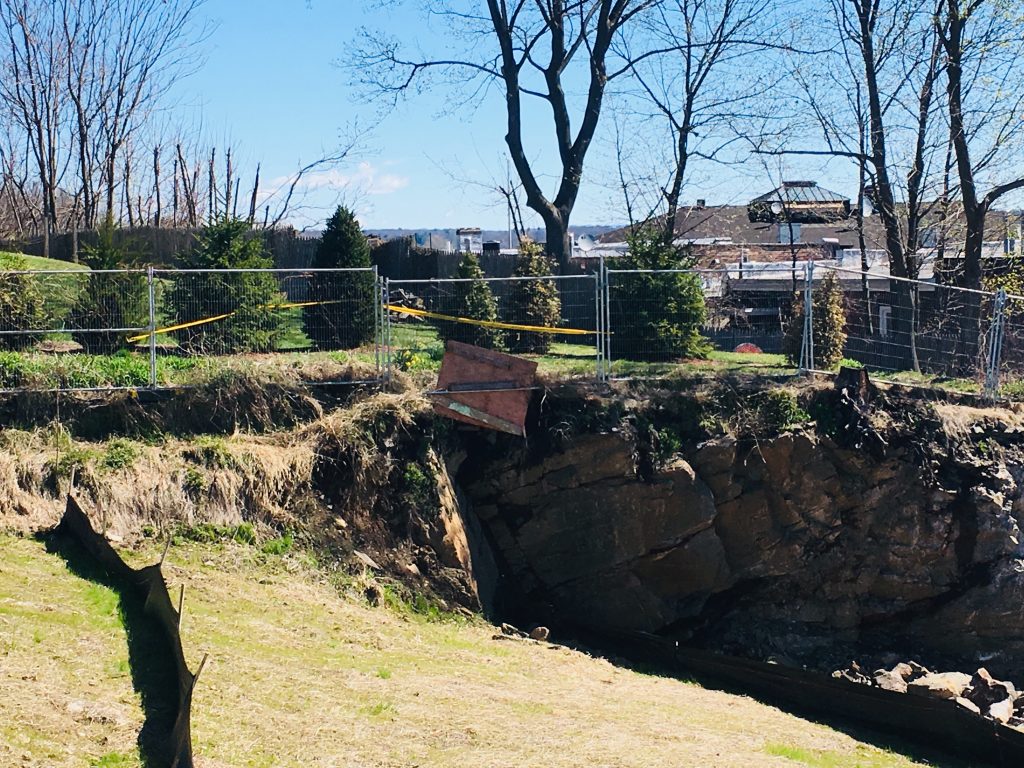
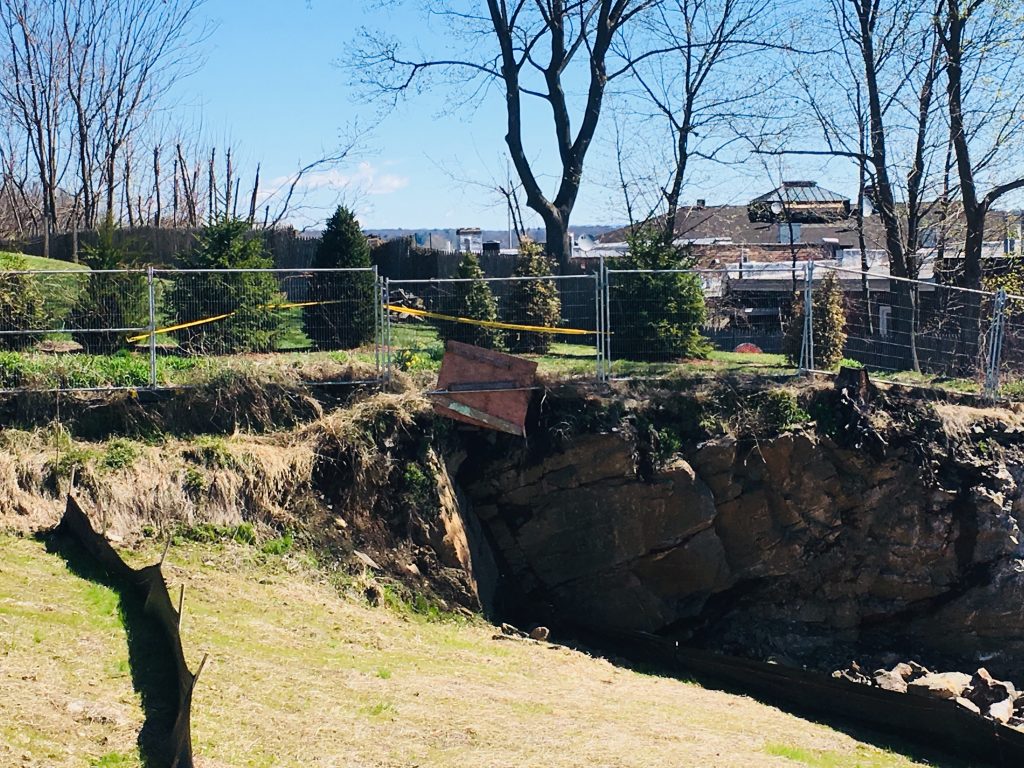
These altered site conditions appear to influence how water moves through the area. During storm events, runoff has been observed in and around the disturbed land, and there have been reports over time of erosion along Company Hill Path and impacts to nearby private properties, including driveway movement, soil loss, and changes in slope and drainage behavior.
Now, the property owner is reportedly offering to transfer 32 Abeel Street to the City for no cost. On its face, this may appear to be a civic gesture, but it raises a more difficult question: what is actually being transferred?
A land deed can be given away. The physical condition of the land cannot.
If the site continues to contribute to erosion, stormwater concentration, or impacts to adjacent properties, then a “free” transfer may not be without cost in practical terms. It may shift an unresolved environmental and engineering condition to the public sector, along with the future costs of stabilization, mitigation, and potential long-term management.
Before any transfer is considered, the City should require an independent engineering assessment of the site’s long-term stability, drainage behavior, and remediation costs. The City must determine whether this property can be stabilized without creating an ongoing burden for surrounding residents and taxpayers.
Without those answers, the City risks accepting not just land, but the long-term consequences of past disturbance.
Kingston’s Common Council and administration now face a choice that goes beyond a single parcel: either require full stabilization and accountability before any transfer occurs, or inherit a problem that neighboring residents have already spent years living beside. And as part of any agreement, the current landowner should be required to publicly acknowledge the burden placed on those neighbors—including years of disruption, property impacts, and ongoing stress—and issue a direct apology to the community affected.
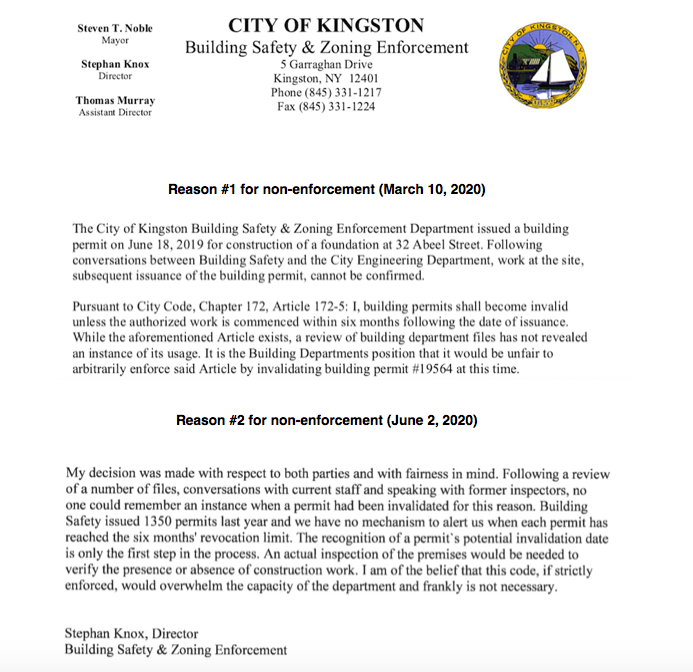
In April, community members impacted by the proposed Irish Cultural Center (ICC) located at 32 Abeel Street in the Rondout co-authored a letter to the Common Council Laws and Rules Committee ostensibly asking, “Why does the City of Kingston have laws on its books that it won’t enforce?” The letter was referring to a recent decision by the Building Safety and Code Enforcement Department guided by the Executive Branch’s Corporation Counsel in the City of Kingston, where it was determined that the ICC’s expired permit (the third since 2011) would not be upheld due to the city not having found “… an instance of its usage” and that it would be “unfair to arbitrarily enforce said article by invalidating (the ICC’s) building permit.”
The Laws and Rules Committee took up the question at its May meeting where they decided to send an inquiry to the Director of Building Safety and Code Enforcement. In an email, Chairman of the Council’s Laws & Rules Committee and Ward 1 Alderman Jeffrey Ventura-Morrell asked, “In your letter to the developers, you mentioned that you found no previous instance of its (the article’s) enforcement and therefore you determined that it would be unfair and arbitrary to enforce it in this instance. Can you please expand on why you reached that conclusion?”
The Director replied, “Following a review of a number of files, conversations with current staff and speaking with former inspectors, no one could remember an instance when a permit had been invalidated for this reason. Building Safety issued 1350 permits last year and we have no mechanism to alert us when each permit has reached the six months’ revocation limit. The recognition of a permit’s potential invalidation date is only the first step in the process. An actual inspection of the premises would be needed to verify the presence or absence of construction work. I am of the belief that this code, if strictly enforced, would overwhelm the capacity of the department and frankly is not necessary.”
What is notable here is that the Building Safety, with guidance from the Executive Branch’s Corporation Counsel, provided two explanations. In his letter dated March 10 to the ICC, the law would not be upheld because the city hadn’t used it before and concluded that it would be unfair to the applicant if it were enforced. In the June 2 reaction to the chair of the Laws and Rules Committee’s inquiry, the reason was because of a lack of mechanism to alert his department of the six month expiration for each permit that they have approved.
It’s problematic for Kingston going forward, as enforcement of the law is critical. If the law is flawed, then it should be reformed. Additionally, in the 21st century, technology must exist to provide a ‘mechanism’ that would allow the City of Kingston Building Department to assure compliance of all of its 1,350 approved building permits. (Note to City: Check out Airtable)
The City of Kingston’s Common Council Laws & Rules Committee will continue the discussion “Building / Zoning Laws” during their remote meeting on Wednesday, June 17th at 6:30pm.
The photo reveals the ICC property looking North from Abeel street, where the developers appear to use “plywood” to mitigate damage.
By Rebecca Martin
After the ground gave way for the neighbors 7-year-old son to fall into the Irish Cultural Center’s project pit, residents living next door worried that their home property line would further erode with that night’s torrential downpour. Erosion has been an issue since last summer due to the apparent poor excavation practices and lack of oversight of the project.
As far as we are aware, the project does not have a stormwater plan in place to mitigate the impacts of rain storms that have compromised the site and Company Hill Path, a significant historic resource adjacent to the surrounding properties.
At last evening’s Planning Board meeting, we captured several items for the public to review that include:
The Irish Cultural Center’s third request for a site plan application in the Rondout, Kingston. (Item #8)
A controversial ‘boarding house’ special use permit on West Chestnut Street, that has been vying for permission to be approved as a ’boutique hotel’. (Item #7)
A downsized project of Benedictine Hospital on Mary’s Avenue (Westchester Medical) by Health Alliance of the Hudson Valley.
The developers for the Kingstonian tabled their project yesterday afternoon.
This post was updated December 21, 2018, to clarify two details. Firstly, the assistant corporation counsel, who provides legal counsel to the city’s commissions and boards, insisted to the Commission that the transcript of the final hearing would be sufficient for explaining the rationale of the Commission’s decision in lieu of a thorough written decision. Secondly, frequent intrusions in the commission’s final deliberations were made by the applicant and their lawyer and not other members of the public.
***
“The purpose...is to provide for the promotion of the educational, cultural, economic and general welfare of the public through the protection, enhancement, perpetuation and preservation of landmarks and Landmark Districts. The legislative body declares that it is in the public interest to ensure that the distinctive landmarks and Landmark District shall not be injuriously affected, that the value to the community of those buildings having architectural and historical worth shall not be impaired and that said districts be maintained and preserved to promote their use of the education, pleasure and welfare of the citizens of the City of Kingston and others.”

Legislative Intent of the Historic Landmarks Preservation Commission, City of Kingston Administrative Code §405-63
The HLPC failed in its review of the ICC—not on principle but on procedure. The final written decision of the HLPC is inadequate in describing the Commission’s reasons for its denying approval for the ICC.No member of the Commission was directly involved in the composition of the written decision, a concern that was raised by members in the weeks following the final hearing. In response, the assistant corporation counsel for the City of Kingston, who provides legal counsel to the city’s boards and commissions, insisted that the transcript would be sufficient for conveying the commission’s rationale. That transcript, which by default became the primary record of the hearing, documents a circuitous deliberation by Commissioners with frequent intrusions by the applicant and their lawyer. The record further reveals the difficulty that Commissioners had in interpreting the criteria for review as outlined in the code, because the language is too vague and weighted towards the consideration of changes to individual buildings rather than new construction in historic districts. In this light, it is not difficult to see why the ZBA and this judge concluded that the HLPC’s decision was “arbitrary and capricious.”
One of the fundamental duties of the HLPC when reviewing proposed changes in a historic district is to ensure that the character of the historic district is maintained, and “prevent construction, reconstruction, alteration or demolition out of harmony with existing buildings insofar as character, material, color, line and detail are concerned, and thus to prevent degeneration of property, to safeguard public health, promote safety and preserve the beauty of the character of the landmark or Landmark District.” (City of Kingston Administrative Code §405-64 D)
No single detail defines a historic district’s character. It is the multitude of details taken together that creates a distinctive environment and sense of place. Such character-defining qualities include the relationships of buildings to each other and to the street. Do the buildings form a continuous streetwall or are they spaced apart? Are they situated directly at the street or are they set back from it? What was the historical development trend that led to their existence? Is there a discernible rhythm or pattern of details, be it building sizes, roof massing, cornices, or windows? Many districts have multiple rhythms. Character is also defined by the type of buildings, their construction, and scale—the architecture of a single-family dwelling is different than that of a store-and-loft building in terms of massing, façade proportion, materiality, fenestration, and building features like porches and storefronts.
The qualities described above are aesthetic ones. It is incumbent on members of the HLPC to consider all of them when considering the appropriateness of new construction in a historic district, be it an addition to an existing structure or a wholly new building on a vacant site.
There was a big turn-out at last evening’s Planning Board meeting, where several items of interest were discussed. They included a Communications Tower being proposed near Colonel Gardens (a public housing complex in Ward 7); The Irish Cultural Center’s (ICCHV) site plan public hearing; and a new proposed project, the ‘Super Garage’ located in the Rondout, Kingston.
Here are highlights.
The outcomes were mostly predictable. The proposed Communications Tower was tabled while the applicant performs a balloon test for visual impacts and looks at a secondary site in the Town of Ulster; the ICCHV was also tabled, although there was some confusion from the public as to what they were expected to comment on without materials or any communication/guidance by the planning department, and the “Super Garage” project and lot line revisions were both tabled as well.
We asked the planning board to table the proposed communication tower project (which they were going to do anyway), in light of learning about New Hempstead’s model law for cell towers. In order to allow the Kingston common council to analyze the overall planning issue and to decide where and under what conditions tower constructions may proceed, a brief moratorium on cell towers given our ongoing comprehensive plan and zoning amendment work could be requested.
Robert Iannucci, the project applicant for the “Super Garage” project, will host a public informational hearing on Thursday, December 6th at 6:00pm at the Cornell Steamboat Building located at 108 East Strand in the Rondout.
VIEW Facebook Event on “Super Garage” Public Informational Hearing
On March 8, 2018, the Irish Cultural Center of the Hudson Valley (ICC) got a pass from the City of Kingston’s Zoning Board of Appeals to move on to the Planning Board’s Site Plan Review when it overturned another City Commission’s decision.
BACKGROUND
In what appears to be the City of Kingston’s first-ever appeal of a Historic Landmarks Preservation Commission (HLPC) decision, the ICC appealed the September 25th, 2017, decision by the HLPC to deny the application a preservation notice of action, the approval necessary for the application to obtain a building permit from Kingston Building and Safety. HLPC commissioners cited concerns
HLPC commissioners cited concerns with:
the width of the building
the proposal’s harmony with existing buildings and the desired character of the neighborhood
relation of the proposed building to neighboring buildings surrounding it
and proportion (how it fits in overall with the district)
The Zoning Board of Appeals heard evidence on the appeal and decided that the HLPC had approved the application in the past. They rendered their decision to overturn the HLPC’s decision and issue the preservation notice of action itself on March 8, 2018..
We looked for another instance where an HLPC decision was appealed to the Zoning Board of Appeals in the City of Kingston but weren’t able to find any evidence of one. The City’s Corporation Counsel together with the ICC’s lawyer determined that next step in an appeals process from their interpretation of the City’s Zoning Law for the HLPC:
Any person aggrieved by an action of the Commission in disapproving or limiting a preservation notice of action application and the Zoning Board’s support of such Commission action may bring a proceeding to review in a manner provided by Article 78 of the Civil Practice Law and Rules in a court of record on the ground that such decisions are illegal, in whole or in part.
What Are the Next Steps in the Process for the Public?
On March 19th, 2018, the ICC returned to the City of Kingston’s Planning Board for Site Plan Review and a Parking Waiver request. The Planning Board decided at that meeting to schedule a public hearing on those two elements of the application to be held on Monday, April 16th.
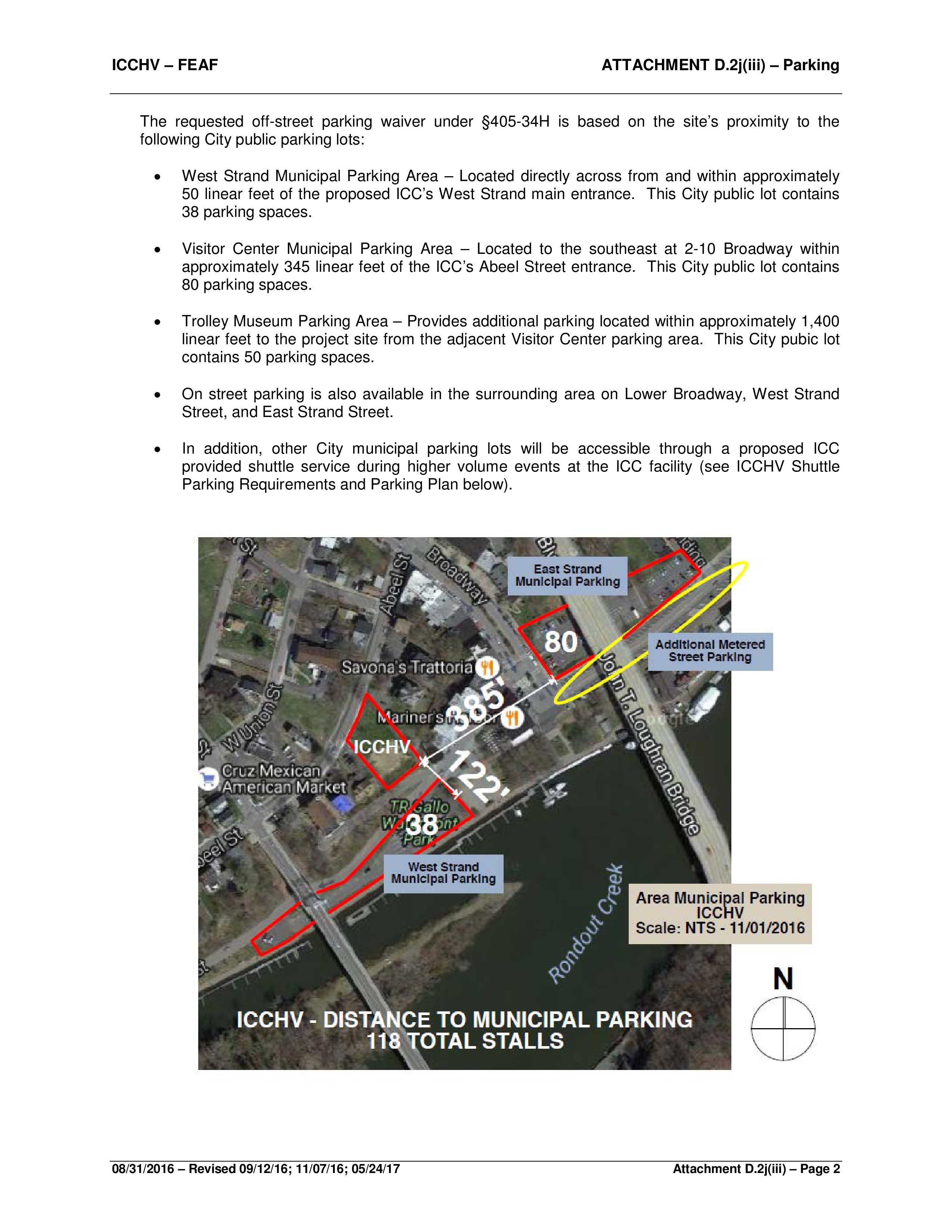
The Site Plan has been updated to address some of the comments from the HLPC. The ICC is required by the City to provide 55 parking spaces, based upon calculations of the square footage of the building. The ICC is offering to provide 8 parking spaces in a private parking lot next to the proposed building. They are requesting a Parking Waiver for the remaining 47 spaces based on the availability of municipal and street parking within 400 feet of the ICC property.
Call to Action
Citizens are invited to attend the Planning Board’s public hearing and speak to the ICC’s Site Plans and Parking Waiver on Monday, April 16th, 2018, beginning at 6:00 pm. Kingston City Hall is located at 420 Broadway in Kingston.
Talking Points
PARKING:
*The ICC would be but one element of commercial activity in the Rondout. Nearby restaurants, museums, and waterfront attractions already compete for parking. The ICC’s proposed uses and inability to provide sufficient parking for itself would increase stress on other local businesses and Rondout economic development.
*The Rondout neighborhood is a deeply residential neighborhood where the majority of housing does not have driveways and residents rely upon street and municipal parking, particularly in the event of snow emergency parking restrictions. The ICC would greatly increase stress on residents in relying heavily on municipal and street parking by preventing them from finding parking near their homes.
*The ICC’s proposal to use municipal lots for their parking needs would take away from mandated public access to the Marina and other water-based activities as outlined in the LWRP.
SAFETY (We don’t want the construction site to become an attractive nuisance.):
* The construction site needs to be secured with sturdy fencing or security guard every day.
ACCESS:
* Any closure of Company Hill Path will affect business and restrict public access to a National Register of Historic Places site.
LOGISTICS:
* What kind of funding do they have to complete the construction in a timely manner?
* What is their timeframe for construction? What happens if they don’t meet the timeframe?
REQUEST:
Don’t make a decision on the application on the same night as the public hearing. The Planning Board members need time to digest the information submitted at the public hearing and in some cases, may need to conduct further research. A vote that evening would appear to be a rush to approve the project.
Deny the parking waiver.
If site plan approval is granted, it should be contingent upon:
No banquet hall use allowed, as the ICC promised.
No noise permits granted and no outside speakers.
No uses not fully enclosed in a structure allowed.
Additional changes to the exterior should be reviewed by the HLPC.
Only upon satisfactory answers to safety, access, and funding questions above.
—
Hillary Harvey is a journalist, and a zoning code activist, working for transparency and responsible development that considers the welfare of residents and small businesses. Together with her neighbors, she runs Grow the R-T Responsibly , a neighborhood collective dedicated to that cause. A yogi and devoted traveler, she lives in an old house in Kingston’s historic Rondout district with her college sweetheart and their three muses.
The Historic Landmarks Preservation Commission (HLPC) recently chose to change its format to allow the public an opportunity to participate on applications in real time, creating a more democratic format for both the applicant and the public. The changes provide a model of a more participatory meeting format that all City of Kingston boards, committees and commissions might consider applying.
Currently, in the City of Kingston, the majority of committees and subcommittees offer public speaking at the discretion of the committee chair. It is possible to reach out to the chair ahead of a meeting to let him/her know that citizens would like time to present comments or questions.
WHAT Come to the public hearing at City Hall, Council Chambers, on Monday, July 10th at 6:00 pm, and weigh in on the latest changes to the proposed Irish Cultural Center (ICC) project.
WHERE
Kingston City Hall
420 Broadway
Kingston, NY
Council Chambers (top floor)
WHEN
Monday, July 10th
6:00 pm Sign-up to speak at 5:45pm
If you can’t attend the meeting, you can submit the comments in the body of this EMAIL and any other additional concerns you might have. The email will go directly to the Kingston Planning Board and City of Kingston. We will receive a copy, too, and will compile a packet to submit to the Board at the public hearing on July 10th.
Deadline for email submissions is July 7th.
WHY Public input on this project proposal so far has helped to make for a stronger Irish Cultural Center proposal. The public needs to keep weighing in until the project fully fits the Kingston waterfront community, or the ICC determines another location that is suited to their goals.
By Hillary Harvey
The Irish Cultural Center proposed for Abeel Street on the Rondout in Kingston has just come back to the Planning Board with the latest in a series of updates to their project site plan.
ICC Site Plans, March 8, 2017 VIEW Floor Plans, March 2, 2017 VIEW
Included are responses to the State Historic Preservation Office, the City of Kingston’s Historic Landmarks Preservation Commission, and the Ulster County Planning Board, all of which were presented at the June 12th City of Kingston Planning Board meeting.
The Irish Cultural Center of the Hudson Valley is proposed to be a 16,213 square foot newly constructed building on a 0.43-acre parcel at 32 Abeel Street with rights, granted by the City of Kingston’s Zoning Board of Appeals, to follow the zoning for West Strand Street. New designs indicate a red, brick building of three stories measuring 49.5′ from the Company Hill Path side (South Elevation), with one story underground on the Abeel Street side (North Elevation). There would also be an elevator accessible roof garden, with outdoor seating and a 12’ tall room that rises above the height of the building. On the Company Hill Path side, there would be three full balconies with exterior gathering space that each run the width of the building. The building would be a “community center” with a 171-seat theater, exhibition space, commercial kitchen, 70-seat pub/restaurant, flex space, offices for the ICC and the Ancient Order of Hibernians (the ICC’s parent organization), radio station, map room, etc. The project would have 8 on-site parking spots and seek a parking waiver from the Planning Board for 47 parking spaces.
There will be a public hearing on these changes at the City of Kingston’s Planning Board meeting on July 10th, during their regular meeting, and comments can be made via email to the Planning Board before July 7th. We encourage everyone to weigh in.