
By Dan Nelson
This is the second installment in a series documenting my efforts to better understand—and ultimately address—the growing problem of freight train horn noise in the City of Kingston, NY. Each post follows the next step in the investigation. Read the first one here
My first post about the freight train noise situation in Kingston was published on KingstonCitizens.org on June 4th. The next day, I heard back from the state DOT. Brian Galvin assured me that they were making regular observations of CSX trains and that the company was operating within the law. There was nothing to be done from a state regulatory standpoint. I mentioned that I had been making 12- and 24-hour-long recordings of the trains so that I could have concrete examples of clock times, patterns, and length of blasts to bring to CSX. When I pressed him further about whether their records of the train horn patterns made these recordings redundant, and whether the observer(s) had taken decibel readings, he replied that they had made no recordings, no notes, and had taken no decibel readings.
This was surprising, especially about not taking decibel readings—how would the DOT know whether CSX was within the regulations, since a decibel range was one component of them? It firmed up my resolve to get a professional decibel meter that’s activated by sounds above the threshold of your choosing, that logs the readings, and connects to a phone app. I’ll position this on a light pole that’s about a dozen feet from the tracks.
I also heard from Esmerelda, who lives near the Gage St. crossing. She vented her frustration in one long, continuous, sleep-deprived paragraph, then thanked me for listening. She included screenshots of boilerplate responses from the Surface Transportation Board as evidence of feeling herself in a helpless position.
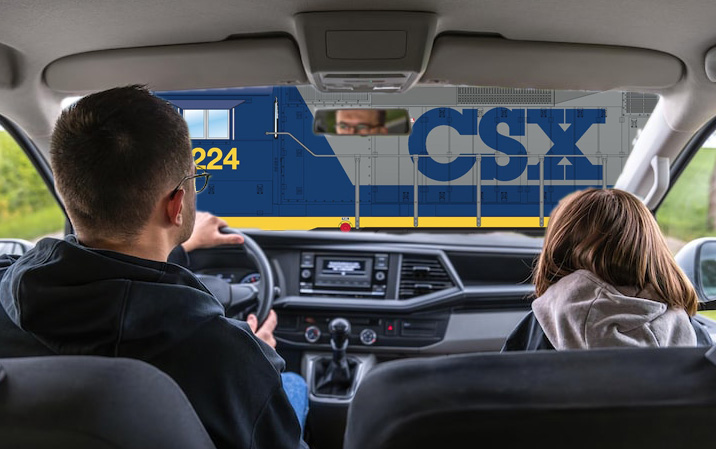
Two days after posting (June 6), as I turned onto Flatbush Ave. to start my walk to work, I saw that a train was stopped in the crossing, with lines of cars waiting in both directions. It was about 8:30 AM. I walked west on Flatbush, away from the crossing, and turned south on Foxhall. I could see the train blocking the Foxhall crossing, a third of a mile down the street. As I walked towards it, the train eventually moved on, but the crossing gates stayed down. As dozens of cars and some pedestrians waited, probably now late for work, the minutes ticked on. Reaching the gate, I could have easily walked around it and continued my direct route to work. But I must maintain unimpeachable behavior where this issue is concerned! So I turned right on Cornell, looking back after a block. The gates were still down, and a truck swerved around them to cross the tracks. It was 8:47 and, returning to the crossing, I called the CSX hotline number on the gate’s sign, reporting the issue to some guy in Florida. Then I continued down Cornell to work. As I crossed Smith Ave., I saw a car at that crossing, also empty, swerving around the gates. I turned to look back at Foxhall one last time, clearly visible a half mile away, before heading south on Broadway, at 8:57 AM. The gates had finally lifted, after about 25 minutes.
At work, in the course of chit-chatting with my colleague as she watched our museum gift shop, I mentioned my efforts in opposing the train noise. A couple overheard as they browsed and introduced themselves, each with a tale of suffering the same noise, she at her place near the Gage St. crossing, and he at his house in
Lake Katrine. As he told me, bitterly laughing, about growing up in Brooklyn near the elevated subway to Coney Island and being rattled by the constant closing-door chimes, audible even to him ten blocks away, it slowly dawned on me where his current house was located: on that street. His street runs parallel to the tracks, not a hundred feet from them, between Esopus Creek and Rte. 9W, one that I had imagined to be the absolute worst place in the greater Kingston area if you were train noise-sensitive, a fabled corridor of house-shaking vibration and nerve-shattering horn blasts. He had lived there for ten years and finally gotten semi-used to it.
“How long has it taken to get used to it?” I asked.
“Ten years,” he replied.
The next day (June 7), as I drove home westbound on Flatbush, rounding and descending the curve at the corner of the cemetery, lo and behold, there was a train as it crawled through the crossing. I reached the queue, stopped, turned off my car, and stared at the train, which appeared to be moving about 10 MPH. After 5-10 minutes, at 10:43 AM I took a brief video on my phone to show how slow it moved. The train then slowed even further, finally stopping. At 10:45, joining several other cars, I made a U-turn, zigzagging through back streets to get to Highland Ave., then Prince, on to Broadway, checking to see if any crossing was clear on the way to shorten the detour. Every crossing from Flatbush to Smith Ave. was blocked by the train. I got home at 10:55 and watched until the train left, at 10:57. It was another instance, for the second day in a row, of a train jamming up Midtown for about 25 minutes.
On June 17, KingstonCitizens.org hosted a webinar presentation by Jess Conard of the rail safety advocacy group Rail Watch (railwatch.net.) Never imagining that she would become such an advocate, she had indeed, following the 2023 toxic rail accident in her town of East Palestine, Ohio, which released tons of chemicals (some whose names you wouldn’t even recognize) into the water supply. You can find a link to the recording of the webinar here: “Rail Safety Starts at Home: Lessons from Our Conversation with Rail Watch’s Jess Conard” (KingstonCitizens.org)
She shared a number of eye-opening things with us:
- Municipalities can do nothing about blocked crossings;
- The FRA (Federal Rail Administration) is staffed by good people, but has structural problems that make it not great at enforcement;
- Before being outlawed, freight lines routinely used “DOT-111” tanker cars that ended up being prone to punctures, even at 15 MPH;
- CSX trains routinely carry pressurized gasses, volatile fuels, corrosive substances, spent fuel, industrial manufacturing agents, the liquid byproducts of plastics recycling, benzene, and chlorine, the latter confirming my suspicion that a derailment resulting in breached tankers could create something like a WWI battlefield in the middle of Kingston;
- My idea of setting up a camera to record a train’s cars and then looking up what each tank carried had already been done, by a friend of someone at Riverkeeper;
- And that, as revealed by Suzanne Cahill, present in the webinar, Kingston has no publicly available disaster preparedness plan for a derailment.
Jess also educated us about Precision Scheduled Railroading, a cost-saving technique that has been adopted by major freight carriers, and which Jess states is not in the public interest. PSR results in trains that are often one to two miles long, which increases the chance of derailments. The distance from Smith Ave. crossing to Flatbush Ave. crossing is about 3⁄4 of a mile (measured on the track line), so the likelihood of a train stoppage resulting in more than one blocked crossing is obviously much higher. She had looked up how many blocked crossings had been reported by the public through the FRA’s Blocked Crossing Reporter webpage, for the entire county of Ulster in a one year period: it had been 3.
Here are the ones I have personally observed since those outlined at the start of this post, a total of 6 in June and 5 in July, all at only 6 of the crossings that exist in Ulster County:
- June ND – Foxhall and Flatbush crossings blocked on a Sat. or Sun. afternoon for about 20 minutes (At this point I had no idea how frequently I’d be reporting these, thus no date noted.)
- June 25th, 8:10 AM, Kingston crossings from Flatbush to Smith Ave. blocked – over 15 min. – reported to FRA – reported to CSX online
- June 28th, 6:10-6:24 PM, Foxhall, stopped for 8 min. of that period – reported to FRA and CSX
- June 30th, 2 PM, Foxhall, gates down 1 minute but no train – reported to FRA and CSX
- July 1st, ca. 12:10 PM, Foxhall, train stopped for at least 10 min.
- July 2nd, 4:51 PM, Flatbush crossing closed at least 25 min, train stopped for at least 15 min. – reported to FRA and CSX
- July 24th, 11:55 AM: Flatbush crossing blocked by a stopped train for an unknown amount of time – reported to FRA and CSX
- July 25th, ca. 9:18 AM, stopped train blocking Flatbush, 10th from the last car in crossing, not blocking Foxhall, left crossing at 10:18 AM – reported to FRA and CSX
“Reported to FRA and CSX online” means that I visited these sites and reported the details of these incidents here:
Flatbush Ave. Kingston NY – crossing ID 507088E
Foxhall Ave., Kingston NY – crossing ID 507091M
Smith Ave., Kingston NY – crossing ID 507093B
NOTE: you must report within 7 days of the incident.
After the webinar, I looked up a train accident Jess had mentioned, which took place on July 6, 2013 in Lac-Mégantic, Quebec. According to the Wikipedia page, which you should look at, “a freight train carrying Bakken Formation crude oil rolled down a 1.2% grade and derailed in downtown Lac-Mégantic, resulting in the explosion and fire of multiple tank cars. Forty-seven people were killed. More than 30 buildings in Lac-Mégantic’s town centre (roughly half of the downtown area) were destroyed, and all but three of the thirty-nine remaining buildings had to be demolished due to petroleum contamination. Initial newspaper reports described a 1 km (0.6-mile) blast radius.”
Were this to have happened at the Smith Ave. crossing, most of Midtown Kingston would be leveled, and most of the city uninhabitable. Lac-Mégantic has one quarter the population of Kingston. The disaster resulted in a number of changes to laws and railroad procedures, though it would not be until 2023 that “federal transport minister Pablo Rodriguez announced the commencement of preliminary work on a bypass.” If this accident hadn’t been enough to push Canadian authorities to re-reroute the train line outside of towns, I couldn’t imagine it happening in Kingston.
All the other avenues for change that I’d looked into, on the city, county, state, and federal level, had begun to look like dead ends. Add the fading of initially enthusiastic contacts who had reached out to me in support, and I began to wonder what it would take to reach my initial, humble goal, of simply quieting down the train honking at night. It started to seem like all or nothing—either the trains would have to be compelled to make massive structural changes to accommodate the needs of Kingston’s inhabitants, or they would be allowed to maintain a status quo of not changing a single tiny thing—with the balance leaning heavily towards nothing.
While writing this piece on July 25th, my partner, who had just left to drive to work, texted me that our crossing, and all the other five crossings up to and including Smith Ave., were blocked for the second time that morning. I grabbed a lawn chair, a sun hat, and my laptop and sat by the tracks writing this, glancing at the stopped, weatherbeaten, graffiti-ed train cars as they sat in silence, squirrels climbing on them, and even a bunny rabbit hopping around it. It moved on ten minutes later and I made my reports:
July 25th, 11:05 AM, all crossings from Flatbush to Smith Ave., train stopped until 11:26, left crossing at 11:30 AM. – made three reports (Flatbush, Foxhall, and Smith) to FRA and CSX online.
These two incidents woke me out of my weekslong resigned attitude. It now seemed that all this wasn’t in my head, just me being an overly sensitive light sleeper, but instead there was something egregious happening. The fact that Kingston drivers now pull a u-turn almost instantly when they see a stopped train doesn’t mean that we have to be resigned to the behavior of a corporation that does nothing for our city except make noise and cause inconvenience, to say nothing of the possibility that it could, at any minute, cause a catastrophic disaster.
In the coming week, I’ll be reaching out to Jess Conard and state representatives Michelle Hinchey and Sarahana Shrestha to continue pressing this issue. Otherwise, all I can do for the moment is report stoppages, which is what I encourage you to do using the links above. Write these incidents down on your phone or in a notebook, too. The lesson from Jess Conard is that activism can work, and her webinar provides lots of examples of this. But in order to resist CSX, we must first assemble a body of evidence, one long horn blast and one stopped train at a time.