
By Rebecca Martin
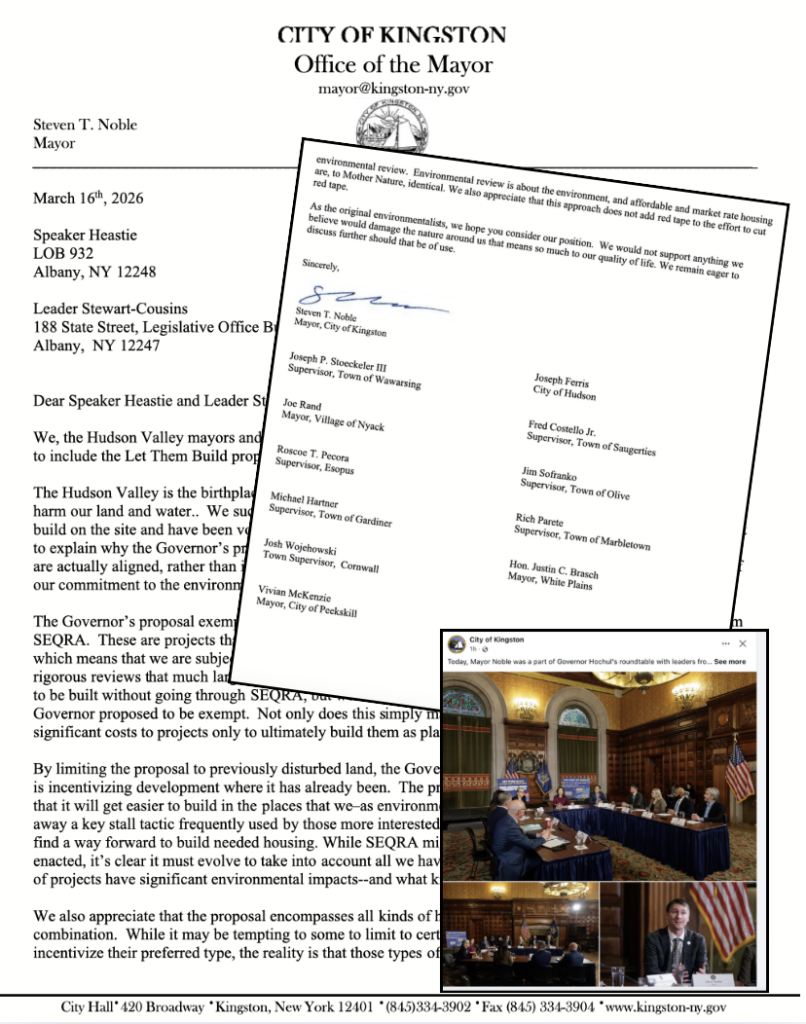
If you live in the Towns of Wawarsing, Esopus, Gardiner, Cornwall, Saugerties, Olive, or Marbletown; the Village of Nyack; or the Cities of Peekskill, Hudson, or White Plains, your local executive signed onto the City of Kingston Mayor Steve Noble’s letter to the state supporting proposed changes to the State Environmental Quality Review Act (SEQR). This letter was submitted just days before Mayor Noble participated in a Governor-hosted roundtable on the proposed regulation changes with a select group of officials.
Please READ the Daily Freeman Article, “Kingston Mayor, Town Supervisors Call on State to Exempt Some Housing Projects from Environmental Review.
THE LETTER is posted in the article on scribd.
At a minimum, community members should ask their local executives why they signed the letter, whether they thoroughly reviewed the proposed regulations, and if other members of their governing body—boards, trustees, or council—were aware or consulted. In our community, for example, the Kingston Common Council reportedly had no prior knowledge of the letter, which is why it later submitted its own separate letter raising concerns. Additionally, the Conservation Advisory Council raised concerns with the Mayor and several city staff in early March—on the record. All of this illustrates how executives can bypass the very bodies responsible for oversight. Connecting these dots is essential, because we expect local officials to collaborate and make decisions for our communities, not for personal gain or future positions at the state level.
Typically, environmental reviews are led by planning boards, planning departments, or legislative bodies—including councils, trustees, and board members. Executives or supervisors signing this letter without input from these bodies or from lawyers familiar with SEQR should not have happened. Legislative bodies also control zoning laws, which determine what projects are allowed and where.
As for the Governor’s proposed SEQR changes, this tactic—slipping major regulatory or policy changes into a budget—is unfortunately common. Across the country and in New York, lawmakers have used budgets to pass unrelated, controversial provisions with minimal public debate, from criminal justice reforms to environmental rollbacks. These “budget riders” take advantage of the must-pass nature of budgets to push through significant changes without public input—exactly the approach being used with the Governor’s “let them build” SEQR changes.
Finally, although the state budget was originally due today, it has been extended, giving municipalities some breathing room to submit letters raising concerns. While the exact new deadline is unclear, this is an opportunity to push back on these regulations being rushed through without public comment. Let them build? Fine—but not without accountability.
NEW! TOOLKIT: Letter for Municipalities and Counties re: Gov. Hochul SEQR Changes. We are making it easy for municipalities and counties to send a letter to the state.
VISIT: Our FAQ with talking points, video of our webinar, the regulations, actions and more.
I think this is a good idea IF:
The previously disturbed land was recently disturbed (within last 10 years maybe) and had gone through a thorough review by the Planning Board which identified all pertinent impacts and the original conditions of approval contained adequate mitigation of those impacts.
The density proposed meets the zoning density of the district. There is still the ZBA for variances if developers want more density (and they all do). Or limit the density increase to ten or twenty percent above current density allowances without having to go through variance process.
Setbacks within zoning districts are maintained. To allow faster processes doesn’t have to also mean diminished standards.